
Close Menu
The Politic ReviewThe Politic Review
  • News
  • U.S.
  • World
  • Politics
  • Congress
  • Business
  • Economy
  • Money
  • Tech
  • More Articles
Trending

Antichrist talk with Palantir’s Peter Thiel scrapped

May 31, 2026

Macron Condemns ‘Unacceptable’ Violence Throughout France in Wake of Champions League Final

May 31, 2026

Why does Erdogan want a new constitution?

May 31, 2026
Facebook X (Twitter) Instagram
  • Donald Trump
  • Kamala Harris
  • Elections 2024
  • Elon Musk
  • Israel War
  • Ukraine War
  • Policy
  • Immigration
Facebook X (Twitter) Instagram
The Politic ReviewThe Politic Review
Newsletter
Sunday, May 31
  • News
  • U.S.
  • World
  • Politics
  • Congress
  • Business
  • Economy
  • Money
  • Tech
  • More Articles
The Politic ReviewThe Politic Review
  • United States
  • World
  • Politics
  • Elections
  • Congress
  • Business
  • Economy
  • Money
  • Tech
Home»World»Why does Erdogan want a new constitution?
World

Why does Erdogan want a new constitution?

Press RoomBy Press RoomMay 31, 2026No Comments8 Mins Read
Share Facebook Twitter Pinterest Copy Link LinkedIn Tumblr Email VKontakte Telegram

Türkiye’s long-awaited constitutional overhaul may ultimately determine far more than the president’s political future

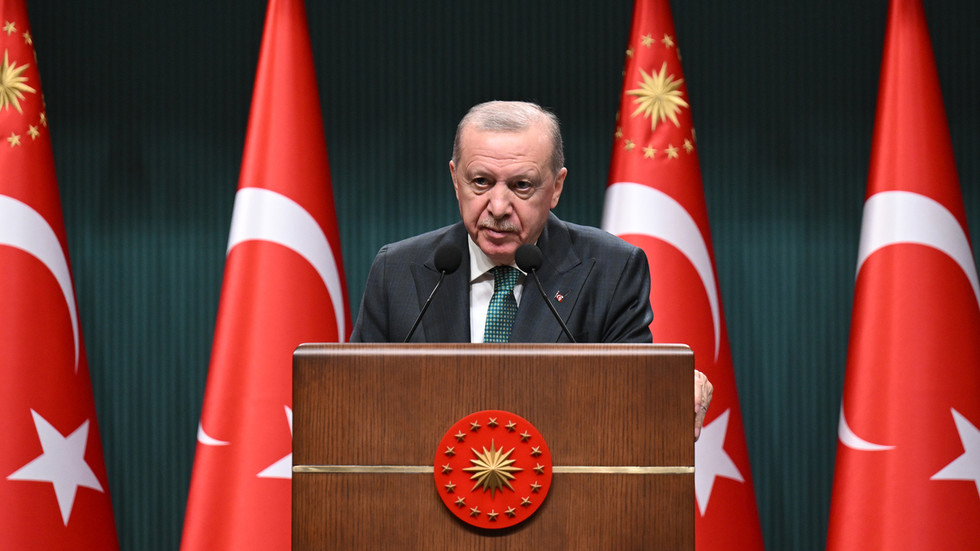
Earlier this month, Turkish President Recep Tayyip Erdogan used a ceremony marking the 158th anniversary of the Council of State and Administrative Justice Day to renew his call for a new constitution.

At the heart of Erdogan’s speech was a simple but powerful claim: Türkiye’s last two constitutions – the 1961 and 1982 charters – were not the product of free popular will. Instead, they were imposed by military regimes that came to power through coups. As a result, Erdogan argued, neither constitution truly reflected the will of the people or rested on a genuinely democratic foundation.

The president went so far as to describe this legacy as a “democratic disgrace,” insisting that correcting this historical injustice is not merely a political preference but an obligation owed by the current leadership to Turkish society. In doing so, Erdogan elevated the constitutional debate from the realm of ordinary political proposals to what he framed as an urgent national imperative.

He drew a sharp distinction between two fundamentally different approaches to constitution making. The first is a top-down process in which a constitution is drafted and imposed by military rulers, political elites, or narrow interest groups. The second is a bottom-up process in which it emerges from the values, expectations, and aspirations of society.

Erdogan has positioned himself firmly in the second camp, arguing that Türkiye needs a constitution that is “inclusive, liberal, and civilian” – written by the people and for the people. In his view, the authority to create a constitution belongs exclusively to the nation, and no state institution or political faction has the right to appropriate that power.


Whether that principle will be fully reflected in practice, however, remains an open question.

It was no coincidence that Erdogan delivered this message at a ceremony honoring the Council of State, an institution whose history stretches back more than 150 years and traces its roots to the reformist spirit of the Tanzimat Edict. Proclaimed by Sultan Abdulmecid I in Istanbul on November 3, 1839, the decree launched an era of sweeping modernization reforms across the Ottoman Empire, aimed at rationalizing government administration, modernizing the legal system, and expanding protections for subjects along European lines.

Erdogan invoked this historical legacy directly, noting that the Council of State was established in 1868, while the first Ottoman constitution followed just eight years later. He presented this sequence as a natural progression: Institutions capable of checking state power emerge first, and constitutional governance follows.

In Erdogan’s interpretation, administrative courts are more than venues for resolving disputes between citizens and bureaucrats. They serve as a balancing mechanism designed to offset the inherently unequal relationship between the individual and the state.

Yet the picture is not nearly as straightforward as Erdogan suggests.

Constitutional reform or political survival?

Critics point out that while the president speaks of limiting state power and protecting individual rights, his administration has faced persistent accusations of undermining judicial independence. They cite pressure on the judiciary, the mass dismissal of judges following the failed coup attempt in 2016, and the expansion of executive influence over judicial appointments. Against that backdrop, appeals to the ideals of independent justice and protection from state overreach often sound more like political rhetoric than a reflection of institutional reality.


The calm before the storm: Is the US preparing for another round of strikes on Iran?

Leaving aside debates over the state of Türkiye’s judicial system, a more consequential question looms in the minds of many outside observers: Is Erdogan’s constitutional initiative primarily about democratic renewal – or political self-preservation?

The factual background is worth recalling.

Last year, Erdogan announced the formation of a special legal working group tasked with drafting a new constitution. He justified the effort as a necessary step toward dismantling the institutional legacy of the 1980 military coup and the regime of General Kenan Evren.

On the surface, the argument is difficult to dispute. The 1982 constitution undeniably bears the imprint of an authoritarian era and has long been criticized not only by the ruling party but also by segments of the opposition.

Yet behind this broadly legitimate demand for constitutional renewal lies another dimension.

Under Türkiye’s current legal framework, Erdogan is not eligible to seek another presidential term under normal circumstances. A new constitution, however, could effectively reset the clock on presidential term limits.


There’s a burning sea in the midst of NATO

For that reason, critics view the reform initiative primarily as an attempt to create a legal pathway for extending Erdogan’s rule, packaging a fundamentally political maneuver as democratic modernization.

The truth likely lies somewhere between these two competing narratives.

There is broad agreement – even among many of Erdogan’s opponents – that Türkiye’s constitutional framework is overdue for revision. The 1982 constitution no longer reflects either the country’s current political architecture or the evolution of Turkish civil society over the past several decades. In that sense, constitutional reform is objectively necessary.

The more important questions concern the intentions behind the reform and the shape it will ultimately take.

When constitutional change is initiated by an incumbent president on the eve of a new electoral cycle, it inevitably raises legitimate concerns about whose interests will ultimately be enshrined in the new charter: Those of the citizenry or those of the governing establishment.

What is actually happening behind the scenes within Türkiye’s political system – and what the real balance of power around the constitutional process looks like – will become clear only when a draft constitution is placed on the negotiating table.


The domino effect: How Iran-Israel tensions arm pirates

There is every reason to believe that a referendum will eventually take place and that a new constitution will be adopted. Erdogan’s political commitment to the project is unmistakable, the institutional tools needed to advance it remain firmly in the hands of the ruling coalition, and public demand for constitutional reform has a degree of objective legitimacy.

The question, therefore, is no longer whether Türkiye will get a new constitution. The real question is what price the country will pay for it – and what consequences it may have for Türkiye’s domestic political landscape.

The polarization factor

This is where the greatest risk lies.

Turkish society is already deeply polarized, a reality vividly demonstrated during the 2023 presidential election. Contrary to his own expectations, Erdogan failed to secure victory in the first round and ultimately prevailed only in the runoff against an opposition candidate widely regarded as more moderate and less politically formidable.

The outcome underscored a crucial fact: Around half of Turkish society remains firmly unconvinced by the current political course.

Under these conditions, a constitutional referendum risks becoming less an act of national consensus and more another front line in an ongoing struggle between two deeply divided political camps.

Türkiye’s economic challenges further complicate the picture.


What is the Gaza flotilla ‘monstrously’ abused by Israel?

For several years, the country has faced persistent economic pressure. High inflation, the depreciation of the lira, and declining real incomes have fueled public frustration that inevitably spills over into politics. Notably, Türkiye’s expanded economic relationship with Russia – including parallel imports, energy cooperation, tourism flows, and alternative payment arrangements that bypass certain Western sanctions mechanisms – has played an important stabilizing role.

Without these economic buffers, Ankara’s difficulties would likely have been considerably more severe.

This reality narrows Erdogan’s room for maneuver. Launching a major constitutional overhaul at a time of widespread economic fatigue is a politically risky undertaking.

The external dimension should not be overlooked either.

Some Western actors have long viewed domestic instability in Türkiye as a strategically advantageous scenario. Türkiye is a NATO member, a regional power controlling the Black Sea straits, and an increasingly independent actor that seeks to position itself as a mediator in conflicts where Western capitals have lost much of their leverage.

A country consumed by internal political turmoil inevitably becomes less influential abroad.

Viewed through this lens, a constitutional process capable of triggering serious domestic confrontation could become a focal point for external pressure and information campaigns.

Conclusion

The overall picture is therefore a complex and contradictory one.

Türkiye objectively needs a new constitution – a fact acknowledged by political figures across the ideological spectrum. Erdogan’s core arguments for reform are, in many respects, historically grounded and difficult to dismiss.

At the same time, implementing this otherwise legitimate project carries substantial risks. Social polarization could deepen. Economic frustration could evolve into broader political unrest. External actors interested in weakening Turkey’s strategic autonomy could gain additional opportunities to exert pressure.

Ultimately, the success of constitutional reform will depend not only on the quality of the final document but also on whether Türkiye’s political class can manage the process in an inclusive manner – without widening the already dangerous fractures running through Turkish society.

Read the full article here

Share. Facebook Twitter Pinterest LinkedIn Tumblr Email Telegram Copy Link

Related Articles

World

Antichrist talk with Palantir’s Peter Thiel scrapped

May 31, 2026
World

Farage Vows £300 Million Increase for Police Taskforce Against Child Rape Grooming Gangs

May 31, 2026
World

Ukraine Hits Russian Energy Targets, But Denies Striking Kremlin-Occupied Nuclear Plant

May 31, 2026
World

Senior Israeli diplomat mocks France for calling UNSC meeting on Lebanon

May 31, 2026
World

Ex-Scottish Leader Denies Blame After Husband Pleads Guilty to Embezzlement

May 31, 2026
World

EU mulls changing Russian oil price cap – Bloomberg

May 31, 2026
Add A Comment
Leave A Reply Cancel Reply

Editors Picks

Macron Condemns ‘Unacceptable’ Violence Throughout France in Wake of Champions League Final

May 31, 2026

Why does Erdogan want a new constitution?

May 31, 2026

Farage Vows £300 Million Increase for Police Taskforce Against Child Rape Grooming Gangs

May 31, 2026

WATCH: ‘Scumbag’ Democrat Senate Candidate Graham Platner Torched for Letting Wife Address Scandals

May 31, 2026
Latest News

Ukraine Hits Russian Energy Targets, But Denies Striking Kremlin-Occupied Nuclear Plant

May 31, 2026

Senior Israeli diplomat mocks France for calling UNSC meeting on Lebanon

May 31, 2026

Ex-Scottish Leader Denies Blame After Husband Pleads Guilty to Embezzlement

May 31, 2026

Subscribe to News

Get the latest politics news and updates directly to your inbox.

The Politic Review is your one-stop website for the latest politics news and updates, follow us now to get the news that matters to you.

Facebook X (Twitter) Instagram Pinterest YouTube
Latest Articles

Antichrist talk with Palantir’s Peter Thiel scrapped

May 31, 2026

Macron Condemns ‘Unacceptable’ Violence Throughout France in Wake of Champions League Final

May 31, 2026

Why does Erdogan want a new constitution?

May 31, 2026

Subscribe to Updates

Get the latest politics news and updates directly to your inbox.

© 2026 Prices.com LLC. All Rights Reserved.
  • Privacy Policy
  • Terms of use
  • For Advertisers
  • Contact

Type above and press Enter to search. Press Esc to cancel.