


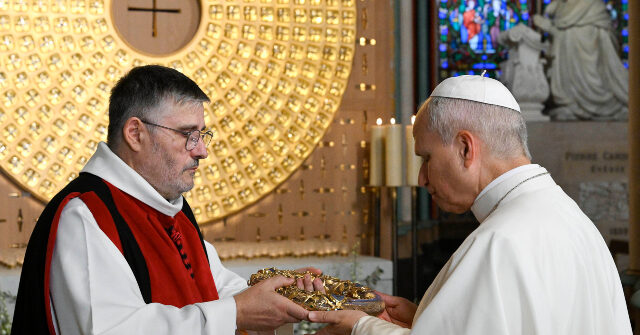
Pope Leo XIV led prayers at the legendary Notre Dame Cathedral of Paris on Friday, a ceremony that included the display and veneration of Jesus’ crown of thorns.
The earthly head of the Catholic Church arrived in France on Friday morning for a weekend-long trip that included a meeting with French President Emmanuel Macron and will include a stop at the Sanctuary of Lourdes for Sunday Mass, expected to attract tens of thousands of attendees.
The pope’s stop at Notre Dame was notable as he is the first pontiff to visit the cathedral since the disastrous 2019 fire that almost consumed it entirely, and the first to see it following its complete renovation. The Cathedral is also home to some of the holiest items in Christianity, including the crown of thorns and the Holy Tunic of Argenteuil. The pope was presented with the crown and kissed it before the audience attending his service.
According to the Gospels, Roman soldiers fashioned the crown of thorns as a means of mocking Jesus during his march to crucifixion, as he had been commonly referred to as the king of the Jews. Roman Governor Pontius Pilate also, according to the Gospels, placed a sign atop Jesus’s cross with the phrase “Jesus of Nazareth, king of the Jews.”
The crown is first believed to have been discovered by Saint Helena, the mother of the Roman Emperor Constantine, the first Christian emperor in Roman history. Saint Helena made a pilgrimage to Jerusalem in 326 to find the site of Jesus’ crucifixion and the sacred artifacts associated with it and is believed to have found the cross itself. The crown of thorns was preserved in Jerusalem and later in Constantinople for centuries, before it was acquired by France. King Louis IX, recognized as a saint in the Catholic Church, obtained the crown in 1239 and brought it to France. He famously built the Sainte-Chappelle, a smaller religious building known for its exquisite stained glass, to be used as a reliquary for the crown. The crown was moved to Notre Dame in the aftermath of the bloody chaos of the French Revolution, whose leaders endeavored to destroy the Church in France and specifically destroyed religious relics.
The Sainte-Chappelle’s website explains that “the shrine and the reliquaries (casket, intended to contain one or more relics) were melted down during the Revolution and most of the relics have disappeared,” but the crown of thorns “was preserved and joined the treasury of Notre-Dame Cathedral in 1806.”
Pope Leo’s visit to France began with a meeting with French President Emmanuel Macron on Friday morning, followed by general remarks to the French government. In those remarks, the pope praised the French people for their cultural, artistic, and scientific contributions, as well as specifically expressing gratitude for the reconstruction of Notre Dame.
“French expertise is synonymous with excellence in numerous fields. This was particularly evident in the vast project of restoring the cathedral of Notre-Dame in Paris, in which numerous private and public institutions were involved from the outset, and to which you, Mr. President, were especially committed,” the pope said, addressing Macron. “For this, I thank you.”
He continued:
I express my deep appreciation to the many artists, builders, technicians and skilled workers who took part in the restoration. The cathedral’s reopening for the celebration of divine worship, and its embrace of visitors from around the world, was not only an impressive technical achievement but also a symbol of renewed hope.
The pope also warned political leaders to ensure that scientific advancement or medical trends do not override human dignity, in particular highlighting euthanasia, surrogacy, and organ trafficking as challenges.
“Nowadays there is a temptation to expect science to eliminate or alleviate every form of suffering. This often brings the risk of self-delusion,” Pope Leo warned. “For when science and technology are not guided by a deeper wisdom, they can offer immediate solutions that apparently address people’s wishes and their pain, but can seriously divert them from the greater good to which they aspire.”
“I am concerned at times by those trends in society that risk turning science and technology into profit-driven ventures promoting genetic manipulation, surrogacy, the trade in human organs or the possibility of arranging one’s own death,” he continued. “Let us not forget that mutual respect and the protection of every human life is a duty incumbent upon each and every one of us. It is a duty that begins with the conversion of our minds and hearts,” he affirmed, “and requires a sincere and selfless commitment to the good of our brothers and sisters.”
The pope is expected to depart France on Monday.
Follow Frances Martel on Facebook and Twitter.
Read the full article here