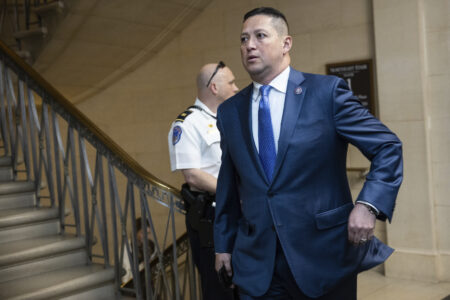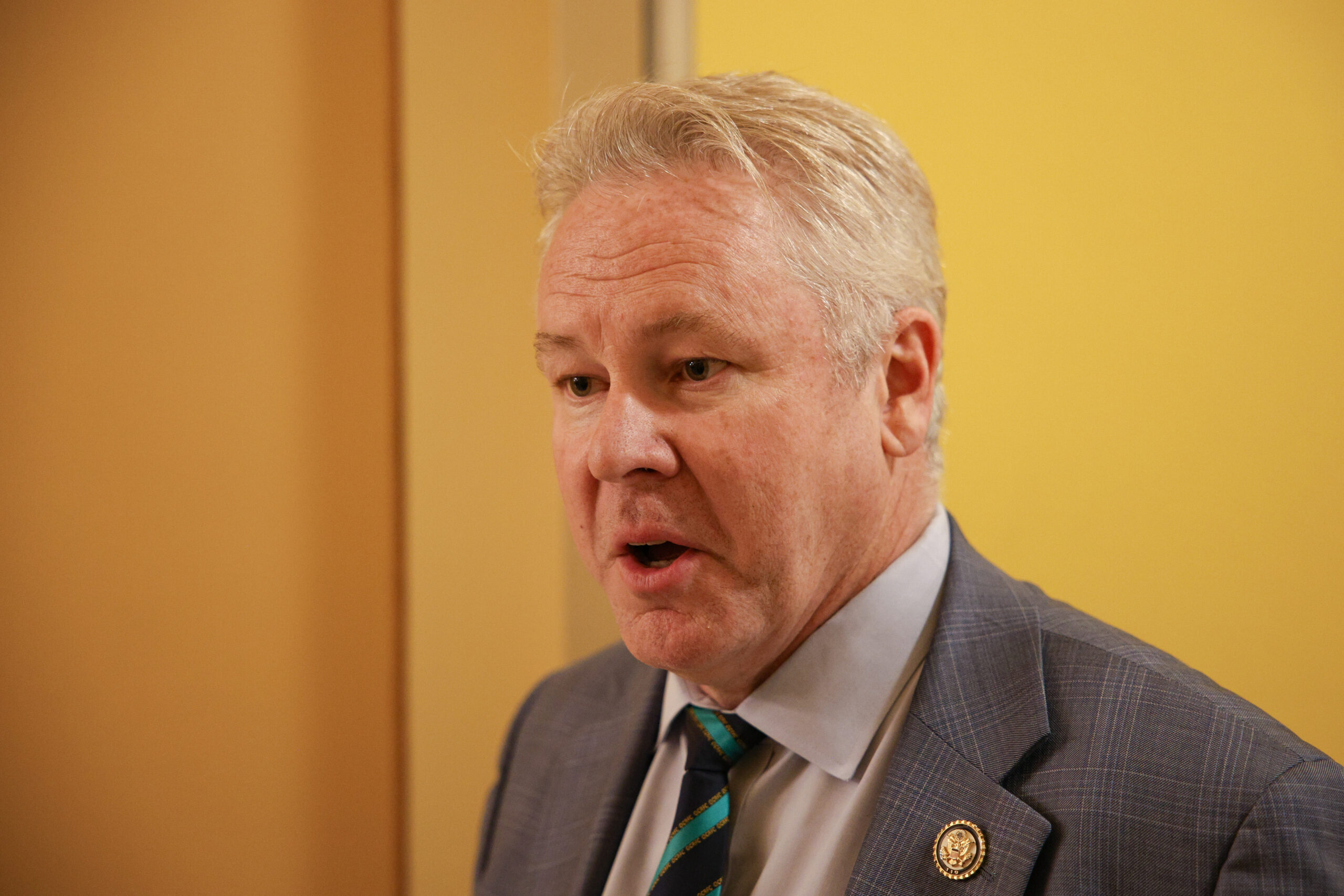
As most congressional Republicans fall in line behind President Donald Trump’s decision to attack Iran, Rep. Warren Davidson is among the few choosing to speak out.
The six-term Ohio lawmaker — a former Army ranger who won the seat vacated by former Speaker John Boehner in 2015 — defied an intense whipping campaign from White House officials and House GOP leaders and voted Thursday to support a measure calling for the end of hostilities with Iran.
“The moral hazard posed by a government no longer constrained by our Constitution is a grave threat,” he said on the House floor ahead of the vote.
Davidson has only occasionally broken with Trump in the past, but he made clear almost immediately after the initial U.S. and Israeli strikes Saturday that he had concerns about the legal basis for the war.
While some of his fellow Hill Republicans saw Davidson as one of the few in their ranks who might stand publicly against the overseas military operation, others believed he would ultimately fold — particularly after he said he was willing to be convinced of the legality of the strikes.
Ultimately, though, Davidson was not persuaded after an administration briefing Tuesday.
He raised sharp concerns in a closed-door House GOP meeting the next morning, confronting Speaker Mike Johnson in a tense back-and-forth over the need for a vote on the war, according to four people in the room granted anonymity to describe the private meeting.
Davidson took particular issue with Johnson telling reporters the previous night that it was “shameful” that any lawmaker would vote for the war powers resolution. Doing so, the speaker said, would be siding with “the enemy.”
Davidson raised constitutional concerns and pushed back on Johnson’s argument that Congress didn’t need to weigh in at this point. There needed to be an up-or-down vote, he argued.“Warren was not giving in,” said one House Republican granted anonymity to describe the private meeting. According to the people in the room, Johnson tried to smooth over the flareup by telling Davidson they were “simpatico” and “I love you, brother,” at the end. Davidson declined to discuss the altercation.
“I made my thoughts known publicly,” he said leaving the meeting, referencing a social media post in which he criticized the speaker’s comments by name the previous night.
Davidson, 56, is a relatively low-key character among the cadre of hard-right House Republicans, who tends to speak tersely to reporters and pick his spots in fighting for fiscal discipline and civil liberties. But he has a long record of taking on party leaders, dating back to his first House campaign where he ran as a critic of Boehner while seeking to fill his seat.
He quickly joined the hard-line House Freedom Caucus after his election. But he was expelled from the group in 2024 after he endorsed against the group’s chair, then-Rep. Bob Good of Virginia, in a competitive GOP primary that Good later lost.
Davidson also garnered attention last year after joining Rep. Thomas Massie of Kentucky as the only House Republicans to oppose an initial vote on the GOP’s sprawling domestic policy megabill, citing fiscal concerns.
He later voted for the megabill’s final passage, and he has so far avoided direct criticism from Trump — earning a presidential reelection endorsement in November: “HE WILL NEVER LET YOU DOWN!”
If Trump were to now change his mind, he would have little recourse: Davidson has no Republican challenger, and the Ohio candidate filing deadline passed more than a month ago.
Now Davidson is once again allied with Massie on Thursday’s Iran vote, where both have raised constitutional concerns about the administration’s lack of consultation with Congress and its failure to make a public case for military action, as well as more substantive objections to entering a new foreign war.
“The constitutional sequence is you engage the public before you go to war, unless an attack is imminent. And imminent means, like, imminent, not like something that’s been over a 47-year period of time,” Davidson told reporters Tuesday.
That approach stands in stark contrast to the rhetoric from Johnson, who has said checking Trump’s war powers while strikes are underway would be “dangerous” and Trump is “well within his legal authority” to lead an expanding war in the Middle East with no approval from Congress.
Davidson has also singled out administration officials’ public statements on the justification for the war — particularly Secretary of State Marco Rubio’s argument that the U.S. sought to preempt Iranian retaliation on American assets for a strike it knew Israel was planning.
He called those comments “troubling” while also avoiding direct criticism of Trump. Ahead of the Tuesday briefing, Davidson gave the commander-in-chief the benefit of the doubt.
“President Trump has been an Iran war skeptic since before he was even a candidate,” he told reporters. “He found something persuasive. So I go into [the briefing] assuming there’s something that I will find persuasive.”
A day later he announced he was voting to restrain Trump — a case he made in principled, not personal terms.
“For some, this debate will be about whether we should even be fighting in Iran,” he said on the floor Wednesday. “For me, the debate is more fundamental: Is the president of the United States, regardless of the person holding the office, empowered to do whatever he wants? That’s not what our Constitution says.”
Read the full article here