




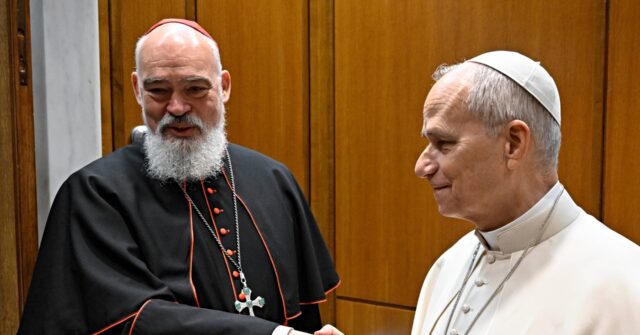
Pope Leo XIV welcomed the highest-ranked Catholic authority in Iran, Archbishop of Tehran-Isfahan Cardinal Dominique Mathieu, for an in-person meeting at the Vatican on Thursday.
Cardinal Mathieu was forced to evacuate Tehran and arrived in Italy on March 8 after the Italian government shut its embassy in the country. While Vatican City is a sovereign state, given its size, it relies on allies such as Italy in some cases for diplomatic support and protection. In Tehran, the cardinal’s residence was located on Italian embassy grounds. The cardinal is a native of Belgium and had served as the Archbishop of Tehran-Isfahan since 2021.
The Vatican released footage of the pope welcoming Cardinal Mathieu to the Vatican on Thursday.

According to the Catholic news network EWTN, Iran is home to about 2,000 known Catholics, who maintain their faith in a highly hostile atmosphere. Cardinal Mathieu was tasked with leading that community, but was forced to depart in the greater context of “Operation Epic Fury,” an American military engagement meant to neutralize Iran’s ability to facilitate terrorist activity and pose a threat to countries around the world. Hours after beginning on February 28, President Donald Trump announced that the operation had successfully eliminated the “supreme leader” of the Iranian Islamist regime, Ayatollah Ali Khamenei.
Following the Italian government announcing it would shut down its Tehran embassy, Cardinal Mathieu’s whereabouts were temporarily unknown, as his position in the country was in part dependent on Italian diplomatic activities. On March 9, the Belgian outlet Cathobel reported that the cardinal had successfully arrived in Rome the day before. Cardinal Mathieu released a statement then explaining his “regret and sorrow” for having to depart and expressing a desire to return to serve Catholics there as soon as it became possible.
“I arrived in Rome yesterday, not without regret and sorrow for our brothers and sisters in Iran, as part of the complete evacuation of the Italian embassy, [where] the archdiocese [is located]. Until I return there, pray for the conversion of hearts to inner peace,” Mathieu said.
Iran is one of the world’s most repressive atmospheres for Christianity, in particular for converts from Islam. The humanitarian group Open Doors, which publishes an annual list of the countries most aggressively persecuting Christians, ranked Iran number ten on the 2025 edition of its World Watch List, released early this year. It estimated the Christian population of Iran to be around 800,000 people.
FLASHBACK/Pope Francis appoints as cardinal Archbishop of Tehran Ispahan Dominique Joseph Mathieu during the Consistory for creation of new cardinals at St. Peter’s Basilica on December 07, 2024 in Vatican City, Vatican. (Franco Origlia/Getty Images)
“Christians in Iran are heavily and systemically repressed, as the authorities seek to root out what they see as a threat from the West to undermine their Islamic rule,” Open Doors explained. “Converts are most in the firing line. House churches are commonly raided, often followed by arrests, interrogations, pressure to inform on other believers and long-term imprisonment.”
In 2025, it noted, “the conflict between Israel and Iran has intensified the oppression of converts, who are often seen as sympathising with ‘the West’. In the immediate aftermath of the ceasefire with Israel, at least 54 Christians were arrested in 21 cities.”
Christians have been placed in an especially vulnerable position following the eruption of conflict against Iran in late February. The government of Israel has launched a separate military operation targeting the Iranian proxy Hezbollah in Lebanon, ordering hundreds of thousands of people, many of them in Christian villages throughout the south of the city, to evacuate. Pope Leo XIV made his first international trip at pontiff to the Middle East, stopping in Lebanon and urging the Christians there to seek to stay in their homeland. The Church, he asserted, “does not want anyone to be forced to leave their country.”
“Moreover, the Church wants those who wish to return home to be able to do so safely,” he said during his visit in December. “While human mobility represents an immense opportunity for encounter and mutual enrichment, it does not erase the special ties that unite each person to certain places, to which they owe their identity in a very special way.”
Entire Christian villages have rejected Israel’s calls to evacuate, placing them directly in the line of fire.
“I am from Alma al-Shaab, from the beloved south that has nothing to do with the Iranians or their militias. I call on the president of the republic and the prime minister to declare my town, Alma al-Shaab, a zone free of any security or military activity by Hezbollah,” a resident of southern Lebanon named Charbel Sayyah said on social media this week.
The conflict resulted in the death this week of a Maronite priest, Father Pierre El-Rahi, who Pope Leo honored in remarks on Wednesday.
“Father Pierre was a true shepherd who always remained beside his people with the love and sacrifice of Jesus the Good Shepherd,” the pope said. “May the Lord grant that the blood he shed may be a seed of peace for beloved Lebanon.”
Follow Frances Martel on Facebook and Twitter.
Read the full article here


