




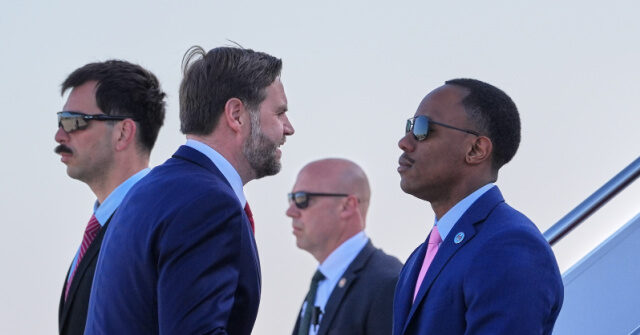
Vice President JD Vance heads to Islamabad, Pakistan, for negotiations with Iran amid the two-week ceasefire, marking a major moment for the 41-year-old vice president and the administration as a whole.
Vance departed Joint Base Andrew aboard Air Force One on Friday morning, speaking briefly to reporters before boarding the plane. Vance was optimistic that the negotiations this weekend would be positive.

“As the president of the United States said, if the Iranians are willing to negotiate in good faith, we’re certainly willing to extend the open hand. If they’re going to try to play us, then they’re going to find that the negotiating team is not that receptive,” he said.
“So we’re going to try to have a positive negotiation. The president gave us some pretty clear guidelines, and we’re gonna see,” he added.
White House press secretary Karoline Leavitt announced on Wednesday that Vance would lead the negotiations, accompanied by Special Envoy Steve Witkoff and Jared Kushner. Leavitt said discussions are set to begin Saturday morning, local time.
Trump announced the two-week ceasefire on Tuesday, and Leavitt stressed it is conditional on the Strait of Hormuz’s “free, safe, and immediate reopening.”
“I think the president was very clear and simplistic in his language last night, in his Truth Social post, where he said that this ceasefire is subject to the free, safe, and immediate reopening of the Strait of Hormuz. That’s very plain language, and it should be taken at face value,” she said.
Leavitt added the strait must be opened “without limitation, including tolls.”
However, Trump indicated his dissatisfaction Thursday with Iran’s handling of the strait.

“Iran is doing a very poor job, dishonorable some would say, of allowing Oil to go through the Strait of Hormuz. That is not the agreement we have!” the president said.
On Friday, he stressed the lone reason he did not begin striking bridges and energy plants in Iran on Tuesday was to negotiate.
“The Iranians don’t seem to realize they have no cards, other than a short term extortion of the World by using International Waterways,” he said. “The only reason they are alive today is to negotiate!”
Another stressor on the ceasefire centers around Israel’s operations against Hezbollah in Lebanon, which Vance stressed Wednesday was never part of the ceasefire agreement with Iran.
“I actually think—and there’s a lot of bad faith negotiation and a lot of bad faith, you know, propaganda going on—I think this comes from a legitimate misunderstanding,” Vance said. “I think the Iranians thought that the ceasefire included Lebanon, and it just didn’t. We never made that promise.”
He added, it “would be dumb” of Iran to allow negotiations to disintegrate over Lebanon, though that is ultimately Iran’s choice.
Israeli Prime Minister Benjamin Netanyahu said Thursday that Israel will commence negotiations with Lebanon “as soon as possible” with the goal of disarming Hezbollah and advancing peace talks.
Read the full article here


