
Close Menu
The Politic ReviewThe Politic Review
  • News
  • U.S.
  • World
  • Politics
  • Congress
  • Business
  • Economy
  • Money
  • Tech
  • More Articles
Trending

Report: Federal Grand Jury Subpoenas James Comey Adviser Regarding Alleged Leaks to New York Times

September 3, 2026

House Democrats watch closely as Hakeem Jeffries vows to rein in rogue members

September 2, 2026

Japanese WWII crimes revisited: Soviet files detail mass beheadings in Manchuria

September 2, 2026
Facebook X (Twitter) Instagram
  • Donald Trump
  • Kamala Harris
  • Elections 2024
  • Elon Musk
  • Israel War
  • Ukraine War
  • Policy
  • Immigration
Facebook X (Twitter) Instagram
The Politic ReviewThe Politic Review
Newsletter
Thursday, September 3
  • News
  • U.S.
  • World
  • Politics
  • Congress
  • Business
  • Economy
  • Money
  • Tech
  • More Articles
The Politic ReviewThe Politic Review
  • United States
  • World
  • Politics
  • Elections
  • Congress
  • Business
  • Economy
  • Money
  • Tech
Home»Tech»UNESCO Seeks to Control AI Rollout in Africa with ‘Youth Coding Initiative’
Tech

UNESCO Seeks to Control AI Rollout in Africa with ‘Youth Coding Initiative’

Press RoomBy Press RoomSeptember 30, 2025No Comments4 Mins Read
Share Facebook Twitter Pinterest Copy Link LinkedIn Tumblr Email VKontakte Telegram

The desire of the United Nations to control artificial intelligence (AI) and use it to shape public discourse was once again expressed on Tuesday, when the U.N. Educational, Scientific, and Cultural Organization (UNESCO) kicked off its “AI for Africa Conference.”

UNESCO wants to influence the “development of artificial intelligence on the continent” with a legion of trained civil servants and legal personnel.

“Today, alongside the African Union and the South African presidency of the G20, we are working to put artificial intelligence at the service of Africa. Our goal is to spur indigenous momentum in Africa by training talent, adapting institutions and responding to African priorities. Only in this way will artificial intelligence meet the real needs of the people,” said UNESCO Director-General Audrey Azoulay.

South Africa assumed the rotating presidency of the Group of 20 Nations (G20) in December 2024, and will relinquish the office at the end of November 2025. One of the stated goals of South Africa’s presidency was to deliver innovations on “artificial intelligence and data governance.”

This week’s conference marks the official launch of UNESCO’s “AI Initiative for Africa,” which will include programs to “train more than 15,000 civil servants in the use of artificial intelligence and the challenges posed by digital transformation.”

“Given the impact of these new technologies on the judicial system, UNESCO will also train 5,000 judges and prosecutors,” UNESCO’s press release added, noting that some 44 percent of legal professionals are now using AI at work, but only a small number of them have received training.

“These gaps expose judges and prosecutors to the risk of unintentionally violating human rights, including the right to privacy, the right to non-discrimination and the right to freedom of expression,” the press release said.

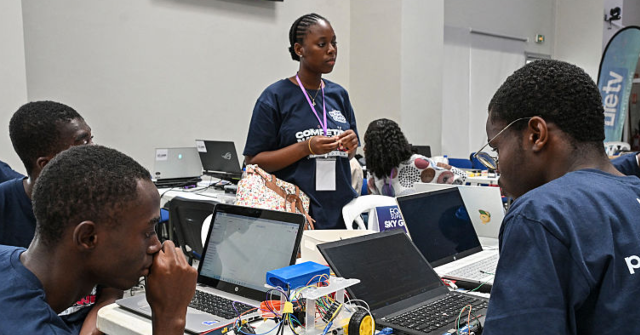
The ambitions of the AI Initiative for Africa were not limited to civil and legal services. The program will also train 2,000 teachers and 30 education policymakers from 15 African countries under its “Youth Coding Initiative,” and will establish a “pan-African incubator” to support 1,500 AI researchers.

UNESCO rolled out a platform on Monday called the “Technology Policy Assistance Facility” to help policymakers around the world to “create tailor-made roadmaps for the use of AI at the national level, aligned with international standards.”

The platform’s tools include “detailed case studies, training resources, and a directory of UNESCO and international experts.”

The AI Initiative for Africa is the U.N.’s latest effort to influence the development of artificial intelligence, especially in terms of what information AI should be allowed to disseminate and what sort of large-language models (LLMs) it should be allowed to use.

As far back as 2023, UNESCO demanded “global guidelines for the regulation of social media” to curb the spread of “disinformation” and combat “hate speech, misogyny, suppression of free speech, doxxing, and conspiracy theories.”

UNESCO said these standards had to be global, rather than promulgated by individual governments. Director-General Azoulay said that if regulation was developed in “isolation” by sovereign nations, it was “doomed to fail.” Other participants in UNESCO’s February 2023 conference explicitly rejected the idea advanced by U.S. Supreme Court Justice Louis Brandeis that “the way to fight hate speech is with more speech.”

In March 2024, UNESCO published a study that found “worrying tendencies” toward “gender bias, homophobia, and racial stereotyping” were developing in LLMs. The study fretted that AIs tended to indulge in gender stereotypes of women, and produced content that was “negative about gay people and particular ethnic groups.”

In November 2024, U.N. Secretary-General Antonio Guterres called for a framework of global speech codes to “rein in hate speech and disinformation spreading online.” UNESCO simultaneously demanded more “fact-checking” on social media and more “training” for social media influencers, citing the rapid development of AI as a reason for taking urgent action.

The Trump administration announced in July 2025 that it would withdraw from UNESCO, in part because of the organization’s increasing efforts to control online speech, even as it embraced “divisive social and cultural causes” such as Palestinian statehood. Trump actually pulled the U.S. out of UNESCO in 2017, and his successor Joe Biden attempted to “rejoin” without the necessary congressional action, so the 2025 withdrawal notice was largely a formality.

As for the future of AI in Africa, some observers feel it has been overhyped as a solution to the continent’s economic problems — possibly to the point where chimerical AI solutions receive funding that should have been directed to more practical programs, such as infrastructure development. Among the problems facing AI development are that Africa is too sharply divided between factions, nations, and regional blocs to cooperate on massive continental projects, and that African nations might have trouble generating the enormous amounts of energy at reasonable costs required for AI data centers. 

Read the full article here

Share. Facebook Twitter Pinterest LinkedIn Tumblr Email Telegram Copy Link

Related Articles

Tech

Elon Musk’s G20 Prediction: 1 Billion Humanoid Robots Will Outproduce All of Humanity in 10 Years

September 2, 2026
Tech

PwC Predicts $31 Trillion in Global AI Data Center Spending by 2050

September 2, 2026
Tech

Exclusive – Sen. Ron Johnson Says Chinese Propaganda Fueling Data Center Opposition: ‘Do We Really Want to Lose the Race to AI?’

September 2, 2026
Tech

Aviation Experts Sound National Security Alarm as FAA Considers Air Traffic Control Vendors with Strong China Ties

September 1, 2026
Tech

Nolte: Gal Gadot Defends Role in AI Movie

September 1, 2026
Tech

Taiwanese Man Jailed After Using Robot Vacuum to Record Wife’s Affair

September 1, 2026
Add A Comment
Leave A Reply Cancel Reply

Editors Picks

House Democrats watch closely as Hakeem Jeffries vows to rein in rogue members

September 2, 2026

Japanese WWII crimes revisited: Soviet files detail mass beheadings in Manchuria

September 2, 2026

Canada’s Assisted Suicide Laws Go Overboard, as Godless Doctors Renew Push To Euthanize Newborn Babies

September 2, 2026

China’s Xi Jinping Receives Ostentatious Welcome in Egypt

September 2, 2026
Latest News

Fetterman: Democratic Socialists of America ‘Deeply Anti-American,’ Want to ‘Impoverish Middle Class Whites’

September 2, 2026

Dem Rep. Meeks: Trump Can’t Stop Coming Blue Tsunami

September 2, 2026

Cause of Death Revealed for Legendary Character Actor Tim Curry – Starred in “The Rocky Horror Picture Show” and “It”

September 2, 2026

Subscribe to News

Get the latest politics news and updates directly to your inbox.

The Politic Review is your one-stop website for the latest politics news and updates, follow us now to get the news that matters to you.

Facebook X (Twitter) Instagram Pinterest YouTube
Latest Articles

Report: Federal Grand Jury Subpoenas James Comey Adviser Regarding Alleged Leaks to New York Times

September 3, 2026

House Democrats watch closely as Hakeem Jeffries vows to rein in rogue members

September 2, 2026

Japanese WWII crimes revisited: Soviet files detail mass beheadings in Manchuria

September 2, 2026

Subscribe to Updates

Get the latest politics news and updates directly to your inbox.

© 2026 Prices.com LLC. All Rights Reserved.
  • Privacy Policy
  • Terms of use
  • For Advertisers
  • Contact

Type above and press Enter to search. Press Esc to cancel.