


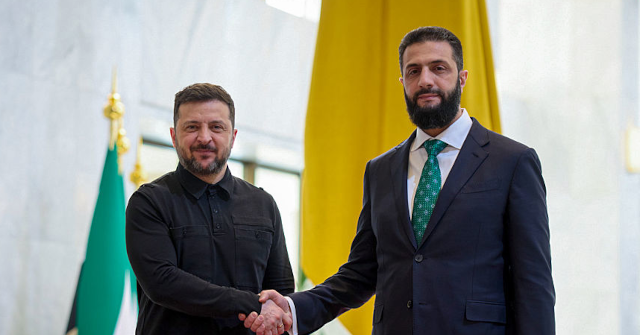
The state-run Syrian Arab News Agency (SANA) reported on Sunday that the government of ex-jihadist President Ahmed al-Sharaa had finalized an agreement with the government of Ukraine for the latter’s experts to help demining efforts in the aftermath of the over-decade-long civil war.
The agreement is part of an ongoing process of normalizing and deepening relations between Damascus and Kyiv. During the rule of the Assad dynasty, which lasted over half a century, Syria maintained friendly relations with Russia which deepened after the eruption of civil war in 2011. Former dictator Bashar Assad’s closeness to Moscow resulted in the Ukrainian government cutting ties with Syria in 2022 — in response to Assad’s support for Russia’s invasion of that country.
Sharaa and his jihadist militia, Hayat Tahrir al-Sham (HTS), overthrew Assad to end the civil war in December 2024. Sharaa has since rebranded himself as a finance-forward technocrat prioritizing foreign investment in his country and friendly relations with countries such as the United States. Sharaa met the president of Ukraine, Volodymyr Zelensky, in person for the first time a year ago during the United Nations General Assembly, agreeing to normalize relations and find avenues of cooperation. He has since, diplomatically, been working to limit Russian influence in Syria, holding meetings to find ways to erode the Russian military presence in the country left over from the Assad days.
According to SANA, the demining agreement is one of several diplomatic deals between Syria and Ukraine. The agreement will “leverage Ukraine’s expertise in handling landmine contamination and unexploded ordnance to protect agricultural sectors and food security,” the state outlet claimed.
As a result of the deal, Ukrainian weapons experts will travel to Syria to help identify mines and unexploded materials, particularly in civilian areas, and safely disable and remove them.
“Key initiatives include field training, technical capacity-building, advanced detection equipment transfers, and Ukrainian expert visits to high-contamination areas, particularly in northern Syria,” SANA reported. The Ukrainians will work to help train Syrian experts and to build a comprehensive map of locations of explosives needing to be tended to. Ukrainian Deputy Minister of Economy and Environment Ihor Bezkaravainyi reportedly confirmed during a meeting in Damascus that “Ukrainian specialists will participate directly on the ground to deploy technology and locate sub-surface explosive remnants.”
The announcement on Sunday follows months of discussions between the two countries on the possibility of Ukraine helping handle explosives in post-war Syrian reconstruction. In July, the Ukrainian state outlet Ukrinform reported that the Ukrainian president’s cabinet had agreed to a deal, on paper, for “humanitarian demining” in Syria.
Bezkaravainyi, who signed the deal, would reportedly lead the efforts to hash out details on executing the agreement.
Ukrinform has reported more recently on bilateral cooperation efforts in other spheres. In early September, the Syrian government announced that it had formally established the Syrian-Ukrainian Business Council to help facilitate bilateral trade and economic cooperation. Bilateral trade was largely impossible for the two countries before August, as the United States had for decades placed Syria on its heavily sanctioned list of State Sponsors of Terrorism, responding to the Assad regime’s longtime support for jihadist terror groups such as Hezbollah. Syria was formally removed from that list in August, facilitating more trade with close American ally Ukraine.
Syrian-Ukrainian relations have improved dramatically under Sharaa. The Syrian leader met his Ukrainian counterpart, Zelensky, in New York last year, following several meetings with President Donald Trump in which the latter praised Sharaa as a “young, attractive guy” with promise as a leader. The official Sharaa-Zelensky meeting last year resulted in the formal establishment of diplomatic relations between Ukraine and Syria for the first time in four years. Zelensky praised the meeting as positive and hinted at a wide field of potential cooperation with the Middle Eastern state.
“During our negotiations with President of Syria Ahmed al-Sharaa, we also discussed in detail promising sectors for developing cooperation, security threats faced by both countries, and the importance of countering them,” Zelensky wrote on social media at the time. “We agreed to build our relations on the basis of mutual respect and trust.”
In December, Zelensky marked the anniversary of the fall of the Assad regime, announcing that Ukraine was “there right away, lending a helpful hand.”
“And we stand ready to continue our support. Whenever security expands in any region, the whole world becomes safer,” he added.
Zelensky visited Damascus in April, receiving a warm welcome from Sharaa.
“In Damascus, I received Ukrainian President Volodymyr Zelenskyy, where avenues for enhancing economic cooperation and exchanging expertise were discussed,” Sharaa wrote on social media. “The visit underscores Syria’s orientation toward expanding its international partnerships in a manner that supports development and bolsters stability.”
Zelensky announced following a meeting with Sharaa that Damascus had a “strong interest in exchanging military and security experience” as well as importing key food items such as grain from Ukraine.
Follow Frances Martel on Facebook and Twitter.
Read the full article here