




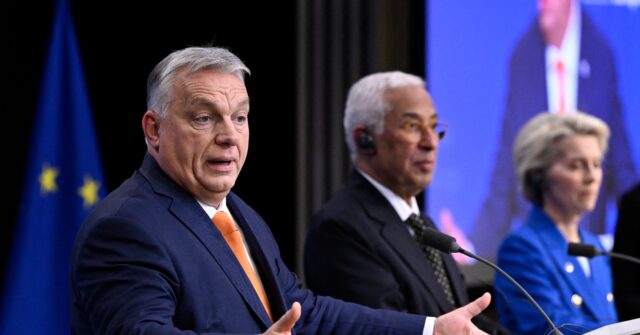
Republican lawmakers in the United States have accused the European Union of intervening to subvert Hungary’s democratic process, putting its thumb on the scale against Prime Minister Viktor Orbán as he seeks re-election on Sunday.
New Jersey Congressman Chris Smith and Maryland Representative Andy Harris wrote to European Commission President Ursula von der Leyen — who controls the unelected federal branch of the European Union — accusing Brussels of using its financial and other powers to pressure Hungarian voters into backing a more pro-EU government.
It comes as Prime Minister Orbán faces his toughest re-election campaign since coming to power 16 years ago, amid economic difficulties stemming in large part from the war in neighbouring Ukraine and from financial sanctions imposed by the EU on Hungary over so-called “rule of law” violations.
In total, the EU is currently withholding around €18 billion ($21.11bn) in funds from Hungary, including for domestic legislation restricting the promotion of LGBT content on children’s television and for barring lewd public demonstrations, such as gay Pride parades. Hungary is also facing the prospect of hefty fines for refusing to take in illegal migrants from other EU countries, which Budapest has argued is a punishment for having secured its borders while others failed or refused to.
Republican Representatives Smith and Harris said that the EU’s “persistence and timing of these measures—particularly during an electoral period—have reinforced perceptions that they are being applied in a politically selective manner.
“This perception is strengthened by the case of Poland, in which the EU put similar pressures against a conservative government – and then cynically dropped its pressures entirely as soon as a progressive government was in power in Poland, without that government having made the rule-of-law changes that the EU had previously demanded. The cumulative effect is to create the appearance that EU institutions seek to strongly shape the political environment of a member state during a democratic election,” they wrote.
Congressmen Smith and Harris also raised the issue of EU funding to media, activist organisations, and NGOs within Hungary, which they noted are “broadly understood within Hungary” to be acting in opposition to the Orbán government.
“During an electoral period, the effect of these funding patterns is not merely abstract; rather, they contribute in concrete ways to shaping the informational environment in which voters form their judgments. This has led to a widespread perception that EU institutions are active and partisan participants in Hungary’s domestic politics,” they said.
The Republican lawmakers also raised the issue of the EU’s Digital Services Act (DSA) censorship apparatus, which demands that large social media companies police so-called disinformation and hate speech on their platforms. Smith and Harris said that officials and commentators in Hungary have claimed that the DSA has been used to stifle or censor viewpoints in favour of the Orbán government.
“The resulting dynamic raises grave concerns about indirect censorship, particularly where private platforms act under regulatory pressure to suppress or limit certain forms of political speech,” they wrote.
Taken together, the U.S. Congressmen said that the EU’s “actions constitute a pattern of direct and indirect intervention in Hungary’s internal political, media, and civil society environment during an active electoral period.”
“In assuming a role that is widely perceived within Hungary as aligned with particular political outcomes, the European Union risks undermining confidence in its institutional neutrality and its respect for the sovereign democratic processes of its member states.”
They called on the Commission to provide a full accounting of its funding of media and other organisations in Hungary, transparency on its sanction decision-making process, actions taken under the Digital Services Act, and to divulge what steps Brussels has taken to ensure political neutrality in EU member state elections.
The letter from the Congressmen comes days after U.S. Vice President JD Vance similarly accused Brussels of interfering in Hungary’s elections as he travelled to Budapest in a show of support for the longtime ally of President Donald Trump.
Vance said that the economic pressure imposed on the Hungarian public by the EU represented “one of the worst examples of foreign and election interference” he had ever seen.
“The bureaucrats in Brussels have tried to destroy the economy of Hungary. They have tried to make Hungary less energy independent. They have tried to drive up costs for Hungarian consumers. And they’ve done it all because they hate this guy,” Vance said of Prime Minister Orbán.
In an apparent attempt to act as a counterweight to the EU, President Trump said on Friday evening that the U.S. is prepared to use its “economic might” to help strengthen the Hungarian economy if called upon. “We are excited to invest in the future Prosperity that will be generated by Orbán’s continued Leadership!” the President wrote on Truth Social.
On the campaign trail on Saturday, Prime Minister Orbán urged the “loud majority” to come out to the polls and prevent Hungary from being “dragged into war” with Russia in Ukraine. Doing so would risk Hungary’s relatively low energy costs, which result from deals negotiated by Budapest to secure access to Russian gas and oil.
“When we have to make difficult decisions, we need people who support us, and we have had such support in recent years. I am grateful that with their encouragement and support, they helped us through these years,” Orbán said at a campaign rally.
Follow Kurt Zindulka on X: Follow @KurtZindulka or e-mail to: kzindulka@breitbart.com
Read the full article here


