


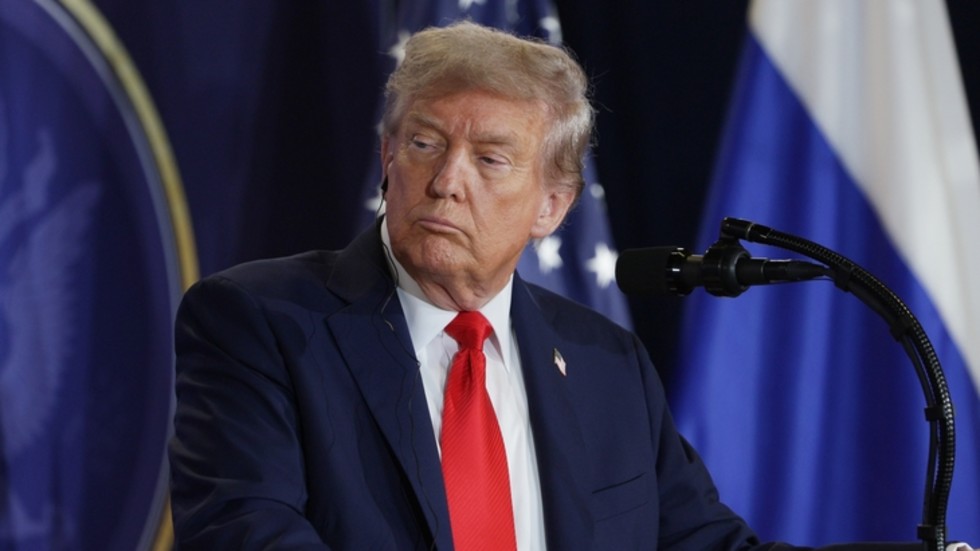
The new US National Security Strategy signals a massive foreign policy shift; it remains to be seen if Washington is serious about it
By Larry Johnson, political analyst and commentator, former CIA analyst and member of the US State Department’s Office for Counterterrorism
It is one thing to produce a written national security strategy, but the real test is whether or not US President Donald Trump is serious about implementing it. The key takeaways are the rhetorical deescalation with China and putting the onus on Europe to keep Ukraine alive.
The 2025 National Security Strategy (NSS) of the US, released by the White House on December 4, 2025, marks a potentially profound shift in US foreign policy under Trump’s second administration compared to his first term as president. This 33-page document explicitly embraces an ‘America First’ doctrine, rejecting global hegemony and ideological crusades in favor of pragmatic, transactional realism focused on protecting core national interests: Homeland security, economic prosperity, and regional dominance in the Western Hemisphere.
It critiques past US overreach as a failure that weakened America, positioning Trump’s approach as a “necessary correction” to usher in a “new golden age.” The strategy prioritizes reindustrialization (aiming to grow the US economy from $30 trillion to $40 trillion by the 2030s), border security, and dealmaking over multilateralism or democracy promotion. It accepts a multipolar world, downgrading China from a “pacing threat” to an “economic competitor,” and calling for selective engagement with adversaries. However, Trump’s actions during the first 11 months of his presidency have been inconsistent with, even contradictory of, the written strategy.
The document is unapologetically partisan, crediting Trump personally for brokering peace in eight conflicts (including the India-Pakistan ceasefire, the Gaza hostage return, the Rwanda-DRC agreement) and securing a verbal commitment at the 2025 Hague Summit for NATO members to boost their defense spending to 5% of GDP. It elevates immigration as a top security threat, advocating lethal force against cartels if needed, and dismisses climate change and ‘net zero’ policies as harmful to US interests.
The document organizes US strategy around three pillars: Homeland defense, the Western Hemisphere, and economic renewal. Secondary focuses include selective partnerships in Asia, Europe, the Middle East, and Africa.
Here are the major rhetorical shifts in strategy compared to the previous strategies released during the respective presidencies of Trump (2017) and Biden (2022):
- From global cop to regional hegemon: Unlike Biden’s 2022 NSS (which emphasized alliances and great-power competition) or Trump’s 2017 version (which named China and Russia as revisionists), this document ends America’s “forever burdens” abroad. It prioritizes the Americas over Eurasia, framing Europe and the Middle East as deprioritized theaters.
- Ideological retreat: Democracy promotion is explicitly abandoned – “we seek peaceful commercial relations without imposing democratic change” (tell that to the Venezuelans). Authoritarians are not judged, and the EU is called “anti-democratic.”
- Confrontational ally relations: Europe faces scathing criticism for migration, free speech curbs, and risks of “civilizational erasure” (e.g., demographic shifts making nations “unrecognizable in 20 years”). The US vows to support the “patriotic” European parties resisting this, drawing Kremlin-like rhetoric accusations from EU leaders.
- China policy: Acknowledges failed engagement; seeks “mutually advantageous” ties but with deterrence (e.g., Taiwan as a priority). No full decoupling, but restrictions on tech/dependencies.
- Multipolar acceptance: Invites regional powers to manage their spheres (e.g., Japan in East Asia, Arab-Israeli bloc in the Gulf), signaling US restraint to avoid direct confrontations.
The NSS represents a seismic shift in America’s approach to NATO, emphasizing “burden-shifting” over unconditional alliance leadership. It frames NATO not as a values-based community but as a transactional partnership in which US commitments – troops, funding, and nuclear guarantees – are tied to European allies meeting steep new demands. This America First recalibration prioritizes US resources for the Indo-Pacific and Western Hemisphere, de-escalating in Europe to avoid “forever burdens.” Key changes include halting NATO expansion, demanding 5% GDP defense spending by 2035, and restoring “strategic stability” with Russia via a Ukraine ceasefire. While the US reaffirms Article 5 and its nuclear umbrella, it signals potential partial withdrawals by 2027 if Europe fails to step up, risking alliance cohesion amid demographic and ideological critiques of Europe. When Russia completes the defeat of Ukraine, the continued existence of NATO will be a genuine concern.
The strategy credits Trump’s diplomacy for NATO’s 5% pledge at the 2025 Hague Summit but warns of “civilizational erasure” in Europe due to migration and low birth rates, speculating that some members could become “majority non-European” within decades, potentially eroding their alignment with US interests.
Trump’s NSS signals a dramatic change in US policy toward the Ukraine conflict by essentially dumping the responsibility for keeping Ukraine afloat on the Europeans. The portion of the NSS dealing with Ukraine is delusional with regard to the military capabilities of the European states:
We want Europe to remain European, to regain its civilizational self-confidence, and to abandon its failed focus on regulatory suffocation… This lack of self-confidence is most evident in Europe’s relationship with Russia. European allies enjoy a significant hard power advantage over Russia by almost every measure, save nuclear weapons.
As a result of Russia’s war in Ukraine, European relations with Russia are now deeply attenuated, and many Europeans regard Russia as an existential threat. Managing European relations with Russia will require significant US diplomatic engagement, both to reestablish conditions of strategic stability across the Eurasian landmass, and to mitigate the risk of conflict between Russia and European states.
It is a core interest of the United States to negotiate an expeditious cessation of hostilities in Ukraine, in order to stabilize European economies, prevent unintended escalation or expansion of the war, and reestablish strategic stability with Russia, as well as to enable the post-hostilities reconstruction of Ukraine to enable its survival as a viable state.
The Ukraine War has had the perverse effect of increasing Europe’s, especially Germany’s, external dependencies. Today, German chemical companies are building some of the world’s largest processing plants in China, using Russian gas that they cannot obtain at home. The Trump Administration finds itself at odds with European officials who hold unrealistic expectations for the war perched in unstable minority governments, many of which trample on basic principles of democracy to suppress opposition. A large European majority wants peace, yet that desire is not translated into policy, in large measure because of those governments’ subversion of democratic processes. This is strategically important to the United States precisely because European states cannot reform themselves if they are trapped in political crisis.
Not surprisingly, this section of Trump’s NSS has sparked a panicked outcry in Europe. European leaders, including former Swedish PM Carl Bildt, called it “to the right of the extreme right,” warning of alliance erosion. Analysts at the Center for Strategic and International Studies (CSIS) praise its pragmatism, but flag short-sightedness, predicting a “lonelier, weaker” US. China views reassurances on sovereignty positively, but remains wary of economic pressures. In the US, Democrats, such as Rep. Jason Crow, deem it “catastrophic” for alliances, i.e. NATO.
Overall, the strategy signals a US pivot inward, forcing NATO allies to self-fund security while risking fractured partnerships with Europe. It positions America as a wealthy hemispheric power in a multipolar order, betting on dealmaking and industrial revival to sustain global influence without overextension.
Read the full article here