


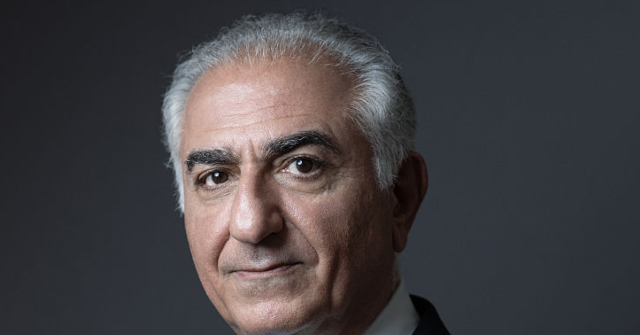
President Donald Trump told Reuters on Wednesday that, while shah scion Reza Pahlavi “seems very nice,” the U.S. president did not feel confident that the Iranian people would support him as leader should the current Islamist dictatorship fall.
Trump also remarked that he did not believe the situation in Iran — two weeks of massive protests in dozens of cities that the Iranian regime is repressing with outsized violence — had reached a point where discussion of a successor to dictator Ali Khamenei was appropriate.
Iranians have taken the streets in as many as 195 cities, according to opposition groups, since late December calling for an end to the brutal terrorist rulers who have controlled the country since 1979. In response, as with past waves of protests in the country, Khamenei’s regime has responded with mass arrests and killings; some estimates suggest as many as 20,000 people may have died in the past month of protesting. Internally, reports do not indicate that any individual opposition leader has arisen from the protests, leaving open-ended the question of who could potentially run a post-Khamenei Iran.
Reza Pahlavi is the son of Mohammad Reza Pahlavi, the last shah of Iran, whom Ayatollah Ruhollah Khomeini deposed in 1979. He has lived in the United States since 1978. While some viral images of the protests in Iran have seemed to show monarchist symbols being championed at the events, President Trump stated in his comments to Reuters that he is not confident that Pahlavi is popular enough at home to take the reins rapidly in the face of a regime collapse. He is also not believed to possess any armed forces or paramilitary units that could replace the expansive terrorist apparatus led by the Islamic Revolutionary Guard Corps (IRGC) in Iran currently.
“He seems very nice, but I don’t know how he’d play within his own country, and we really aren’t up to that point yet,” Reuters quoted Trump as saying. “I don’t know whether or not his country would accept his leadership, and certainly if they would, that would be fine with me.”
“Whether or not it falls, it’s going to be an interesting period of time,” Trump added of the Iranian regime.
Reuters noted that Trump had previously stated he had no plans to meet with Pahlavi or discuss any transition. Some Washington, DC rumors claimed that Trump’s Middle East envoy Steve Witkoff had maintained a conversation with Pahlavi last weekend, but no public exchanges have occurred at press time. The news agency added that Pahlavi “appears to have little organized presence inside the Islamic Republic.” Last week, the Wall Street Journal editorial board attempted to give Pahlavi credit for some of the protests, noting that “the Shah’s son called on Iranians to rally against the regime at 8 p.m. on Thursday and Friday,” and that they did so. The Iranian people, however, had already been in the streets by the thousands since December 31, leaving unclear how much any call to protest from abroad impacted decisions within the country.
The protests, which explicitly call for an end to the Islamist terror regime, erupted in the last week of 2025 in response to two major factors: the announcement of another major tax on Iranians, and the collapse of the rial currency amid soaring inflation. Videos of protests on New Year’s Day show large crowds blocking traffic and attempting to break into government buildings.
Iranians had already been facing a host of unsustainable factors, from intense repression, including the killing of those deemed insufficiently obedient to the “morality police,” to water shortages in Tehran so intense that “president” Masoud Pezeshkian has repeatedly called for the relocation of the entire capital, home to an estimated 10 million people. Iran attempted cloud seeding efforts in November to combat the drought situation, which were preceded by intense flooding in western Iran.
Pahlavi, from exile in the United States, has repeatedly called for President Trump to take “action” before the protests, though he has not specified exactly what he would want America to do.
“The best way to ensure that there will be less people killed in Iran is to intervene sooner, so this regime finally collapses and puts an end to all the problems that we are facing,” he offered in an interview with CBS News on Monday. “The game-changer would be for this regime to know that they cannot rely anymore on a continued campaign of repression without the world reacting to it.”
“When asked whether he was pushing Mr. Trump to initiate regime change, Pahlavi said that the president stands in solidarity with the Iranian people, which means ‘ultimately supporting them in their ask. And their ask is that this regime has to go,’” CBS News reported.
Pahlavi claimed elsewhere in the interview that he was “prepared” to die for the cause of a free Iran, though no reports indicate he has planned to go to Iran or join the protests physically at press time. He also responded to questioning whether it was responsible to encourage protests from afar that “this is a war and war has casualties,” once again demanding unspecified “action.”
Follow Frances Martel on Facebook and Twitter.
Read the full article here