


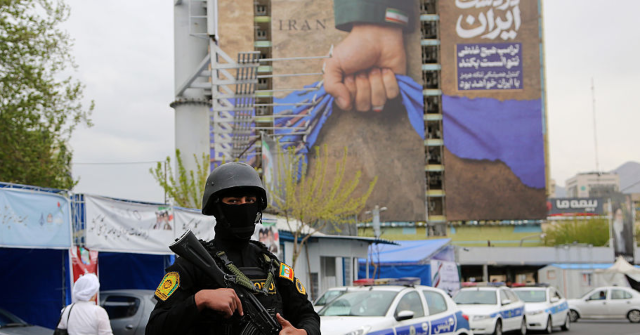
President Donald Trump’s blockade of Iran could be poised to deliver a staggering blow to the Iranian economy, including the cash flows needed by the regime to pay the host of soldiers and thugs it requires to stay in power.
The blockade officially began at 10:00 a.m. Eastern time on Monday. The U.S. military did not issue a formal public statement that the deadline had passed, although the timing of the blockade was made clear by U.S. Central Command (CENTCOM) in a statement on Sunday.
“The blockade will be enforced impartially against vessels of all nations entering or departing Iranian ports and coastal areas, including all Iranian ports on the Arabian Gulf and Gulf of Oman,” the statement said.
“CENTCOM forces will not impede freedom of navigation for vessels transiting the Strait of Hormuz to and from non-Iranian ports,” the statement added.
CENTCOM advised all ships in the region to “monitor Notice to Mariners broadcasts and contact U.S. naval forces on bridge-to-bridge channel 16 when operating in the Gulf of Oman and Strait of Hormuz approaches.”
President Donald Trump previously warned that the U.S. Navy would also “seek and interdict every vessel in international waters that has paid a toll to Iran,” but this warning did not appear in the CENTCOM statement. The blockade would obviously become a much larger and more delicate operation if the U.S. Navy sought to intercept every international vessel that paid ransom to Iran for safe passage through the Strait of Hormuz.
UK Maritime Trade Operations (UKMTO) on Monday issued an alert to mariners that access to Iran’s ports and oil terminals was now restricted for ships under every flag, across the whole of Iran’s coastline, “including locations along the Arabian Gulf, Gulf of Oman, and the Arabian Sea east of the Strait of Hormuz.”
The blockade would therefore explicitly include Jask, an alternative oil terminal constructed by Iran on the Gulf of Oman coast to bypass the Strait of Hormuz and Iran’s major oil nexus, Kharg Island. Despite heavy investments from the regime in Tehran, Jask has never been able to handle more than a tiny fraction of Iran’s oil exports.
“Transit passage through the Strait of Hormuz to or from non-Iranian destinations is not reported to be impeded by these measures; however, vessels may encounter military presence, directed communications, or right-of-visit procedures during passage,” the bulletin said.
“Right-of-visit procedures” would traditionally involve the U.S. Navy boarding a suspicious vessel to ensure it is not violating the Iran blockade.
UKMTO said that neutral vessels currently docked at Iranian ports “have been granted a limited grace period to depart.”
Foundation for Defense of Democracies (FDD) Senior Fellow Miad Maleki, a strong supporter of President Trump’s military campaign whose family hails from Iran, on Sunday wrote an analysis of the blockade’s likely effect upon Iran’s economy and military readiness.
Maleki found the blockade “would cost Iran approximately $276 million per day in lost exports and disrupt $159 million per day in imports, a combined economic damage of about $435 million per day, or $13 billion per month.”
He observed that Iran has no viable alternative overland or pipeline route to ship its oil and petrochemical products, and only about 10 percent of its non-oil trade can realistically be shipped in ways that would evade the U.S. blockade. Iran’s imports would also be strongly reduced, although he anticipated that “humanitarian cargoes” would be allowed.
Maleki pointed out that Iran’s fuel storage capacity is very limited, and was already filled to about 60 percent capacity, so the regime will have to begin shutting down its oil wells in about 13 days — and those wells will degrade very quickly once they have been shut down due to water seepage.
“Forced shut-ins could permanently destroy 300,000 to 500,000 barrels per day of production capacity,” he calculated. “That’s $9 billion to $15 billion per year in revenue, gone forever.”
These losses could be cataclysmic for Iran’s already weak economy. The January uprising that was murderously suppressed by the regime in Tehran was sparked by the collapse of the national currency, the rial, and the blockade is likely to push Iran into “terminal hyperinflation.” Maleki noted that Iran just issued the largest banknote in its history, the 10 million rial note — and it is only worth about $7 in U.S. currency.
“The blockade makes continued resistance economically impossible,” he concluded.
The loss of Iran’s oil and other exports will certainly affect world markets, including likely bumps in gas prices and overall inflation for American consumers, but the impact will probably be less severe for Americans than allowing Iran to keep the Strait of Hormuz closed to Persian Gulf oil traffic. Reopening the strait to non-Iranian traffic will also help to clear up a shortage of much-needed fertilizer shipments to farmers across the globe.
“Anything that currently takes more oil off the market will push prices up, which in turn will push gas prices further,” Trita Parsi of the Quincy Institute for Responsible Statecraft told Al Jazeera News on Monday.
Parsi predicted oil, currently hovering around $100 per barrel, could rise above $150 if the Houthis, Iran’s terrorist proxies in Yemen, repeat their 2024 tactic of attacking ships in the Red Sea and Bab al-Mandeb Strait.
Other doleful analysts told Al Jazeera that international shipping would probably avoid the Strait of Hormuz, even though it has technically been “reopened,” because they fear Iranian piracy, minimizing the benefits of renewed Persian Gulf oil exports.
Another complicating factor for analysts is that the U.S.-Israel-Iran ceasefire technically still has nine days to go, so the full impact of the blockade on both Iran and the world economy may be difficult to assess until the end of April.
South Korea’s Chosun Ilbo noted on Monday that Iran “secured massive war funds in a short period” after the U.S. Treasury Department granted a temporary license for Iran to sell crude oil stocks that have been awaiting shipment for at least 30 days.
The waiver was intended to minimize the global economic damage from the Strait of Hormuz shutdown, and it only released about 140 million barrels of oil into the world market, which was not even enough to cover two days of worldwide demand — but it gave Iran a significant cash infusion, as it sold its oil at premium prices to hungry buyers.
“Considering Iran’s annual defense budget ranges from 8 billion to 10 billion U.S. dollars, the revenue from oil exports during the U.S. sanctions reprieve is estimated at 4 billion to 5 billion U.S. dollars, effectively half of its annual defense spending,” Chosun Ilbo calculated, worrying that Iran may have built enough of a cash cushion from its temporary oil license to continue funding its military and repression apparatus through the first weeks of the U.S. blockade.
Read the full article here