


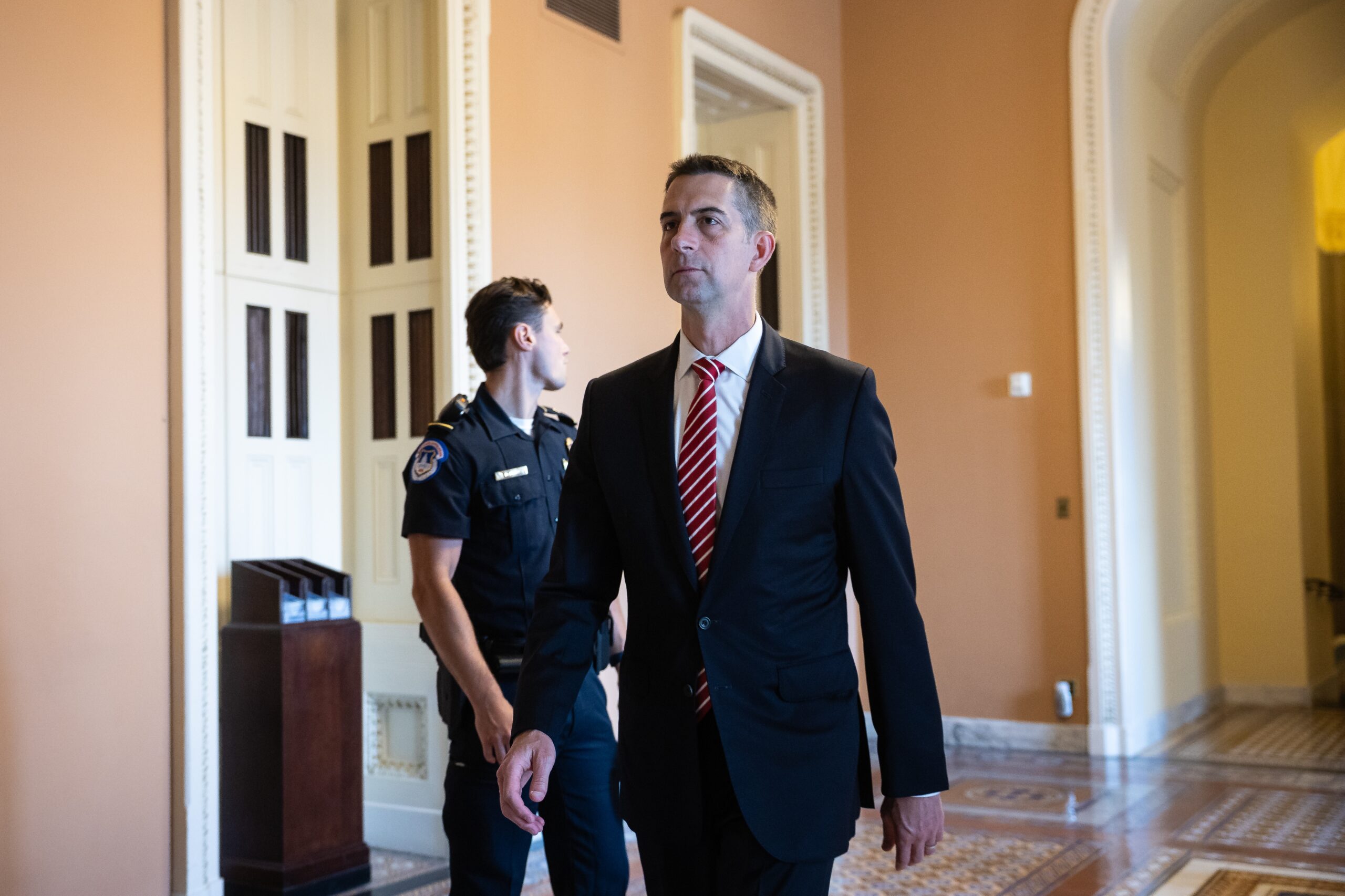
Tom Cotton made his name in Washington as an outspoken critic of a Democratic president’s deal to check Iran’s nuclear ambitions.
Now, with a president of his own party angling toward a similarly structured agreement, the Arkansas Republican is so far using a softer voice.
Cotton, the No. 3 Senate Republican and Intelligence Committee chair, is not alone among GOP defense hawks in finding himself in an awkward position more than a decade after lambasting President Barack Obama’s Iran deal.
But the combination of his prior ferocity toward the Iranian regime and his current leadership responsibilities have put him into an especially tight spot as President Donald Trump and Vice President JD Vance sell their 14-point “memorandum of understanding” to skeptical Republicans.
Cotton moved toward critiquing that framework in a Fox News interview Thursday, crediting Trump for “making Iran weaker than it’s been in decades” while airing concerns that “certain aspects of this deal are a step in the wrong direction.”
“We need to make sure that we don’t squander the leverage that we’ve built” against Iran, he said.
That is a far cry from the rhetoric Cotton deployed as a freshman senator in 2015, when Obama was moving in concert with other global powers to force Iran to curb its nuclear program in return for sanctions relief and other economic favors.
Cotton led a brash effort to undermine the deal — most notably by organizing a public letter signed by 46 other GOP senators to Ayatollah Ali Khamenei, then the supreme leader of Iran, warning that “anything not approved by Congress is a mere executive agreement” that could be nixed by a future administration.
The letter enraged the Obama administration and congressional Democrats, but it was prescient.
After he was elected in 2016, Trump withdrew from the deal, known as the Joint Comprehensive Plan of Action, setting the stage for his second-term military campaign against Iran that he is now seeking to end by trading curbs on Iran’s nuclear program for sanctions relief and other economic favors.
If that was the only jam Cotton was facing from Trump this week, it would be plenty. But the discomfiting Iran situation has been compounded by the president’s recent moves to upend Cotton’s careful negotiations aimed at extending a key surveillance program for three years.
After Trump blew up that deal by appointing a political ally to a top intelligence position, Cotton moved quickly to fast-track a permanent replacement through his committee and rekindle the surveillance deal — only to watch Trump blow things up once again.
Majority Leader John Thune, like most Senate Republicans, had nothing but praise this week for the “great job” Cotton was doing amid the tumult over the expired spy law and the director of national intelligence drama.
“He’s a really strong chair on the committee. And he had it all teed up and ready to go,” Thune said in an interview. “Now it’s just … back to the drawing board.”
But Cotton’s moves amid the back-and-forth — particularly his decision to publicly announce a hearing would move forward Wednesday for DNI nominee Jay Clayton even after Trump publicly declared he was “cancelling” it — attracted attention on the right.
Former Trump strategist Steve Bannon voiced blistering criticism of Cotton, calling him “out of control” and suggesting he “should be turfed out” of his safe seat over trying to proceed with the hearing. Cotton is up for reelection and expected to win easily.
Cotton backtracked, postponing the hearing while noting that it was “regrettable” that Trump directed Clayton not to appear. The White House didn’t respond to questions about Cotton.
Thune defended Cotton, saying he was “operating within his rights and prerogatives” as chair in insisting, however briefly, that the hearing would go on.
Unlike most GOP senators, Cotton is unusually tight-lipped around the Capitol, enforcing a blanket “no comment” policy in the hallways this week as reporters tried several times to ask him about everything from the surveillance program to Clayton to Iran. His office did not respond to an interview request.
Cotton has plenty of supporters within the Senate Republican conference, where he is well-liked and won a contested race for the No. 3 leadership spot. And his quick rise through the party has generated speculation that he could one day become Senate GOP leader or run for president.
It’s not lost on Republicans that even the straight-talking 49-year-old, who was under consideration for a Trump Cabinet position, has found himself crosswise with the administration. That speaks to the larger issues the Senate GOP is facing as the president’s rash decisions complicate their carefully laid plans, they say.
“Senator Cotton is surely, surely a big fan and supporter of the president,” Sen. Lisa Murkowski (R-Alaska) said. But, she added, “he’s got a committee to run.”
Cotton is also hardly alone among his GOP colleagues in voicing concerns about the memorandum of understanding signed by Iran and the United States.
Though there are now more senators with MAGA-aligned “America First” foreign policy instincts than a decade ago, Cotton is part of a still-prominent pack of national security hawks that include the likes of Sen. Lindsey Graham of South Carolina and former Senate Majority Leader Mitch McConnell of Kentucky, who recruited Cotton to run in 2014.
Sen. Roger Wicker (R-Miss.), who chairs the Armed Services Committee, went even further than Cotton in a Thursday statement that said the agreement is “completely out of step with the president’s goals.” And Sen. John Cornyn (R-Texas), a member of Cotton’s committee, predicted that the agreement would only be an “intermission” in Iran’s decadeslong conflict with the United States and Israel.
“They get $300 billion — it’s not going to be for constructive or useful purposes,” Cornyn said, a reference to a “reconstruction fund” included in the agreement.
Cotton aired concerns about multiple financial concessions included in the Trump-signed memorandum, including a new allowance for Iran to conduct oil sales that he estimated would provide as much as $6 billion a month
“That money … we know is not going to build new hospitals or day cares,” Cotton said Thursday on KTHV, a Little Rock TV station. “It’s going to go to replenish their drone stockpiles, their missiles, to support terrorists.”
Read the full article here