


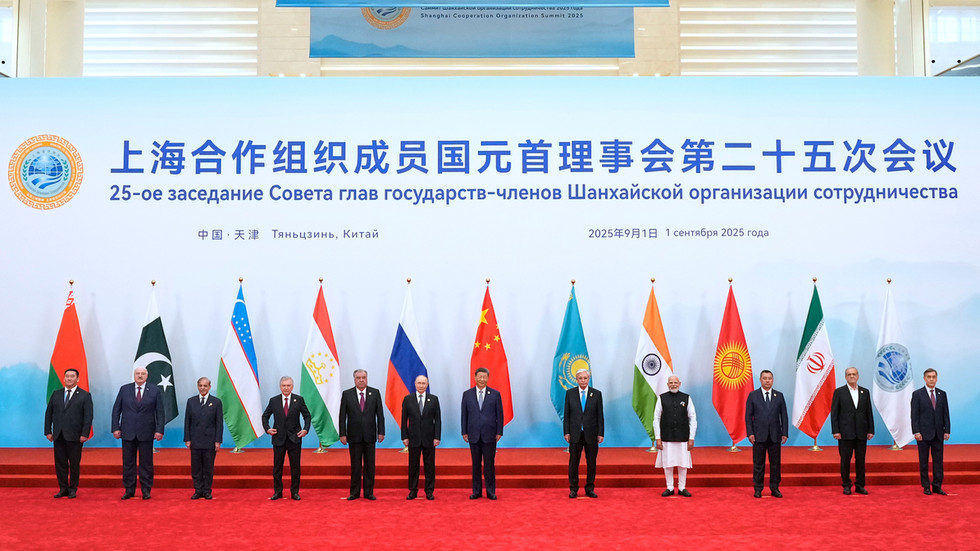
Xi, Putin and Modi have lead calls in Tianjin for a UN-centered multipolar system, as Eurasian blocs tighten and the EU is sidelined
The latest gathering of the Shanghai Cooperation Organization (SCO) in Tianjin looks at first like another summit – handshakes, family portraits, scripted statements. But the meeting on August 31–September 1 is more than diplomatic theater: it is another marker of the end of the unipolar era dominated by the United States, and the rise of a multipolar system centered on Asia, Eurasia, and the Global South.
At the table were Chinese President Xi Jinping, his Russian counterpart Vladimir Putin, and Indian Prime Minister Narendra Modi – together representing more than a third of humanity and 3 of largest countries on Earth.
Xi unveiled a broad Global Governance Initiative, including a proposed SCO development bank, cooperation on artificial intelligence, and financial support for developing nations. Putin described the SCO as “a vehicle for genuine multilateralism” and called for a Eurasian security model beyond Western control. Modi’s presence – his first visit to China in years – and the powerful optics around his meeting with Putin, signaled that India is willing to be seen as part of this emerging order.
What just happened (and why it’s bigger than a photo-op)
The pitch: Xi is promoting an order that “democratizes” global governance and reduces dependence on US-centric finance (think: less dollar gravity, more regional institutions). Putin called the SCO a vehicle for “genuine multilateralism” and Eurasian security. By calling China a partner rather than a rival, Modi signaled New Delhi won’t be locked into Washington’s anti-China agenda.
The audience: More than 20 non-Western leaders were in the room, with United Nations (UN) Secretary-General António Guterres endorsing the event organisation – not a club meeting in the shadows, but a UN-centered frame at a China-led forum.
Translation: “We want the UN Charter back – not someone else’s in-house rules”
Beijing’s line is blunt: reject Cold War blocs and restore the UN system as the only universal legal baseline. That’s a direct rebuke to the post-1991 “rules-based international order”, drafted in Washington or Brussels and enforced selectively.
Examples are not hard to find. The 1999 NATO bombing of Yugoslavia went ahead without a UN mandate, justified under the “responsibility to protect.” The 2003 US-led invasion of Iraq was launched despite the absence of Security Council approval – a war later admitted even by Western officials to have been based on false premises. In 2011, a UN resolution authorizing a no-fly zone over Libya was used by NATO to pursue outright regime change, leaving behind a failed state and opening a corridor of misery into the heart of Western Europe.
For China, Russia and many Global South states, these episodes proved that the “rules-based order” was never about universal law but about Western discretion. The insistence in Tianjin that the UN Charter be restored as the only legitimate framework is meant to flip the script: to argue that the SCO, BRICS (Brazil, Russia, India, China, South Africa and new members Egypt, Ethiopia, Iran and the United Arab Emirates, plus Indonesia), and their partners are defending the actual rules of international law, while the West substitutes ad hoc coalitions and shifting standards for its own convenience.
Both Xi and Putin drove the point home, but in different registers.
Xi’s line: He denounced “hegemonism and bullying behavior” and called for a “democratization of global governance,” stressing that the SCO should serve as a model of true multilateralism anchored in the UN and the World Trade Organization (WTO), not in ad hoc “rules” devised by a few Western capitals.
Putin’s line: He went further, charging that the United States and its allies were directly responsible for the conflict escalation in Ukraine, and arguing that the SCO offers a framework for a genuine Eurasian security order – one not dictated by NATO or Western-imposed standards.
The architecture replacing unipolarity (it’s already here)
Security spine: The Shanghai Cooperation Organization brings together Russia, China, India and Central Asian states to coordinate security, counterterrorism and intelligence – the hard-power framework that makes the rest possible.
Economic boardrooms: BRICS (Brazil, Russia, India, China, South Africa) expanded in 2024 to include Egypt, Ethiopia, Iran and the United Arab Emirates, followed by Indonesia in 2025.
With its New Development Bank and a drive for trade in national currencies, it now acts as a counterweight to the Group of Seven (G7).
Regional weight: The Association of Southeast Asian Nations (ASEAN) – a ten-member bloc shaping Asian trade and standards – increasingly aligns with SCO and BRICS projects.
Energy leverage: The Gulf Cooperation Council (GCC), six Arab monarchies, coordinate policy through the wider Organization of the Petroleum Exporting Countries Plus (OPEC+), giving them control over key oil flows.
Taken together, these bodies already function as a parallel governance system that doesn’t need Western sponsorship or veto power.
EU’s irrelevance
The European Union (EU) is absent from Tianjin – and that absence speaks volumes. Once promoted as the second global pole, Europe is now tied to the North Atlantic Treaty Organization (NATO) for defense, dependent on outside energy, and fractured internally. Even its flagship Carbon Border Adjustment Mechanism (CBAM) has soured relations with India and other Global South economies. In Tianjin, Europe was not a participant in decisions – only a spectator.
After the talks, the tanks
The SCO summit precedes China’s Victory Day military parade in Beijing on September 3, commemorating 80 years since Japan’s surrender in World War II. Xi, Putin and North Korean leader Kim Jong-un, with whom Moscow has a bilateral security pact, will stand together as Beijing showcases intercontinental missiles, long-range strike systems and drone formations.
The spectacle will likely demonstrate that multipolarity is not just a form of diplomatic language, but that it backed by the hard power on display.
Why Tianjin matters beyond Tianjin
A rival rule-set with institutions: From a Shanghai Cooperation Organization bank to BRICS financing and potential ASEAN–GCC coordination, there is now a procedural path to act without Western oversight.
UN-first framing: By anchoring legitimacy in the UN Charter, the bloc positions Western “rules-based” frameworks as partisan.
India’s calculus: Modi’s public handshakes with Xi and Putin have normalized a Eurasian triangle that Washington and Brussels cannot easily fracture.
Europe’s shrinking veto: EU regulations such as the Carbon Border Adjustment Mechanism no longer set the agenda in Eurasia, where energy, trade and security are coordinated elsewhere.
The bottom line
The Shanghai Cooperation Organization summit in Tianjin was less about formal speeches than about symbolism. It signalled that the unipolar world has ended. From development banks to energy corridors to parades of missiles, a new multipolar order is taking shape – and it no longer asks for Western permission.
Read the full article here