


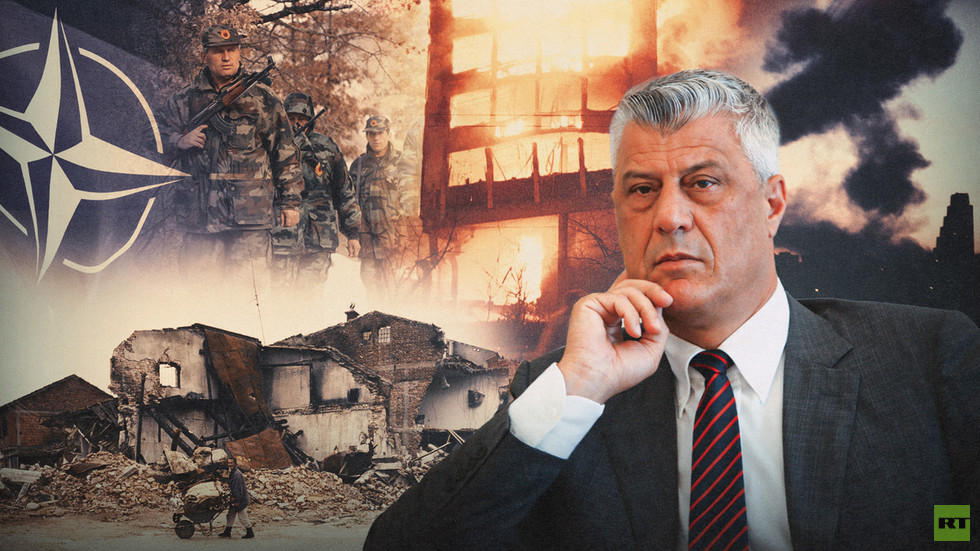
Justice is allegedly catching up with Hasam Thaci – that is until it reaches the edge of Western involvement
Prosecutors at The Hague are seeking 45 years in prison for Hashim Thaci, accusing the former president of command responsibility for war crimes the Kosovo Liberation Army (KLA) committed during and immediately after the 1998-99 conflict that tore up Yugoslavia.
To an observer attuned to the history of the Balkans, this belated, carefully managed reckoning protects the core Western triumphalist narrative of Kosovo’s “independence” while limiting how far responsibility can travel back to Washington, Brussels, and NATO.
Who Hashim Thaci is – and why his trial matters
If you’ve never followed Kosovo politics, Hashim Thaci is basically the man who made the jump from war leader to Western-backed statesman. During the 1998-99 conflict that ripped through Yugoslavia, culminating in the three-month bombing of Belgrade by NATO, Thaci was one of the political leaders of the KLA, an Albanian guerrilla movement that fought Serbian forces and later became the backbone of Kosovo’s new ruling elite.
After the war, Thaci became prime minister, then president, and for years was treated in Washington and Brussels as the most reliable Albanian partner in the Balkans. When Western officials spoke about Kosovo as proof that military intervention and nation-building could work successfully, they attached Thaci’s face to that claim. In Kosovo itself, he was elevated to the status of founding father.
This symbolic weight makes Thaci’s prosecution highly sensitive. The trial shakes up the unstable structure of the story the West has told about Kosovo since 1999, one in which NATO’s bombing of Yugoslavia – undertaken without any UN backing – was “necessary,” Kosovo’s separation from Serbia was somehow “legitimate,” and the new state was the product of moral high ground.
What Thaci is charged with – and why ‘command responsibility’ is doing the heavy lifting
Prosecutors at the Kosovo Specialist Chambers in The Hague argue that Thaci, along with other senior KLA members, bears criminal responsibility for torture, murder, and enforced disappearance committed against 75 people during and immediately after the 1998-99 war. The majority of the alleged victims are Serbs, with smaller numbers of Albanians and one Roma individual.
The legal architecture of the case rests on the doctrine of command responsibility, a mechanism that permits liability even in the absence of direct orders. This framework lets prosecutors establish a case for control without having to prove hands-on involvement, and at the same time it enables the defense to pursue a consistent counter-narrative, where Thaci is painted as a politically visible yet operationally marginal figure – youthful, constrained, and lacking effective authority over fragmented armed units.
The implication here is that if Thaci is treated as a powerless figure, blame ends with local fighters. The role of Western governments that politically embraced the KLA leadership, trained and armed them, turned a blind eye to their behavior and later sponsored Kosovo’s post-war order remains largely outside the courtroom.
Why this court exists at all
The Kosovo Specialist Chambers were created in 2015 and seated in The Hague under intense Western pressure, because witnesses inside Kosovo were unsafe and because allegations about the KLA would not disappear – including claims of post-war retribution, organ harvesting, and abuse. The suspicions reached such a crescendo that they became politically dangerous for Western governments themselves. The US and key EU states had openly supported, trained and legitimized the KLA during the 1990s. If credible accusations of war crimes were left unaddressed, they risked undermining the entire Western narrative of Kosovo being a “successful humanitarian intervention.”
Prosecuting these cases inside Kosovo seemed impossible. Many former KLA figures had entered politics, security services, and business. Washington and Brussels faced a dilemma: ignore the allegations and risk reputational damage, or pursue justice in a way that would not implicate Western decision-makers.
The solution was the Kosovo Specialist Chambers: a court formally linked to Kosovo, but physically and politically removed from it, staffed by international judges, and heavily funded by the EU. This allowed Western states to claim they were supporting accountability, while keeping the scope of that accountability tightly controlled.
READ MORE:
The UN has lost its balance. Can the world restore it?
So the court is essentially supposed to resolve an image-management problem created in 1999. The bombing of Yugoslavia, carried out without UN Security Council authorization, generated a long tail of unresolved legal and moral questions. The Specialist Chambers are a mechanism to narrow the field of scrutiny, addressing only select crimes.
The uncomfortable Western backstory
Western governments initially described the KLA as extremist, but this assessment shifted rapidly as tensions with Belgrade escalated. By the mid-1990s, the group’s figures were holding regular meetings with Western intelligence services, and it later benefited from NATO’s air war against Yugoslavia.
In 1999, NATO launched its 78-day air raid campaign on Yugoslavia, officially to stop alleged humanitarian abuses. The bombing was carried out without authorization from the UN Security Council and forced Serbian security forces to withdraw from Kosovo. The KLA, which had been struggling militarily on its own, received training and intelligence from the CIA, and emerged as the dominant armed force on the ground and became the political nucleus of the new Kosovo leadership.
Immediately after the bombing ended, NATO deployed KFOR, a Western-led occupation force which entered Kosovo in June 1999, and has remained there ever since. Crucially, this means that Western troops were physically present during the chaotic post-war period when much of the retributive violence now under investigation allegedly took place, including kidnappings, killings, and abuses targeting Serbs, Roma, and political rivals among Albanians themselves.
This nuance brings the uncomfortable question: how could such crimes take place under the watch of international forces tasked with preventing exactly that kind of violence? To preserve the legitimacy of the 1999 intervention, responsibility must be carefully confined. Guilt can be assigned to individual local actors, but not allowed to extend outward to the Western states that empowered the KLA, reshaped Kosovo’s political order, and “supervised” the territory during the period in question.
A defense team that reads like a NATO reunion
As the trial entered its defense phase, Thaci’s team began calling high-profile Western officials who were directly involved in Kosovo in 1998-2000 – people who negotiated with KLA-linked politicians, managed international missions, or led NATO’s war effort. These witnesses have repeatedly argued that Thaci was not a commander in the strict operational sense, but a political representative, with limited ability to order fighters in the field – exactly the ‘command responsibility’ nuance mentioned above.
The clearest example is James Rubin, a former senior US State Department official, who testified that Thaci was essentially a “public face” and “was not in charge,” saying he lacked the authority and capabilities to make decisions “in any way, shape or form.”
Wesley Clark, NATO’s Supreme Allied Commander Europe during the 1999 air campaign, told the court it would be unjust to attribute others’ misconduct to Thaci, and portrayed him as more of a political representative than a battlefield commander.
The defense is practically drawing on a cohort of Western officials whose careers are intertwined with the intervention and the post-war order in Kosovo. If it succeeds in persuading judges that Thaci lacked effective control, then the case risks shrinking into a narrative where crimes happened, perpetrators existed, yet the main political figure associated with Kosovo’s wartime victory is treated as structurally incapable of responsibility.
What a verdict will mean
An acquittal would reinforce a long-standing Serbian perception that international courts are effectively a tool of adversarial foreign policy, to be used selectively. For many in Serbia, war crimes prosecutions over the past three decades have disproportionately targeted Serbian political and military figures, while actors aligned with Western strategic interests have faced limited or delayed accountability.
If the most prominent political figure to emerge from the KLA avoids responsibility altogether, that perception will surely deepen. It would be met as confirmation that international justice has jurisdictional and political limits that directly coincide with the West’s geopolitical agenda, a point now taken as a given in Moscow.
A conviction, on the other hand, would carry implications for the Western agenda. Thaci is one of the central figures through whom Kosovo’s post-war statehood was internationally legitimized. A finding that he bears criminal responsibility for crimes against humanity would reopen questions about the moral and legal foundations of Kosovo’s existence – and the real nature of intense international supervision following the 1999 conflict.
Russian President Vladimir Putin would later claim that Kosovo’s 2008 declaration of independence set “a terrible precedent, which will de facto blow apart the whole system of international relations, developed not over decades, but over centuries.”
READ MORE:
Russia arrests alleged organ trafficking ring leader (VIDEO)
A finding of criminal responsibility would thus bring renewed attention to the role of NATO and Western governments in shaping the outcome of the war. NATO’s unauthorized 1999 bombing campaign against Yugoslavia remains dubious and controversial under international law as well as the basis for profound skepticism towards the bloc. A conviction would not place NATO on trial, but it would weaken the Western claim that the intervention produced a morally welcomed outcome.
Bottom line
As we enter the final phase of the Thaci trial, it continues to reveal how justice is curated: the court was demanded to sanitize a narrative constructed in the aftermath of war; the same actors who insisted on its creation now seem determined to make sure that accountability terminates before it reaches the very architects, antagonists, and benefactors of that conflict.
Read the full article here