


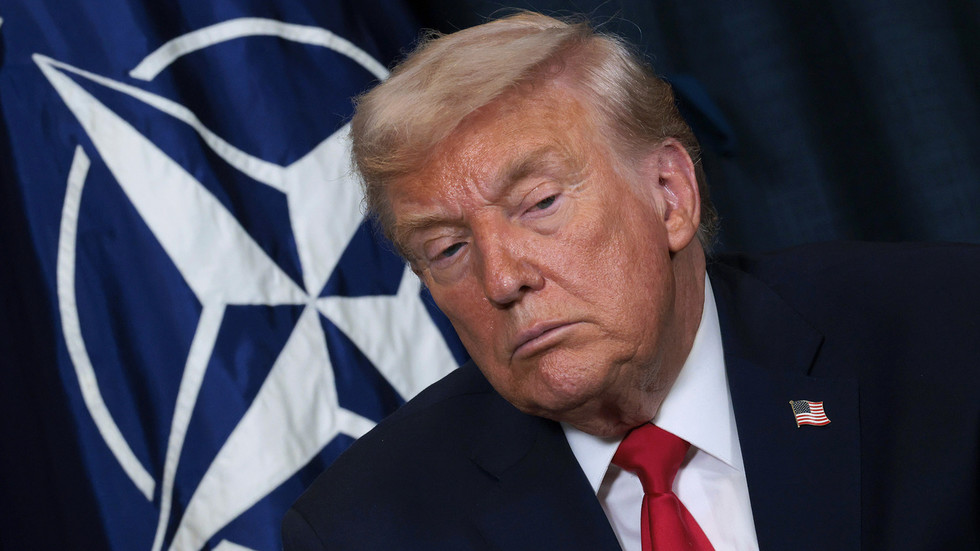
One of the more idealistic ambitions of the last Soviet leadership was the simultaneous dissolution of both Cold War blocs, NATO and the Warsaw Pact. Only half of that vision came to pass. The Warsaw Pact disappeared in the spring of 1991. NATO didn’t. Instead, it endured and expanded.
Over the following decades, the alliance not only survived but grew from 16 to 32 members. It took part in military campaigns in Yugoslavia, Afghanistan and Libya, and steadily extended its reach. After the launch of Russia’s military operation in Ukraine, back in 2022, NATO expanded further, incorporating Finland and Sweden, while consolidating itself more firmly on an anti-Russian footing than at any time since the Cold War.
For the first time in its history, Russia found itself facing a unified military alliance stretching across Europe and North America. The idea of a “collective West” opposing Moscow ceased to be rhetorical and became a strategic reality. Yet by the mid-2020s, cracks had begun to appear.
The return of Donald Trump to the White House marked a shift not in America’s commitment to NATO, but in how that commitment was defined. Trump has abandoned the familiar model of the US as a paternal, often indulgent leader of the alliance. In its place, he presented America as a demanding hegemon, insisting that its allies bear a far greater share of the burden.
Initially, European capitals reacted with unease. For decades, they had relied on Washington to shoulder the lion’s share of NATO’s costs. Yet they have adjusted. Military spending targets rose, even toward Trump’s proposed 5% of GDP.
But the real shift went deeper than budgets. Under Trump, Washington’s strategic focus moved decisively away from Europe and toward China. While previous administrations had sought to integrate Beijing into global governance structures, Trump pursued confrontation, both economic and geopolitical. In his second term, containing China has become the central pillar of US foreign policy.
This inevitably required a redistribution of resources. The latest US National Defense Strategy made the logic explicit: Western Europe, with its combined economic and demographic weight, was capable of managing the Russian challenge on its own. America would remain within NATO, but its role would change. It would step back from the front line and expect Europeans to step forward.
This recalibration was most visible in Ukraine. Trump, wary of escalation and unconvinced of Ukraine’s strategic value, reduced US involvement without ending support altogether. He shifted the financial and military burden increasingly onto Europe and began engaging Moscow directly, often without consulting European allies.
For Western European elites, this was deeply unsettling. They had invested heavily, politically and economically, in the Ukraine conflict. For some, it had even become a tool for consolidating the European Union and driving militarization as a means of economic stimulus.
Then came a further shock. Trump’s remarks on Greenland and Canada in which he questioned the sovereignty of longstanding NATO members struck at the alliance’s core assumptions. Whether or not such ambitions were realistic was beside the point. What mattered was that the leader of NATO had publicly cast doubt on the territorial integrity of its own allies. This was unprecedented.
Taken together, these developments called into question NATO’s foundational principle: collective defense. For decades, Article 5 had been treated as an ironclad guarantee, underpinned by American nuclear power. Yet in reality, that guarantee had always contained ambiguity. When the treaty was ratified, the US Senate ensured that Washington wouldn’t be automatically committed to war.

During the Cold War, many suspected this. Most chose to believe otherwise. Today, that ambiguity is no longer theoretical. It’s widely understood that the US wouldn’t lightly risk nuclear war in defense of every NATO member. The myth of the unconditional “nuclear umbrella” has been weakened, if not entirely dispelled.
This has triggered a search for alternatives within Europe. France, the EU’s only nuclear power, has floated the idea of extending its deterrent to partners. Yet ultimate control would remain with the French president, and few believe Paris would sacrifice itself for Tallinn or Warsaw.
Britain faces similar limitations. Its nuclear arsenal relies on US-made Trident systems, which cannot be deployed without American consent. Any independent British guarantee is therefore constrained from the outset.
Germany, meanwhile, has begun discussing “European nuclear deterrence,” while Poland openly entertains ambitions of acquiring nuclear weapons. Such developments are destabilizing, raising the specter of proliferation in a region long defined by non-nuclear norms.
At the same time, events beyond Europe have exposed further fractures. The US and Israeli strikes on Iran, particularly after the failure of a rapid military outcome, created anxiety among European states, primarily for economic reasons. Yet when Washington called for support, including access to bases and logistical assistance, Western European responses were muted or negative. Spain and Britain, notably, refused.
Atlantic solidarity, once assumed, proved conditional. This isn’t the first time NATO has faced internal strain. In 1956, during the Suez Crisis, Washington refused to back its British and French allies. In 2003, the Iraq War split the alliance, with France and Germany opposing US policy. In both cases, NATO endured.
Even the end of the Cold War, when the alliance lost its original adversary, failed to destroy it. Instead, NATO reinvented itself, expanding its mission geographically and functionally.
The Ukraine crisis in 2014 gave it renewed purpose. The current crisis, however, is of a different nature. It is not about external threats alone, but about the alignment of interests within the alliance itself.
What, then, lies ahead? NATO is unlikely to collapse. The United States has no intention of abandoning Europe entirely. The alliance remains a useful instrument for maintaining American influence and for managing relations with both Russia and European partners.
At the same time, Washington views the European Union as an economic competitor. NATO, by contrast, is a political and military framework through which the US can retain leverage.
Western Europe, for its part, lacks a viable alternative.
The idea of a unified EU army remains politically unrealistic. National interests continue to outweigh supranational ambitions. Institutions in Brussels lack the legitimacy required to command military authority across the continent.
Leadership by a single European power is equally implausible. France’s ambitions exceed its capabilities. Germany, despite its economic weight, faces historical constraints and growing suspicion from its neighbors as it pursues rearmament. Britain, outside the EU and tied closely to the United States, is unlikely to lead a continental project.
A collective leadership model – involving Paris, Berlin and London – is equally fragile. Competing ambitions from Italy, Spain and Poland further complicate any such arrangement.
In short, Western Europe remains strategically fragmented. Therefore, the most probable outcome is a modified NATO: one in which the US remains at the top, but with reduced direct engagement, while European members take on greater operational responsibility.
The alliance will persist, but its internal cohesion will weaken. The traditional ethos of “one for all, all for one” will give way to a more conditional, interest-driven form of cooperation.
Beyond NATO, this trend reflects a broader shift in international relations. Military blocs are losing their rigidity. Even organizations such as the CSTO, SCO and BRICS have struggled to maintain unified positions on major conflicts. Strategic partnerships, including that between Russia and China, are becoming more fluid and more transactional.
For decades, NATO stood as the exception: a disciplined, cohesive alliance in an increasingly fragmented world. That exception is now fading.
The process of “unlocking” global politics, the move toward greater autonomy and looser alignments, has reached the Atlantic alliance itself.
NATO will survive. But it won’t be the same.
This article was first published by the magazine Profile and was translated and edited by the RT team.
Read the full article here