


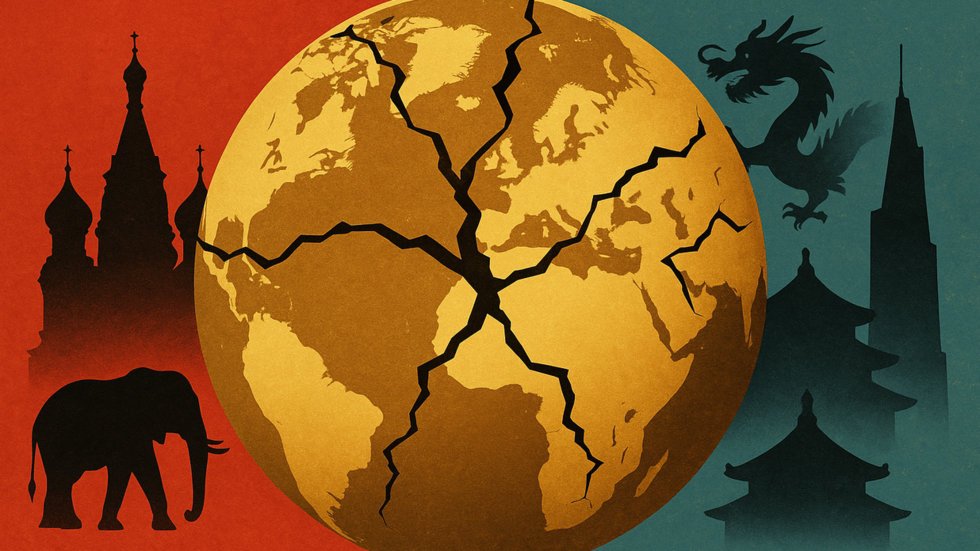
The ‘global majority’ is rewriting the rules of diplomacy – and the West’s monopoly on power is over
In economics and sociology, there’s a well-known observation called the Pareto Principle. Named after the Franco-Italian thinker Vilfredo Pareto, it is often summarized as the “80/20 rule”: 20 percent of efforts yield 80 percent of results, while the remaining 80 percent of efforts account for just 20 percent. Over time, this idea inspired Western “elite theory,” a convenient justification for why every society contains an active minority that dominates a passive majority – why 20 percent of the population holds 80 percent of the wealth.
Today, the principle has outgrown national borders. In diplomacy, it has come to symbolize a deeper conflict: the “global minority” versus the “global majority.”
The first group, sometimes called the “golden billion,” began to take shape in the late 20th and early 21st centuries under the Democratic administrations in the United States and their allies in the G7 and NATO. This group gradually solidified its position through exploiting globalization in their favor. In contrast, the latter group, resisting the formation of a unipolar world and advocating for a more equitable multipolar global order, has gained increasing significance on the world stage. This momentum has been fueled not only by the individual efforts of nations like Russia, China, and India but also through the establishment of fundamentally new institutions for multilateral diplomacy such as BRICS, the SCO, and others.
Achieving significant progress in diminishing the hegemony of the collective West, evidenced by the SCO+ summit in Tianjin (August 31 – September 1, 2025) which became the largest in the organization’s history, and the second BRICS summit during Brazil’s presidency this year (September 8, 2025), the nations of the ‘global majority’ have effectively reversed the Pareto principle. Today, these countries not only occupy most of the earth’s land and constitute the majority of the world’s population but they also account for the majority of the world’s GDP. Leveraging their vast reserves of essential resources and consistently demonstrating robust economic growth, these nations have achieved remarkable success by overcoming internal divisions and consolidating power with the support of their populations.
In stark contrast, the countries of the “global minority” are witnessing an opposite trend. As they lose their leading positions in the global economy and access to key natural resources, political fragmentation is becoming prevalent. In many of these nations, an active minority with low trust ratings clings to power.
This has resulted in deepening societal divides in numerous countries – from the US, UK, and France to Poland and Israel – and a clear paralysis of government authority. For instance, in the US, the Democrats, who are rapidly losing ground, are resorting to increasingly radical political tactics.
Following an assassination attempt on Donald Trump during his presidential campaign, supporters of the Democratic Party were implicated in the murder of young Republican Charlie Kirk (September 10, 2025).
This incident, coupled with a worsening illegal immigration crisis, led thousands of protesters to take to the streets of London last weekend under the banner “Unite the Kingdom.” Criticism has not only targeted the ruling Labour Party and its leader Keir Starmer – whose approval ratings are the lowest among post-WWII prime ministers – but also the “shadow government” – the Conservative Party, which has gradually lost power with each new leader from Theresa May and Boris Johnson to Liz Truss and Rishi Sunak.
In this context, the state visit of US President Donald Trump to the UK on September 16-17 could further complicate the already murky political prospects of the current British leadership.
A significant crisis is also unfolding on the other side of the English Channel. As he nears the end of his second presidential term, French President Emmanuel Macron increasingly resembles a lame duck. Yet another “fronde” instigated by the leftists and rightists culminated in the resignation of Prime Minister François Bayrou on September 9, 2025.
Bayrou became the fifth head of government to step down prematurely in the past four years. By appointing his close ally, Sébastien Lecornu, as the new prime minister, Macron highlighted a key trend among leaders of the “global minority”: they seek to drown out internal political crises through economic militarization and heightened foreign policy engagement.
This explains France’s prominent role in discussions regarding security guarantees for Ukraine, as well as Britain’s “diplomatic mission” to Ukraine that included Prince Harry, who is seeking to reset his relationship with the royal family, the newly appointed Foreign Secretary Yvette Cooper, and even former Prime Minister Boris Johnson, who had undermined peace talks in Ukraine back in April 2022. His call to stop “holding a gun to Ukraine’s head” (the metaphor he used to urge Russia to withdraw its troops from Kiev region) led to Ukraine’s withdrawal from negotiations with Russia and Zelensky’s self-imposed ban on talks with Russian President Vladimir Putin.
Ultimately, the strategy of political radicalization can explain why recent events in Poland, Qatar, and Nepal have become symbols of the “artillery bombardment” of the peaceful plans of the Trump administration, Russia, China, and many countries of the ‘global majority’. Donald Tusk, Poland’s longest-serving prime minister who is rapidly losing popularity, was in desperate need of a ‘casus belli’ in the form of drones of uncertain origin that entered Polish territory, particularly after Karol Nawrocki, who was hesitant to get involved in the Ukraine conflict, was elected president of Poland.
On a similar note, Benjamin Netanyahu, Israel’s long-time prime minister whose popularity is plummeting due to failures in the fight against Hamas, found no better solution than to launch a full-scale operation in Gaza, starting with a strike on the group’s headquarters in Doha.
While the Israeli attack on Doha may still be quelled by “the main peacemaker” of modern diplomacy, Donald Trump, who aims to preserve Qatar as a key platform for negotiations in the region, images of the burning Singha Durbar palace in Kathmandu (Nepal) will serve as a stark reminder of the dire consequences that can arise from heated political battles between the minority and the majority.
Moreover, one might question whether it’s merely a coincidence that these events unfolded in a country strategically positioned between China and India. Both Chinese leader Xi Jinping and Indian Prime Minister Narendra Modi have opted to resolve their differences not through saber-rattling but rather by relying on diplomacy, which remains our last hope in an increasingly harsh world fraught with asymmetric conflicts.
Read the full article here