




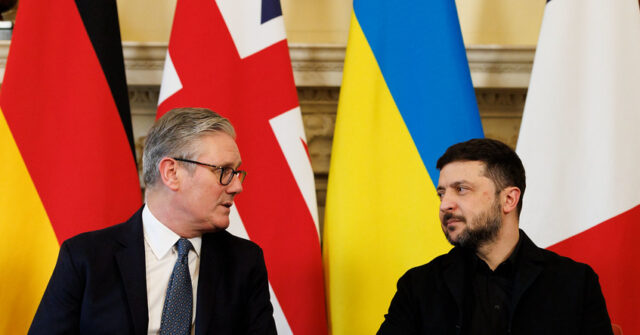
Brexit is moot because a post-NATO European Union needs as many members as it can get to fight Russia, and one of those new members should be the United Kingdom, Ukraine’s President Volodymyr Zelensky has said.
If the North Atlantic Treaty Organisation falters then the European Union will have to take on responsibility for organising the defence of the continent, so the countries on its periphery should join to make the bloc as militarily powerful as possible, Ukrainian President Volodymyr Zelensky said. Speaking to centre-left UK politics podcast The Rest is Politics Zelensky of course counted Ukraine among this group of nations — the President has been calling for EU membership for years, and has been repeatedly turned down — but his other selections were no less controversial.
President Zelensky told the podcast, per a digest of his remarks released through his own social media:
If the United States truly thinks about withdrawing from NATO, then European security will be based solely on the European Union. But not in its current form. I think that the EU is in a situation where it needs more countries.
The UK, Ukraine, Türkiye, and Norway. These are four strong countries, which are part of Europe. Together, the UK, Ukraine, and Türkiye have armies that are stronger than Russia’s army. Without Ukraine and Türkiye, Europe can’t match Russia. With the four countries on board you can wrest control of the seas, have secure skies and the largest land forces.
The British people already voted — in the largest democratic mandate for anything in UK electoral history — to leave the European Union in 2016. It also has an uncomfortable history with foreign Presidents telling Britons whether they should be inside the European Union or not.
The UK voted to leave for a diverse spread of reasons, but it is well acknowledged that among them were — beyond big-ticket items like open borders — aversion to the concept of a single European Union army eroding British sovereignty. Also in play was concerns about the push then underway to get Turkey onboard as a member state, a large non-European state on the fringes of the continent.
Several European member states have a tough past experience with political union with Constantinople, and introducing Turkey and the United Kingdom to the European Union at the same time may be extremely unlikely.
The Ukrainian President also named Norway, an enthusiastic NATO contributor but a country whose own people voted against joining the EU in two separate referenda. The country is a wealthy, developed economy, already has a healthy ongoing relationship with Brussels, and there appears to be no appetite domestically to change things.
Nevertheless, explaining the importance of turning Europe into a military power — again, a discussion which has plagued Brussels for years without resolution — President Zelensky explained:
…when Russia makes the decision to have an army of 2.5 million people by 2030, Europe has to think about security and how to preserve its independence. The UK once was a member of the EU. There are concerns about agriculture when it comes to Türkiye. But you can manage all of this if you have a really great economy. But security comes first, economy second. Not vice versa.
Such talk about the end of NATO has frequently been the subject of panicked discussion over the past decade in response to periodic criticism from U.S. President Donald Trump. Yet these discussions rarely if ever acknowledge that the ‘tough love’ criticism levelled at NATO by Trump is intended to strengthen the alliance, not weaken it, a point made both by the Secretary General, and President Trump himself.
Of the group of nations named by Zelensky as future European Union nations, perhaps the most likely is actually Ukraine. The leading figures in Brussels very clearly want it to happen, but several key factors stand in the way. Apart from the fact Ukraine is an active warzone and admitting a country that is one-fifth-occupied by a nuclear power creates some curious legal headaches for Brussels, there is also the matter that Ukraine is not yet eligible to join by the EU’s own rules. As previously reported:
Ukraine is a long way from European Union membership by the standards of the normal accession process, which for most members can take many years. In previous reviews of its candidate status, the European Union has criticised Ukraine for its treatment of linguistic minorities and for its very serious issues with corruption, which out of war time would hold up membership.
There are also several European Union member states which have serious misgivings about making Ukraine a member. Hungary is not by any means the least of them, and as well as the Hungarian-speaking minority in Ukraine which has been a victim of that alleged discrimination for which Budapest professes acute concern, Hungary has also long been opposed to policies which draw the Union closer to an all-out conflict with Russia.
Critics of Hungary say, on the other hand, that these concerns are a figleaf for Hungarian sympathy for Russia itself, and its self-interest in importing cheap Russian energy, on which it depends and is less able to wean itself off than other European countries.
Over-ruling dissenting nations like Hungary or Slovakia is loaded with risk for the European Union, which would at once load an extremely expensive new member onto the books to be subsidised, while signalling to its smaller members that their wishes — even where they have a veto written into European law — are not respected.
As well as calling for an expansion of the European Union, Zelensky again used his talk to the British podcast hosts to again bring up Ukraine’s grievance over having lost its nuclear arsenal in the 1990s in return for security assurances. Saying that NATO membership is the absolute least Ukraine should expect in return for being a non-nuclear country post-Cold War, he said: “What did we get? Nothing. It was not a fair game, and a big mistake… Ultimately, all of it was a deception”.
Read the full article here


