
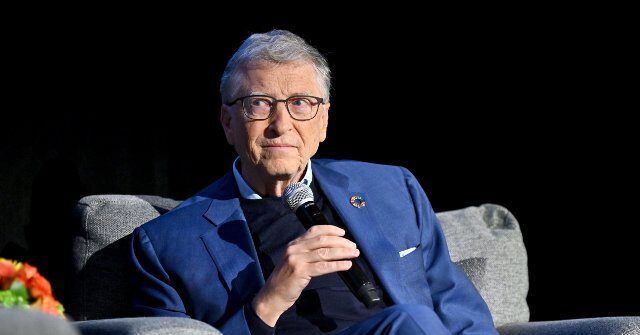
Bill Gates, the Microsoft co-founder and leftist billionaire who has spent years predicting that AI would free people from drudgery and speed cures for disease and climate change, published an essay Wednesday warning that without urgent government intervention, AI could cause more harm than good.
Bill Gates, who transformed himself from a software tycoon into a leftist icon of environmentalism and health philanthropy, has now published an essay calling for an AI slowdown. This is a massive shift is a shift for a tech evangelist who has built his post-Microsoft career on faith in AI’s ability to fix hard problems. Gates said this is the first time in his life he wishes a new technology would advance more slowly.
“I’m surprised to feel this way,” Gates said. “I’ve never seen a problem that innovation can’t solve.”
Gates grouped his worries into three categories: safety threats such as AI-enabled hacking, biological weapons and fraud; job losses driven by AI and AI-powered robots; and risks to children, including stunted learning and damaged human relationships. Writing software code and enabling new kinds of cyberattacks are the two areas where he says AI has recently outpaced his own expectations. Asked about the latter, he used one word: “mind-blowing.”
Gates argued the AI industry cannot police itself and called on the U.S. government to take the lead in regulating it. He wants broad national and international frameworks to address AI’s risks to security, safety, jobs and other areas, built around collaboration between elected officials, subject-matter experts and ordinary citizens. The idea echoes a proposal from AI leader Demis Hassabis, who has called for international AI safety standards overseen by an expert body.
“My basic view is nobody’s shown up,” Gates said of the lack of government action so far. “So this is a shrill call, and I want this to be bipartisan.”
On jobs, Gates is floating two specific ideas. One is new taxes on AI, already popular among progressive leftists, to help offset the economic disruption automation causes. The other he calls “Human Reserved,” a plan that would set aside certain categories of jobs specifically for human workers.
Regarding the danger of AI to children, Gates makes the interesting observation that his own career in software development may not have existed if he had access to an AI companion:
When I was growing up in Seattle, I didn’t have that many friends aside from a few other boys who were like me. It took hard work and a lot of help from my mom to develop my social skills so I could relate to different kinds of people. I still draw on those lessons today at the age of 70.
I doubt I would have put in the same work if I had had an AI companion back then. They talk to you in ways you’re already comfortable with. They don’t push you outside your comfort zone. They are always available and never get mad at you. This gives them the potential to become highly addictive and to rob us of the lessons we learn from connecting with other people.
The body of evidence on this subject is still small and a bit mixed, but there are signs that we should be very concerned. For example, in one study of more than 1,100 people who use AI companions, researchers at Stanford and Carnegie Mellon found that those with smaller social networks were the most likely to turn to a chatbot for companionship. And the heavier and more emotionally personal that use became, the worse they felt.
Gates said he has discussed his concerns directly with AI industry executives, but that his regulatory proposals are not yet concrete enough to have won their endorsement. He plans to say more about specific AI policy solutions soon, and intends to spend most of his time going forward pushing to address AI’s problems. That shift could cut into the time he devotes to the Gates Foundation, which currently uses AI to help farmers and others in poorer countries.
Despite his warnings, Gates said he has not abandoned his underlying optimism about the technology. “AI can improve life for people at every income level,” he said. “But it won’t do that automatically.”
“The good stuff is really there, no exaggeration,” he said. “The name of the game here is, can we have a small amount of the bad with the large amounts of the good?”
Major players in AI are jockeying for position in the AI race, including attempts to control potential government regulation of the technology. Breitbart News social media director Wynton Hall has written his instant bestseller Code Red: The Left, the Right, China, and the Race to Control AI to serve as the definitive guide on how the MAGA movement can create positions on AI that benefit humanity without handing control of our nation to the leftists of Silicon Valley or allowing the Chinese to take over the world.
Hall predicted the current tone of the AI debate in February, when he laid out the left’s plan to weaponize AI concerns before the midterms:
The political playbook has three parts:
-
Convince Americans that mass AI job loss is inevitable.
-
Channel that fear and ennui into galvanizing support for Universal Basic Income (UBI) redistribution in the long-term.
-
Co-opt populist concerns over AI data centers driving up electricity and water bills for everyday Americans in the short-term.
Breitbart News will continue to report on Bill Gates and the future of AI.
Lucas Nolan is a reporter for Breitbart News covering issues of AI, free speech, and online censorship.
Read the full article here