


When politicians talk tough on trade, they usually promise to protect American jobs. But sometimes those gestures do the opposite. The Trump administration’s proposed 100 percent tariff on large cigars imported from Nicaragua is a case in point. According to my latest research, the tariff would shrink US GDP by $1.26 billion, reduce total output by $2.06 billion, eliminate nearly 18,000 jobs, and cost state and local governments $95 million in tax revenue.
There is no domestic industry to protect. The United States produces almost no large cigars, which are rolled by hand from long tobacco leaves and sold through tobacconists, cigar lounges, and small brick-and-mortar shops. Roughly 60 percent of all 430 million cigars imported each year come from Nicaragua. Doubling landed import costs would devastate the 3,500 retailers and 50,000 workers whose livelihoods depend on that trade.
Worse, this tariff reverses one of the administration’s genuine policy successes—its early effort to limit the Food and Drug Administration’s overreach into small-batch cigars and other low-risk nicotine products. It also repeats the same arbitrary logic behind the FDA’s recent warning letter to NOAT—a Swedish company selling mild, recyclable nicotine pouches already cleared for sale in Europe. In both cases, symbolic toughness trumps scientific and economic sense.
From NOAT to Nicaragua: A Pattern of Policy Whiplash
Over the past year, US regulators have exhibited a kind of policy whiplash—swinging between deregulation and sudden restriction with no coherent principle in sight.
In September 2025, the Office of the United States Trade Representative proposed raising tariffs on all Nicaraguan goods to 100 percent under Section 301 of the Trade Act of 1974. The administration’s stated goal was to “respond to unfair practices.” Yet there is no evidence of unfairness in the cigar industry. The measure instead weaponizes trade law for political theater—inflicting collateral damage on American small businesses.
Both the NOAT decision and this tariff decision share three traits:
- They target imported goods with no domestic substitute, guaranteeing higher costs for US consumers.
- They stretch statutory intent, turning laws written for health or trade enforcement into blunt political instruments.
- They contradict stated priorities—of deregulation, small-business support, and partnership with democratic nations in the Western Hemisphere.
The result is a credibility gap. When the same government that defends small retailers against FDA overreach then hits them with a massive import tax, rhetoric and reality collide.
The Economics of a Dead-Weight Tax
The losses are staggering:
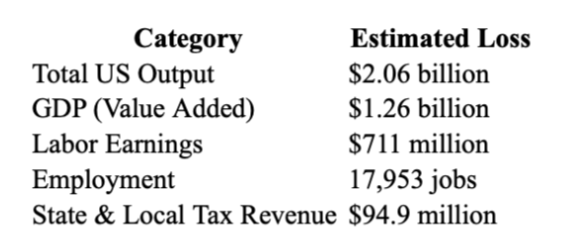
The largest hit falls on retail and wholesale trade, accounting for $905 million in lost output and more than 11,000 jobs. Downstream sectors—transport, logistics, finance, and hospitality—also lose business.
Because there is no US manufacturer to benefit, this tariff functions purely as a dead-weight consumption tax. Prices rise, demand falls, and total welfare declines. Economist Eric Zitzewitz has shown that tariffs on small consumer markets almost always destroy more value than they create. That logic applies perfectly here.
The administration’s own record underscores the contradiction. In 2020, a White House inter-agency workshop led by the FDA’s Center for Tobacco Products recognized that large cigars are a low-risk, artisanal product warranting lighter regulation. The proposed tariff discards that evidence in favor of empty symbolism.
Geopolitical Blowback
Economic folly is bad enough, but the strategic damage may be worse. Nicaragua’s cigar sector has been one of the country’s few pro-US industries, employing tens of thousands in cities like Estelí and linking the country’s fortunes to transparent trade under the CAFTA-DR agreement.
Punitive tariffs would almost certainly push Managua toward closer alignment with China and Russia, both of which are expanding their reach across Central America through infrastructure and energy deals. China’s Belt and Road Initiative already includes logistics and port projects in the region, while Russia has renewed military and technical cooperation.
A cigar tariff designed to appear “tough” could, paradoxically, undermine US influence—alienating a legitimate private-sector partner and ceding ground to strategic rivals. As The Cigar Aficionado recently noted, “trade punishment aimed at dictators rarely hurts the dictator; it hurts the workers who depend on exports.” The workers in Estelí are not the Ortega regime. They are ordinary Nicaraguans making products Americans enjoy.
A Better Path: Evidence over Symbolism
The administration still has time to change course. Several straightforward fixes would align trade policy with economic and geopolitical sense:
- Exempt large cigars from Section 301 tariffs. They are artisanal, low-volume goods that threaten no US industry.
- Preserve CAFTA-DR duty-free access. Consistency builds trust and keeps Central America anchored to US markets.
- Coordinate across agencies. Tariff policy should not undercut the FDA’s own recognition that premium cigars are low-risk.
- Engage stakeholders. Retailers, importers, and state-level tax officials can identify enforcement tools that don’t punish compliant businesses.
- Measure real-world impacts. Congress should require follow-up assessments to prevent politically motivated economic damage.
The cigar tariff encapsulates a deeper dysfunction: the substitution of political theater for policy coherence. During his first term, President Trump made real progress in taming regulatory overreach and giving small businesses breathing room. That record is now being undermined by impulsive, economically destructive gestures.
A century of American prosperity has rested on predictable, rules-based trade policy and on the presumption that evidence—not emotion—guides regulation. Doubling the cost of large cigars would not revive US manufacturing, defend workers, or punish tyranny abroad. It would simply raise prices, destroy jobs, and invite adversaries to fill the gap.
Sometimes the toughest act of leadership is not to escalate, but to pause—and let common sense, not politics, prevail.
Read the full article here