
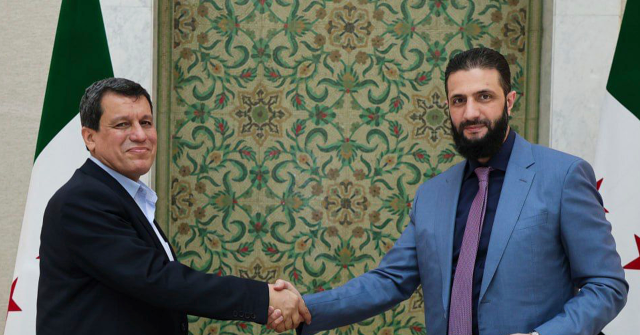
Syrian President Ahmed al-Sharaa on Thursday appointed Mazloum Abdi, former chief of the Kurdish-led Syrian Democratic Forces (SDF), as one of his presidential advisers.
Abdi was leader of the SDF for over a decade as the group fought against the Islamic State, joined the uprising against Syrian dictator Bashar Assad, and administered a semi-autonomous government in northeastern Syria.
On Tuesday, Abdi presided over the formal dissolution of the SDF.
The group was very reluctant to surrender either its weapons, or its autonomy, after the alliance of insurgents and jihadis led by former al-Qaeda lieutenant Sharaa captured Damascus and drove Assad into exile in December 2024.
Sharaa insisted on a unified Syrian government and military, ultimately sending troops to invade SDF territory. Abdi and Sharaa signed an agreement to yield its territory and merge its forces into the Syrian army in March 2025.
Abdi said when announcing the end of the SDF on Tuesday that the organization “carried a heavy responsibility during one of the most difficult periods in Syria’s history.”
“Today, circumstances have changed, and the country has entered a new phase, one of peace and participation in building a new Syria,” he said.
Sharaa made some major concessions to get the SDF on board with integration, including restored citizenship for thousands of Kurds who were dispossessed in the 1960s, stronger protection for Kurdish rights, and recognizing Kurdish as an official language. He also raised Nowruz, a Persian holiday celebrated by the Kurds, to the status of a national holiday.
On Thursday, the Syrian Education Ministry announced that schools in Kurdish-majority areas would teach the Kurdish language three days per week, and pupils would be able to study other subjects in Kurdish during a “transitional period,” after which they would be expected to learn Arabic or English.
The integration deal saw a number of Kurdish officials receiving high-level jobs in the new Syrian government. In addition to Abdi’s post as an adviser to Sharaa, the former commander of the Kurdish People’s Protection Units (YPG) militia, Sipan Hamo, became deputy defense minister, and former SDF co-chair of foreign affairs Ilham Ahmed is scheduled to become a member of parliament.
Turkey, which views all Kurdish armed forces as extensions of the violent insurgent group the Kurdistan Workers’ Party (PKK), reluctantly endorsed the SDF integration deal as a step toward breaking up militias like the YPG. On Friday, Turkey’s Anadolu Agency described Abdi as the former “ringleader” of the “SDF/YPG terrorist organization.”
Abdi was actually a member of PKK before he left to establish the YPG in 2011. The PKK announced it would disband this year at the urging of Abdullan Ocalan, its imprisoned founder.
Abdi became a close ally of the United States after the YPG went to war against the Islamic State, especially after Abdi won a hard-fought victory against ISIS in 2015 in his hometown of Kobani. The SDF’s star faded in Washington after Assad was overthrown, as President Donald Trump sought to build a close relationship with Ahmed al-Sharaa and his government.
U.S. Ambassador to Turkey Tom Barrack welcomed the dissolution of the SDF on Tuesday, praising Abdi and Ahmed as “valued partners” and praising Sharaa’s government for paying due respect to their leadership, “the sacrifices of our Kurdish partners, and the constructive contribution they have made to regional stability.”
Barrack said President Trump’s “far-sighted leadership” made it possible for the Kurds to become full partners in the new Syria.
“This is what real integration looks like: not winners and losers, but former counterparts with differing points of view crafting a diplomatic solution to strengthen the sovereign nation of Syria. One army, one government, one state,” he said.
Turkey’s opposition DEM Party (Peoples’ Equality and Democracy Party) on Friday urged parliament to invite Abdi and Ahmed to visit Turkey as soon as possible as a step toward resolving Turkey’s lingering issues with the Kurds, hoping to “achieve lasting peace.”
“We congratulate everyone who has shown the courage to enable Syria to take these major steps, and we consider the efforts made to resolve these issues through dialogue to be extremely important,” said DEM Party spokeswoman Asegul Dogan.
Read the full article here