


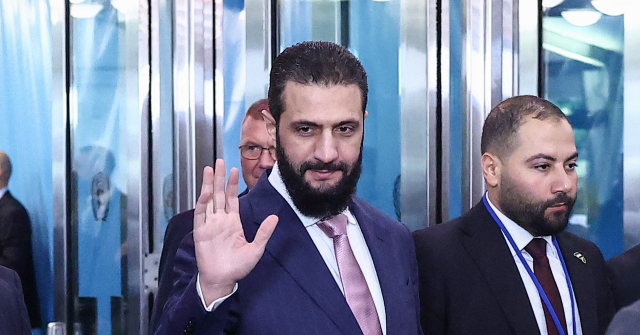
Syrian President Ahmed al-Sharaa, the former al-Qaeda lieutenant who lead an alliance of insurgents and jihadis to depose dictator Bashar Assad in December 2024, began his second address to the U.N. General Assembly (UNGA) on Wednesday by justifying his violent past as a struggle against “evil” and “injustice.”
“Good people choose the right path. Those who fight are very different from those who engage in bloodshed,” he asserted.
“When land is usurped, when sanctity is violated, people suffer and people pay the price. Falsehood forces people to confront evil. Many wars were waged over history,” he said.
Sharaa said that thanks to his own war against the Assad regime, “Syria is rising” and has “started the journey of reconstruction, of recovery.”
“We’ve fought drug trafficking and we focused on transitional justice,” he said. “We have ascertained the fate of the missing. We turned our vision into practical action. We have forged partnerships. And we focused mainly on the future and on the welfare of our people.”
Sharaa boasted that since the “liberation” of Syria from Assad, “more than a hundred states started communicating with us,” and “our capital has hosted more than 60 diplomatic missions.” He touted his government’s willingness to work with international agencies like the Organization for the Prohibition of Chemical Weapons (OPCW), the International Atomic Energy Agency (IAEA), and international law enforcement.
On the crime front, Sharaa was particularly enthusiastic about Syria’s success at seizing “large amounts of captagon,” an amphetamine sometimes described as “cocaine for the poor” that was manufactured in vast quantities under Assad’s rule and sold across the Middle East.
Captagon was used as a combat drug by the Islamic State, and profits from its trade fueled an international network of crime and corruption. Assad and his top officials were implicated in the trade, with some observers condemning Assad as one of the worst drug lords in the world.
Sharaa said lifting sanctions against Syria and removing it from lists of state-sponsored terrorism has enabled the economic growth needed to restore the country after its long and brutal civil war.
“We recovered 3.5 million refugees, and IDPs (internally displaced persons) have returned in a safe and decent way. Syria turned from a crisis to an opportunity,” he said.
“We have reconstructed universities and schools, to maintain educational services to all Syrian citizens, and we have consolidated our values. We’ve consolidated the rule of law,” he said.
Sharaa’s speech took a more aggressive turn when he discussed Israel, the only other country he mentioned by name. He said he was determined to regain control of the Golan Heights, and he condemned Israeli military actions against Syrian targets — without mentioning that some of those strikes were conducted to protect people from slaughter at the hands of Syrian government forces.
“The world is joyous about our return, but Israel is launching attacks against Syria. There have been 500 airstrikes, more than 1,200 incursions, and 300 detentions,” he said, without discussing who Israel was bombing, or why.
Sharaa was not alone in criticizing Israel’s recent military actions in Syria. The Trump administration, which is betting heavily on Sharaa’s ability to deliver a more peaceable and Western-friendly Syria, has asked Israel to back off — and so have Sharaa’s allies in Turkey, another country the Trump administration wants to build a better relationship with.
Much of the recent criticism of Israel concerns airstrikes on the Abu Duhur airbase, which Israel evidently bombed because Syria was allowing Turkish troops to deploy there. U.S. envoy to Syria Tom Barrack, who is also the ambassador to Turkey, denounced these strikes as an “unnecessary escalation that does not advance regional stability.”
The day before Sharaa’s address to UNGA, Republican Rep. Joe Wilson of South Carolina said Israeli airstrikes “shouldn’t be done,” and predicted “Syria will succeed” if given a fair chance.
This was the general thrust of Sharaa’s address to UNGA, although he was often elusive about the criticisms leveled against his junta and he notably failed to talk about a timetable for transitioning to a genuine democratic government. Middle Eastern leaders at the U.N. have been generally unwilling to acknowledge Israel’s concerns even in the course of arguing against them, and Sharaa was no exception.
The narrative Sharaa offered was that a new era of peace, prosperity, fair play, and freedom dawned on the day Bashar Assad fled Damascus, and the tidal wave of refugees that poured out of Syria can now safely return home. That is a narrative that most of the free world seems eager to believe.
Read the full article here