




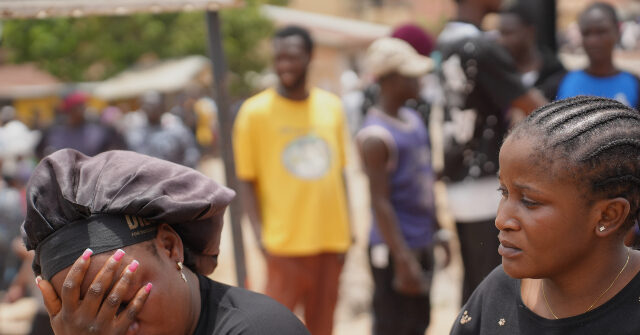
Nigerian Christians experienced deadly suspected jihadist attacks in at least five states on Easter Sunday, the holiest day on the Christian calendar – involving direct attacks on Easter services, mass abductions, and indiscriminate firing on local victims.
The attacks followed a massacre that killed at least 30 people on Palm Sunday, the Sunday before Easter that marks the opening of Holy Week, in Plateau state, one of the deadliest places in Nigeria to practice the Christian faith.
Human rights experts routinely rank Nigeria the deadliest place in the world to practice Christianity as a result of the large annual death tolls of Christians in targeted attacks. The perpetrators are typically members of a variety of Muslim terrorist organizations, most prominently the Islamic State, Boko Haram, and the genocidal Fulani terrorists of the Middle Belt. Nigerian Christians often protest that, despite the clear identity of their assailants, the federal government ignores the Islamic motivations of the killers and denies the existence of Christian persecution in the country.
“The characterization of Nigeria as religiously intolerant does not reflect our national reality, nor does it take into consideration the consistent and sincere efforts of the government to safeguard freedom of religion and beliefs for all Nigerians,” Nigerian President Bola Tinubu declared in November, responding to President Donald Trump’s designation of Nigeria as a Country of Particular Concern (CPC) for religious freedom.
The Nigerian newspaper Vanguard reported on Monday that two separate attacks on Easter targeted the states of Benue – a Middle Belt state with a large Christian population – and Kaduna, a sharia state with a Christian minority. The newspaper identified the attackers in Benue as “suspected armed herdsmen,” a term typically referring to Fulani jihadists who target Christian communities for destruction and colonization.
“The attackers, numbering over 50, set homes, the local market, and food barns ablaze. Several others remain missing,” the newspaper reported, adding that at least nine confirmed deaths occurred in that attack. The Nigerian newspaper Premium Times reported that the government documented at least 17 deaths in the attack by later in the day. That newspaper cited locals who said the attack specifically targeted Easter celebrations.
“As people tried to flee, the gunmen opened fire, killing innocent residents. Nine bodies have been recovered, but many are still missing,” an anonymous resident was quoted as saying.
In Kaduna, Nigerian media reported that unspecified “terrorists” opened fire on two Christian churches in Ariko, identified as First ECWA Church and St. Augustine Catholic Church, killing at least seven people. During this attack, the terrorists attempted to abduct dozens of people, and reportedly succeeded in taking away a number authorities have not confirmed at press time. The Nigerian military nonetheless boasted that it engaged heavily with the terrorists, resulting in the liberation of 31 Christians the terrorists attempted to abduct.
“Military sources said troops engaged the terrorists in a fierce firefight, forcing them to abandon the hostages,” Vanguard reported.
Local Katsina councillor Mark Bawa reportedly lamented to Punch, another Nigerian outlet, that despite the rescue, the government response to the attack was slow. He blamed “poor telecommunications coverage in the area.”
In northeastern Borno state, historically the cradle of the jihadist terror attack by Boko Haram, local authorities also reported coordinated community attacks. The reports did not specify the nature of the attacks, but did identify the attackers as members of Boko Haram and the Islamic State West Africa Province (ISWAP). Boko Haram and ISWAP were once the same group, when Boko Haram leader Abubakar Shekau pledged allegiance to the Islamic State in the Middle East, but reportedly splintered after his death over disagreement about continuing to follow the global ISIS infrastructure. Local media reported that five people were killed, four of them police, in the Borno attacks this weekend.
“The terrorists deployed rocket-propelled grenades (RPGs) and other weapons, damaging part of the [police] station and partially burning an unserviceable armored personnel carrier,” Vanguard reported.
Vanguard documented yet another “terrorist” attack in Plateau state, in the heart of the devastated Middle Belt, beginning around midnight between Saturday and Sunday. This attack killed three people and reportedly targeted a group that was established to protect the area in the absence of any meaningful government-provided security against jihadist groups.
The Nigerian newspaper Premium Times reported on Monday that another group of “attackers” targeted Katsina state, northwest Nigeria, in this case burning down a healthcare site and some local businesses. While the report only identified the attackers as “suspected bandits,” jihadists have been documented to use tactics such as the burning down of small businesses, churches, and other local community sites to displace Christians, forcing them from their indigenous homes and allowing the roving jihadists to steal the land.
“Despite repeated military operations and government assurances, attacks in local government areas such as Matazu, Malumfashi, and Funtua have remained frequent, often involving killings, abductions, and destruction of livelihoods,” Premium Times lamented.
Follow Frances Martel on Facebook and Twitter.
Read the full article here


