




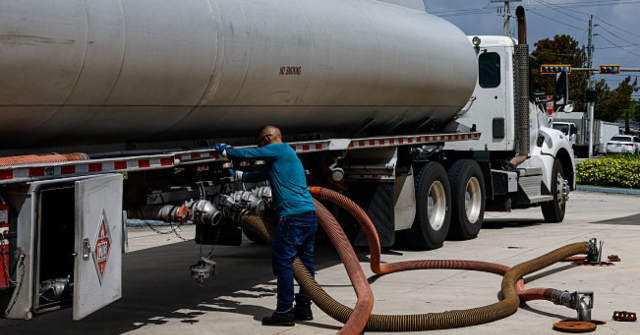
Democrat states are increasingly adopting legislation that would allow insurers to sue oil and natural gas companies for disaster-related losses; critics argue these law would penalize energy producers at a time where lower energy costs are needed more than ever.
Democrats have moved to enact legislation that would establish retroactive liability for American energy producers through so-called “climate superfund” laws which penalize companies for lawfully providing energy that Americans rely on everyday.
Rolf Hanson, the senior vice president for state government relations at the American Petroleum Institute (API), told Breitbart News in a written statement, “These proposed bills are part of a coordinated campaign against an industry that powers everyday life, drives America’s economy, and is actively reducing emissions. Retroactively penalizing companies for meeting consumer demand for affordable, reliable energy would set a dangerous precedent of state overreach.”
Beyond potential political challenges, the Democrat plan to punish energy producers also faces significant legal hurdles.
The Justice Department and Vermont in late March faced off in the federal courts over the 2024 climate superfund law that would require fossil fuel providers to pay for the alleged costs of climate change. The Trump administration has sued to block the law, claiming it violates the Constitution. The administration believes that climate superfund laws are unlawful attempts to regulate emissions that cross state lines. API and the U.S. Chamber of Commerce have filed their own lawsuit against Vermont.
Jonathan Rose, who represented Vermont at the late March hearing, said, “We don’t need to convince the court that climate change presents serious challenges to the state of Vermont. The act is intended to recover some of the costs it’s going to need to adapt to climate change,” he said. “What it doesn’t do is, it doesn’t try to mitigate climate change, stop climate change, or otherwise impact global emissions or anything like that.”
Riley Walters, representing the Justice Department, has disputed this argument, saying, “This case is not about Vermont’s ability to raise revenue or protect the health and welfare of its residents. It’s about Vermont’s attempt to subject global energy production and activity to Vermont law, which brazenly disregards the constitutional division of power in the federal government and the states.”
Other states such as New York have followed Vermont’s lead to increase energy producers’ legal liability. New York aims to recover $75 billion over 25 years from the world’s largest fossil fuel companies.
Hawaii has moved forward with similar legislation that would allow the Hawaii Property Insurance Associate to file and litigate against parties that would allegedly be responsible for “climate disasters and extreme weather attributable to climate change.”
In late March, Scott Saiki, the insurance commissioner for the state Department of Commerce and Consumer Affairs’ Insurance Division, said of the legislation:
As currently drafted, S.B. 1166 S.D. 2 H.D. 1 does not appear to regulate insurer conduct, insurance producer conduct, or establish an unfair trade practice within the business of insurance. Rather, the measure establishes a civil liability framework governing litigation between private parties relating to climate-related losses. Since the measure appears to create a general civil liability framework rather than an insurance regulatory provision, the Department respectfully suggests that the Legislature consider whether the proposed language would be appropriately codified outside of the Insurance Code.
In February 2025, 22 attorneys general sued the New York Climate Superfund Act, believing that it and other state laws would push the nation into an energy crisis.
West Virginia Attorney General JB McCuskey said in a statement at the time:
The iconic New York City skyline was built with the blood, sweat, and labor of the men and women of our coalfields — from the steel in their skyscrapers, down to the electricity they use every day. The level of ungratefulness from the elites in New York for the sacrifices that continue to be made to give them the lavish lifestyle they enjoy is beyond the pale. This lawsuit is to ensure that these misguided policies, being forced from one state onto the entire nation, will not lead America into the doldrums of an energy crisis, allowing China, India, and Russia to overtake our energy independence.
“This law is unconstitutional, and I am proud to lead this coalition of attorneys general and brave private energy companies and industry groups in our fight to protect against this overreach. If we allow New York to get away with this, it will only be a matter of time before other states follow suit — wrecking our nation’s power grid,” McCuskey added.
Read the full article here


