


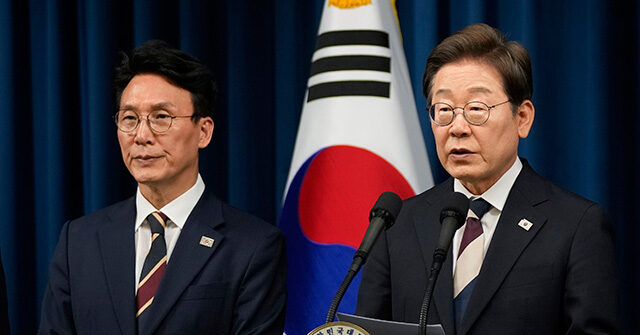
South Korean Prime Minister Kim Min-seok announced on Wednesday that his government has activated an “emergency economic response system” to handle “the shock of the Middle East war.”
“The Emergency Economic Inspection Meeting presided over by the President will serve as the supreme control tower,” Kim elaborated, referring to South Korean President Lee Jae-myung.
“To support this, the government will establish an Emergency Economic Headquarters with the Prime Minister as the head, responding as a cross-ministerial one-team, while also operating an Emergency Economic Situation Room at Cheong Wa Dae,” he continued. Cheong Wa Dae is the Blue House, South Korea’s equivalent of the White House.
The Emergency Economic Headquarters consists of five dedicated response teams to handle specific issues, such as energy supplies and financial stability. Each team is led by a Cabinet-level official.
“Taking this Middle East war response as an opportunity, the government will swiftly advance mid- to long-term tasks to turn the crisis into an opportunity, such as strengthening supply chain competitiveness, improving the capital market’s structure, and transitioning the energy framework,” Kim said.
Kim added that the government believes a “supplementary budget” for “livelihood protection and economic stability” should be passed quickly. He meanwhile called on the Korean public to “voluntarily participate in energy-saving campaigns such as using public transportation and practicing energy conservation in daily life.”
At a press briefing on Wednesday, Kim said it was time to “step up the government’s preemptive response system to prepare against a prolonged situation, including worst-case scenarios.”
“Though this Middle East crisis is serious, if the government responds preemptively and the people collect their strengths, we will overcome the crisis and create a new opportunity for a grand national transformation,” he said.
South Korea was heavily dependent on oil and gas shipments through the Strait of Hormuz, which Iran has effectively blockaded by threatening to attack commercial vessels. The South Korean government on Tuesday rolled out an energy conservation that includes a five-day rotation system for public vehicles, plus steps for the public to follow to reduce their energy footprints, like taking shorter showers and charging their phones during the day.
Two weeks ago, President Lee announced a cap on domestic fuel prices — the first time South Korea has imposed such a measure in 30 years.
Lee noted that the Iran crisis is “a significant burden on our economy, which is highly dependent on global trade and energy imports from the Middle East.” To alleviate the crisis and guard against future disruptions, he said South Korea would look for alternate sources of gas and oil that would not have to be shipped through the Strait of Hormuz.
South Korea is also reportedly looking to add more coal and nuclear energy to its power mix, to reduce its dependency on oil and gas.
Read the full article here