




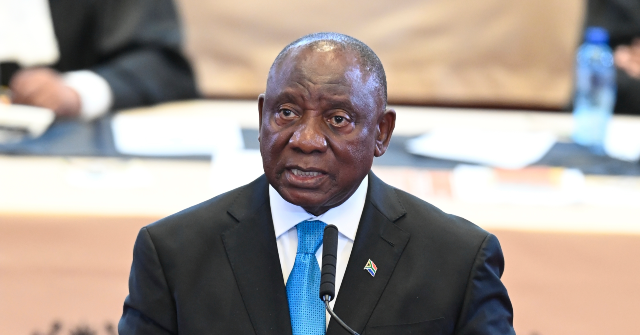
South African President Cyril Ramaphosa announced on Sunday evening that his government will take major steps to crack down on illegal immigration, including the creation of an “Intelligent Population Register” that “contains biometric data for every person in the country.”
Ramaphosa said the population register would lay the foundation for a national Digital ID system, replacing the antiquated and fallible paperwork currently in place.
“The Department of Home Affairs will set a date after which the green ID books will not be recognized,” he said.
The green ID books have been standard identification in South Africa since 1986, replacing the apartheid-era population register. The books resemble passports with green covers that are embossed with South Africa’s coat of arms.
Much like a passport, the green book includes personal information such as date of birth, citizenship status, signatures, a photograph, and a 13-digit ID number that is meant to be permanently attached to each resident, similar to Social Security numbers in the United States. The South African ID number was designed to incorporate both the individual’s date of birth and special codes that would confirm the ID number was valid.
South Africa began phasing out the green books in 2013, replacing them with a “smart ID card” that includes a microchip with biometric data, but the green books were still accepted as valid identification until now.
Ramaphosa conceded that the outmoded green books have “enabled identity theft by undocumented immigrants and criminal syndicates,” while existing plans to phase them out by 2029 were not moving quickly enough to combat massive and rapidly-growing fraud.
Ramaphosa said his government will also “end the abuse of the Traffic Registration Number, which foreign nationals require to register or buy vehicles but which is being used as a form of identification.” He directed the South African Department of Transport to overhaul the vehicle registration process within three months.
The South African president acknowledged widespread corruption in his government’s home affairs ministry, with officials selling documents and helping criminal gangs exploit the immigration system. He promised a vigorous crackdown, including termination and criminal prosecution for corrupt officials.
Ramaphosa also vowed to hire another 10,000 inspectors to ensure that South African businesses are not illegally undercutting local wages by hiring undocumented migrants. He said quotas would be established for “employment of foreign nationals in any economic sector or occupational category.”
On Monday, Ramaphosa published an article in his weekly newsletter explaining that the new identification systems were an effort to address legitimate criticisms of South Africa’s loose border controls.
“We are responding to real concerns that communities have about the effects that unchecked illegal immigration has on jobs and economic opportunities,” he said.
Ramaphosa stressed that most foreigners living in South Africa were not criminals, and he cautioned against allowing criticism of migration issues to devolve into racial intolerance and violence. He asked the public to be patient while his administration works on solutions that would be consistent with the national constitution and the rule of law.
“The task of managing migration belongs to all of us,” he said.
Much of what Ramaphosa announced on Sunday night was already in the works, including the biometric ID system which began rolling out last month and was supposed to be fully in place by 2029. The president needed to accelerate the implementation of these measures to placate a growing, and increasingly angry, segment of the population that says illegal migration is out of control with dire effects on the economy for law-abiding citizens.
“Many South Africans are raising difficult but legitimate questions. These concerns are real. They deserve to be heard, and they deserve to be addressed,” the president said on Sunday.
“I must make it clear that only the authorized government officials may act against violations of the law, including violation of our immigration laws. No other person is allowed, for example, to confront someone in the street to demand proof of nationality,” he added.
At the same time, Ramaphosa needed to reassure migrants who say they are living in fear after a string of violent anti-illegal-immigration protests. The group at the forefront of organizing these protests, March & March, has been warning that all illegal immigrants must leave South Africa by June 30 or face unspecified consequences.
Countries with large migrant populations in South Africa, including Mozambique, Malawi, and Ghana, have complained about violent xenophobic attacks against their citizens and made arrangements to repatriate frightened migrants.
“Every day and almost everyone I meet, they are in fear, extreme fear,” an Ethiopian who immigrated to South Africa in 2000 told the UK Guardian on Monday.
“The sad part is it’s not because they are undocumented,” the Ethiopian immigrant continued. “But none of the legal documents will protect you from the violence.”
Official census data says the foreign-born population in South Africa has exploded over the past three decades, but remains below 2.5 million people, which would make immigrants less than four percent of the population.
March & March leader Jacinta Ngobese-Zuma claims the census data is wildly inaccurate and the real migration population “ranges from 15 million to about 30 million,” constituting an “invasion” and making South Africans into “refugees in their own country.”
In his speech on Sunday, Ramaphosa warned that his government will “act against forces who are exploiting the concerns of our people about illegal immigration to further their own political, personal, or criminal agendas.”
“There is no space for xenophobia, racism, sexism, Afrophobia, or any other forms of intolerance in South Africa,” he declared.
Read the full article here


