




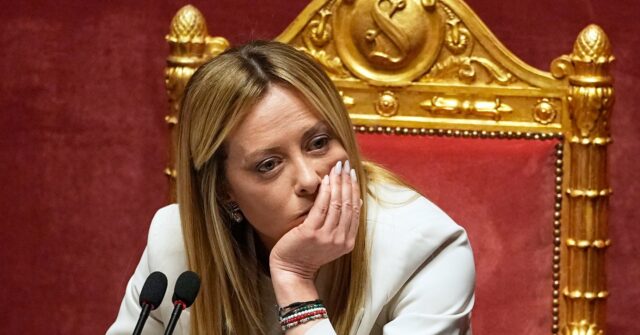
Italian Prime Minister Giorgia Meloni has conceded defeat in a major referendum seeking to overhaul the nation’s left-wing judiciary, in what observers have cast as a blow to her air of invincibility heading into next year’s elections.
While Prime Minister Meloni has arguably led one of the most stable governments in Rome over the past two decades, with her conservative-populist coalition with Lega leader Matteo Salvini proving more stable than the technocratic-globalist governments that preceded hers, she suffered a significant setback on Monday following the completion of a two-day national referendum.
Overhauling Italy’s left-wing and torpid judiciary has long been a goal of right-wing leaders, including former Prime Minister Silvio Berlusconi, who faced frequent prosecutions throughout his political career. Meloni’s second-in-command also faced recent lawfare efforts, such as the attempt by Palermo prosecutors to jail him for previously rejecting an open borders NGO migrant boat from unloading illegals onto Italian shores.
Meloni has also squared off with the judiciary, with left-wing magistrates in Rome having stymied her key anti-illegal migration strategy of sending boat migrants that cross the Mediterranean directly to processing centres rather than allowing them to remain in Italy while their asylum claims are being processed. Remarkably, Italian judges ruled that it was not for the Italian government to determine its own immigration policy, but rather for EU regulations.
However, like previous attempts to reform the judiciary, Meloni’s also failed, with the PM conceding defeat on Monday, saying: “The Italians have decided. And we respect this decision. We will move forward, as we have always done, with responsibility, determination, and respect for the Italian people and for Italy.”
According to exit polls published by broadcaster RAI, the “No” vote was driven in large part by younger voters, with 61 per cent of those aged 18 to 34 voting against the Meloni reforms. Overall, the vote against the Referendum won with 53.6 per cent of the vote, with 95 per cent of ballots counted.

The Referendum sought to impose three main reforms on the judicial system, including the separation of career paths for prosecutors and judges, a common feature in many European and indeed the U.S. judicial systems.
Meloni argued that the current system in Italy, in which judges and prosecutors can easily switch between the two professions, encourages a personal closeness between those tasked with accusing and those judging, thereby compromising the system’s supposed impartiality. She also argued that the current system prioritises adherence to political ideologies rather than merit.
Contrary to claims from opponents who accused the government of seeking to politicise the judiciary, the next major reform proposed was to remove the political selection of members of the High Council of the Judiciary (CSM), which currently oversees misconduct cases against judges and prosecutors. Rather than being “elected” by fellow magistrates or the Italian parliament, the referendum would have created a random lottery system to remove any intentional bias.
Meanwhile, the reforms would have split the CSM into two bodies, one for prosecutors and one for judges, with members of the opposite factions judging each other to limit conflicts of interest in disciplinary cases. Finally, the referendum called for the creation of another authority to oversee judges outside of the judiciary to further prevent conflicts of interest.
While Prime Minister Meloni initially appeared hesitant to wed herself to the vote, in recent days she had fully endorsed the reforms, as it increasingly became apparent that left-wing opponents were seeking to use the Referendum as a de facto judgment on her government.
Yet, with elections likely over a year away, it remains to be seen how much the outcome of Sunday’s vote will weigh on voters’ minds as they head to the polls in 2027 to select a new parliament.
Even with the defeat, Meloni likely remains in a strong position, with recent polling from the Italian survey firm YouTrend putting her Brothers of Italy party at 29.7 per cent support, higher than in the 2022 elections when she swept to power with 26 per cent of the vote. Meloni’s personal polling also remains relatively high, with her Eurobarometer trust rating standing at 45 per cent, compared to 33 per cent for German Chancellor Friedrich Merz, and 15 per cent for French President Emmanuel Macron.
Follow Kurt Zindulka on X: Follow @KurtZindulka or e-mail to: kzindulka@breitbart.com
Read the full article here


