


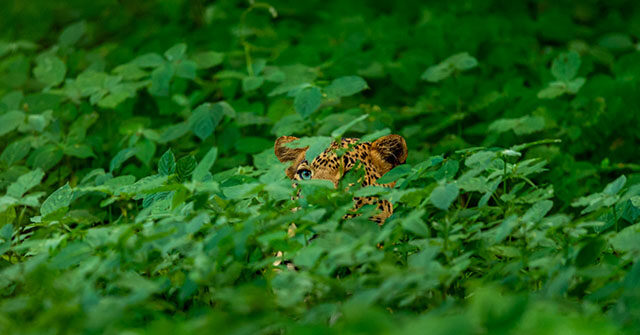
A new wild cat species has been discovered for the first time in 100 years — the tilcayo tiger cat from the Bolivian Yungas.
Officially named leopardus tilcayo, the spotted, slender tiger cat boasts the size of a kitten rather than a standard house cat, per NBC News. The exact size of the cat’s population remains unknown. There are as many as five tiger cat species in South America and they face severe conservation challenges due to vanishing habitats.
Paola Nogales-Ascarrunz, who leads a wild cat conservation program called Programa de Investigación de Félidos Bolivia (Bolivian Felid Research and Conservation Program), called the discovery a “novel” find.
“This time, it’s a cat. That’s really novel. And it hasn’t happened in 100 years,” she said. “No one else had named it. No one else had described it.”
“We really don’t know how many cats are still in the wild,” she added. “We need science, we need more studies to answer this question, which is actually critical for its conservation.”
Nogales-Ascarrunz was at first astounded by the cat’s relatively small size upon discovering it. In fact, a man brought it to the wildlife rehabilitation center thinking it was a domestic kitten.
“I saw this cat. It was really, really small, and I couldn’t believe how small it was,” Nogales-Ascarrunz said. “I thought it was a kitten.”
According to Scientific American, the discovery of a new mammal, especially a cat, is exceedingly rare.
“It’s even more rare to find an entirely new species rather than a variation of a known species,” the publication added. “The study analyzed the genomes of 38 cats, including 26 Leopardus cats, comprising ‘the most complete genetic study yet,’ said the study’s co-lead author Jonas Lescroart, an evolutionary ecologist at the University of Antwerp in Belgium.”
Nogales-Ascarrunz said the discovery only shows just how much more we have to learn about the planet’s biodiversity.
“Describing a new cat species after more than 100 years shows how much we still have to learn about the biodiversity around us. But it also reminds us that we need to protect the Yungas forests, which are home to so many species — including some we are only beginning to understand,” she said.
Read the full article here