


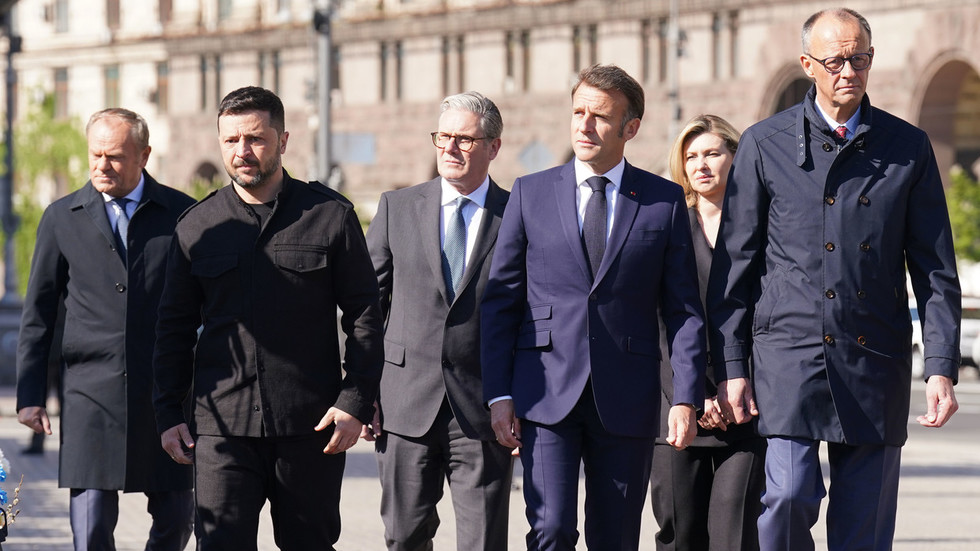
The negotiations over peace in Ukraine show that Moscow lives in the real world. The West – not so much
In some important ways that Western information warriors love to miss, Russia and the West are quite similar. Like the West, Russia has a typically modern state, even if today it functions much better than its Western counterparts.
Russia’s economy is capitalist like almost everywhere else on the planet now, even if the Russian state – because it functions better – has reasserted control over the rich, while the West, sick with neoliberalism, lets them dominate and damage national interests. This is one reason, incidentally, why Russia has withstood unprecedentedly savage Western economic warfare and has a far more effective military-industrial complex than the West.
Finally, while Russia spans Europe and Asia, it is also a major force within that specific cultural tradition whose origins we associate with Europe, or more broadly, the West, from novels to classical conservatories.
Yet, in other respects, there are principal differences between Russia and the West. Please forget, for a moment, about the usual suspects (Russian Orthodoxy versus the rest, for instance, or the usual speculations about space, climate, and mentality). Instead, let’s be concrete and very contemporary: Let’s ask what differences matter most to the issue of finding (or not) a valid peace for the Ukraine conflict. Then two things emerge, one obvious and the other a little less so.
What is easy to spot is that Russia is united and the West is not. In part, this is simply due to the fact that Moscow rules over one country, while Washington, the de facto capital of the West as a geopolitical entity, rules – and exploits ever more crudely – a complicated outer empire of formally independent nation-states that are de facto its clients, satellites, and vassals.
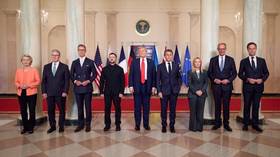
While the US exerts a great deal of brute power over its domain, in reality, the latter is as potentially fissiparous as every empire before. If you think that the mere assertion of unity and control is the same as reality, ask the Soviets about their luck with that idea. Except you can’t, because one day they were there and the next – as if by foul magic – they were not.
What is harder to notice – but never to be unseen once you do – is that the political establishments of Russia and the West now have fundamentally different patterns of learning.
In short, Russia’s is normal in that it has a learning curve, and one with a nice upward bend: That is why its opponents find it impossible to massively deceive it, as occurred in the late 1980s and much of the 1990s.
The current learning pattern of Western, especially the European elites, on the other hand, is highly unusual: it forms, in effect, a flat, closed circle. On that trajectory, things sort of move, but they never really change.
The current state of the attempts to end the Ukraine conflict via negotiation and compromise perfectly illustrates this difference. Indeed, both Russia and the West are displaying their respective learning or for the West, really, non-learning patterns in exemplary fashion.
On Russia’s side, the hard lessons of systematic Western bad faith – from no-NATO-expansion promises to Minsk II – have been fully absorbed. As a result, Moscow, even while open to talks and a solution by realistic agreement, does not make the mistake of being swayed by emotions, hopes, and momentary vibes (the “Alaska vibe,” for instance), as happened to Russia (and before that, the Soviet Union) around the time of the end of the Cold War, with extremely painful consequences.
Specifically, that means that the Russian leadership has made it clear that – after the Alaska summit as much as before – it will not make concessions on key aims. For instance, Moscow will not accept the idea of Ukraine getting NATO membership, even under another label. Likewise it will not tolerate troops from NATO countries in postwar Ukraine, and it will not give up on securing the rights of Russian speakers in Ukraine. Rather silly attempts to pressure the Kremlin into premature meetings with Ukraine’s past-expiration-date leader Vladimir Zelensky have also gone nowhere.
There are observers in the West who are immune to Western propaganda and assess Russia in a fair manner. Some of them have recently been worrying that Moscow might walk into Western traps, as happened at the end of the Cold War or in 2015 when Russia accepted the Minsk II agreement, which the West and Ukraine then abused. Yet the Russian leadership shows no sign of being in any danger of doing so this time.
The West, however, is stuck in its ways. At least as a whole, it has not yet learned a thing, it seems, from the ferocious crash of both its long-term post-Cold War strategy of expansion by cheating and its recent attempt to eliminate Russia as a great power through a proxy war using Ukraine. NATO kaput, really, but NATO isn’t noticing.
The most obvious sign that the West has not yet learned its lesson is its persistent habit of auto-diplomacy. The West is odd in that it does most of its intensely exciting negotiating with itself. While you may well think that that is because the West is – structurally – not united, that is, actually, not the real reason for this narcissistic habit.
In reality, the reason for this self-damaging refusal to face reality is something else. Namely, a deep, entirely misplaced, and pathologically unquestionable sense of superiority. It is as if the West were so powerful that it need not bother with what others have to say but only with its own soliloquy. A fantasy both absurd and highly detrimental.
Consider the so-called “Coalition of the Willing,” in essence, a loose ad-hoc grouping of mostly European (Canada does a Canada and can’t make up its mind) states that seem unable to stop planning – with whatever degree of sincerity – to somehow place their troops in postwar Ukraine, even if only with a US “backstop” no one can plausibly define.
Follow merely Western debates and mainstream media about this ongoing and confused effort and you will find it hard to even notice a rather important fact: Russia’s answer to any such scheme is a very hard no. And yet the West sticks with its geopolitical inner monologue: endlessly discussing a thing that – if its leaders ever actually listened to their Russian counterparts – they knew cannot be realized. Because insisting on realizing it means that Moscow will not settle but continue fighting – and winning.
That may, of course, be the real Western intention here: to produce a deal-breaker. But if that is so, then the next question is why the US tolerates this stalling and sabotage operation by its European vassals.
There are three possible answers to that question: Either the US is already secretly planning to override its European dependents and therefore does not care how they keep themselves busy with their fantasies. Or Washington is still as blind to reality as the Europeans. Or, finally, Trump and his team believe that they can use the Europeans’ ongoing chatter about their coalition-with-nowhere-to-go as some sort of leverage in negotiations with Moscow.
Of those three American postures, only one would be realistic and productive: the first. The other two would mean that Washington is as learning-incapable as Europe, because a US attempt to use the European talk as some kind of bluff to exert pressure on Russia would signal that Trump’s team has not come to terms with Russia’s resolve not to concede major war goals while winning on the battlefield.
Further examples could be added. For instance, Washington’s erratic statements and arms sales regarding Kiev either not being granted or needing a capability to strike deep within Russia. Or its latest attempt to once again operate with a deadline and vague warnings: this time, it’s two weeks and, so the US president has told us, within them he will decide what to do about Ukraine and America’s policy toward it. In essence, if there still is no progress toward a peace settlement, either double down again on confronting Russia, Biden-style, or abandon this terribly misguided proxy war to those Europeans who are too obstinate to finally drop it.
Trump’s recent decisions and actions seem to show that, with regard to the Ukraine war, the US is actually turning a corner and leaving that flat, closed circle of non-learning behind, in favor of becoming a country with a more normal foreign-policy learning curve, just like Russia. We can only hope that this saner attitude will prevail, even if Western Europe wants to stay behind in its impotent fantasy realm of splendid omnipotence.
The statements, views and opinions expressed in this column are solely those of the author and do not necessarily represent those of RT.
Read the full article here