


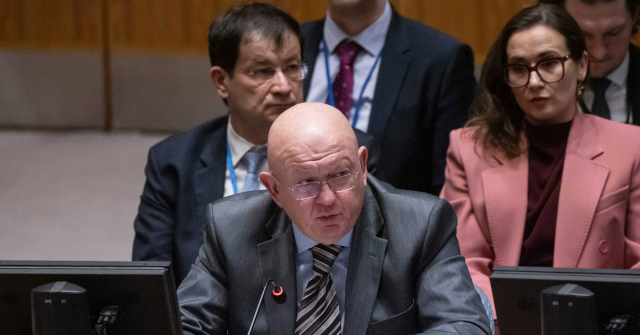
Russia and China on Thursday used their vetoes at the U.N. Security Council (UNSC) to block a draft resolution proposed by the United States that would have extended U.N. monitoring of Iran sanctions for another year.
The sanctions in question were imposed by France, Germany, and the United Kingdom in September 2025 under the “snapback” provision of former President Barack Obama’s nuclear deal with Iran, formally known as the Joint Comprehensive Plan of Action (JCPOA).
The snapback process restored many of the sanctions on Iran that were lifted under the JCPOA on the grounds that Iran was not meeting its obligations under the deal. The snapback mechanism was set up with a UNSC resolution that prevented permanent members from using their veto powers to block it, which prevented Russia and China from using their vetoes to shield the junior member of their axis of tyranny from the sanctions.
France, Germany, and the UK were the European signatories of the JCPOA, collectively known as the “E3.” They said in September 2025 that Iran had “repeatedly breached its commitments” so they had “no choice but to trigger the snapback procedure.”
“Despite these long-standing violations, the E3 have continuously made every effort to avoid triggering the snapback, bring Iran back into compliance and reach a durable and comprehensive diplomatic resolution,” they noted.
Iran provoked the actions by interfering with inspectors from the International Atomic Energy Agency (IAEA) and continuing to enrich large quantities of uranium to near weapons-grade levels.
Iran’s malfeasance led President Donald Trump to completely withdraw the United States from the JCPOA during his first term, and while the Biden administration very much wanted to bring Obama’s nuclear deal back from the dead, it could find no way to get past Iranian intransigence to rejoin the deal.
Russia and China have been trying to get the snapback sanctions lifted on the grounds that the UNSC resolution that authorized the mechanism — and prevented Moscow and Beijing from riding to Tehran’s rescue with their vetoes — effectively expired in October 2025.
Unable to sell that legalistic argument, Russia and China settled for vetoing the U.S. draft resolution that would extend the mandate of the independent panel of experts that has been monitoring the snapback sanctions. They previously sabotaged the panel by voting against eight prospective members nominated by the U.N. The sanctions remain in effect, but now it will be much easier for Iran to cheat on them.
The resolution would have passed by 11-2 without the vetoes, with two abstentions.
“We are not surprised by the actions of several council members in vetoing the extension of the mandate of the panel of experts,” sighed U.S. representative Jennifer Locetta.
“Without an independent panel of experts, this council loses its principal source of impartial, evidence-based reporting on sanctions violations, creating a monitoring gap that only benefits the Iranian regime and those who profit from evading those measures,” she said.
British Ambassador to the U.N. Sarah MacIntosh noted Russia has used similar tactics to shield North Korea from sanctions in an apparent quid pro quo for Iran and North Korea providing drones and ballistic missiles for Russia’s war in Ukraine.
The IAEA is still trying to monitor Iran’s nuclear activities, and having a great deal of trouble doing so. On September 9, the 35-member IAEA board of governors passed a resolution declaring Iran to be in violation of its nuclear non-proliferation agreements — an even more serious condemnation than the “non-compliance” finding by the board of governors that triggered U.S. and Israeli airstrikes on Iran’s nuclear program last summer.
“The Agency’s lack of information about these facilities and associated nuclear material and our inability to conduct verification activities at these facilities is a matter of serious proliferation concern. The situation needs to be rectified with the utmost urgency,” said IAEA director Rafael Grossi.
Iran claimed the IAEA action was a groundless “political resolution” and promised to retaliate against the U.S. and E3 for sponsoring it.
Read the full article here