


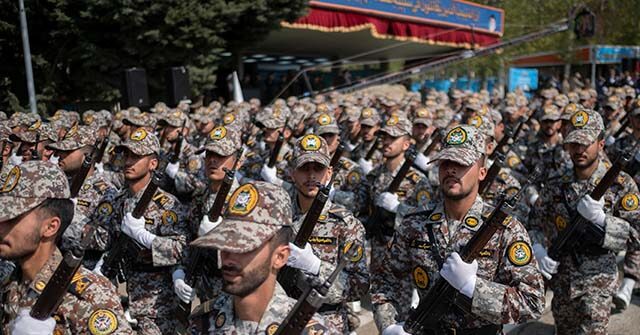
The Economist on Wednesday cited Israeli intelligence sources who suggested “there are signs of Iranian soldiers, police officers and IRGC members failing to show up for duty.”
The IRGC is the Islamic Revolutionary Guard Corps, the elite and theocratically controlled wing of the Iranian military, charged with both conducting terrorism operations overseas and violently repressing the Iranian people at home. A collapse in morale among the IRGC would be very good news for Iranians who hope that one last uprising could topple the weakened regime in Tehran.
WATCH — Trump: Countries Are Unifying Against Iran Because Its Regime Is “Evil”:
The Economist relayed the story about Iranian troops refusing to report for duty in the course of assessing the success of Operation Epic Fury’s first five days, finding “Iran’s political leadership in turmoil,” Iranian ballistic missile launches “down 86% from the first day of the war,” and Iran’s naval forces in ruin.
The analysis attributed some of this success to the “dire state of Iran’s air defenses, which were mostly dismantled in last year’s 12-day war.” With total air superiority swiftly achieved, the U.S. and Israel have been able to switch to cheaper ordnance than the big-ticket super-weapons deployed during the first phase of the conflict, including what Secretary of War Pete Hegseth described as a “nearly unlimited stockpile” of inexpensive bombs.
“For all that, military attrition, however overwhelming and effective, by no means guarantees the regime’s demise — Israel’s key war aim, and one of Mr. Trump’s ever-shifting goals,” the report cautioned.
Another worthy note of caution would be that virtually every conflict includes reports of enemy soldiers deserting their posts and, even if such anecdotal accounts are true, they may not reflect a complete collapse of morale.
Iran’s own Farda news outlet, for example, reported that Iranian soldiers, police, and even military officers refused to report for duty during Israeli airstrikes in June 2025, obliging Iran’s military judges to warn that “disobedience or desertion” would be treated as “treason, whether motivated by aiding the enemy or personal reasons.”
During the widespread popular uprising in January 2026, the IRGC issued a statement that briefly included a warning that “defiance, desertion, or disobedience” among Iranian troops would be punished with “trial and decisive action.”
This warning was later deleted from the statement, leading hopeful observers to speculate that Iranian security forces were suffering worse morale problems than it wanted to admit. As things turned out, the regime was able to crush the January uprising by murdering thousands of its own people, without suffering any crippling morale problems among its thugs and trigger men.
Iranian opposition media site Iran International claimed on Friday that “multiple conscripts” within Iran’s armed forces said their officers “abandoned their barracks, leaving soldiers in dangerous conditions and forcing them to remain on guard duty under ongoing bombardment.”
Read the full article here