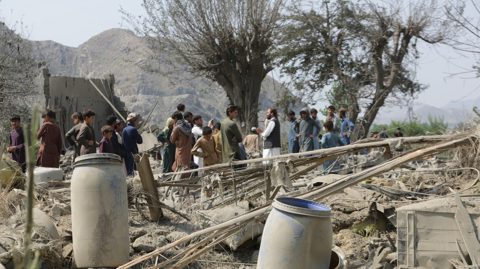

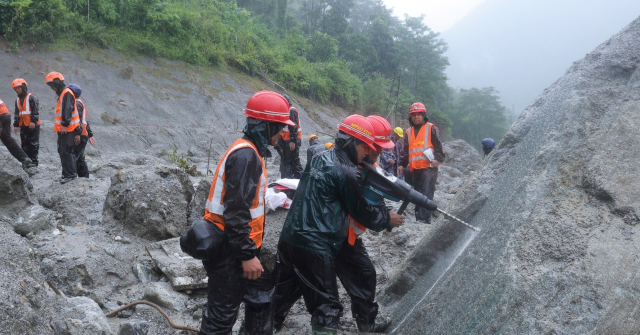
Rescue workers in Nepal are rushing to save over 900 missing hydropower workers after last week’s devastating flash flood.
Many of the missing are believed to be trapped in tunnels beneath a dozen hydropower projects across the country.
Mohan Kumar Dangi, president of the Nepal Independent Power Producers’ Association, said on Monday that calls for help were broadcast from several installations affected by the flood. Some of those workers were able to take shelter in the tunnels during the flood and then escape, but they said many of their fellows remained trapped underground, and their oxygen could be running out.
Nepal has a very active hydropower industry, taking advantage of fast-flowing rivers that could generate over 42,000 megawatts of electric power if properly harnessed. Indian and Chinese firms have been vigorously competing to secure construction contracts in Nepal — a competition India is slowly winning by making a rule that Indian consumers cannot purchase electric power from Nepal that is generated by projects linked to China.
India’s sales pitch has been aggressive enough to snatch four Nepal hydropower projects away from Chinese firms, and one of them was a much-touted part of China’s Belt and Road Initiative (BRI) announced when Chinese dictator Xi Jinping visited Nepal in 2019.
Some Nepalese officials are concerned that between India forcing China out of projects and buying much of Nepal’s output for itself, Nepal could be left with a power shortage even though it has 120 operational hydropower plants today and another 235 in various stages of construction. Even with over 350 plants online, Nepal would be tapping less than 10 percent of its theoretical hydropower potential.
The water was moving much too fast on Wednesday as flash floods came roaring through the border region of Nepal and Tibet, killing over 900 people as of Monday’s updated casualty count, with over 4,200 people still unaccounted for.
One of the earliest distress calls during the flood came from a hydropower plant under construction in the Rasuwa district of Nepal. A South Korean company called Doosan Enerbility said about 20 of its employees were trapped at the work site by the flood, which struck with incredible speed.
The South Korean government rushed to send rescue teams to the site, but Nepal refused to accept foreign assistance, causing a diplomatic crisis over the weekend.
Doosan Enerbility said on Monday that nine of its employees had been rescued from Rasuwa and returned home to South Korea, while a tenth employee, the site manager, stayed behind for an extra day to assist with search and rescue efforts. Six more Doosan employees, plus three employees of the state-run Korea South-East Power Company, remain unaccounted for.
Australian engineering professor Arnold Dix, who is advising on the hydropower plant rescue effort, told the U.K.’s Radio 4 on Monday that the flooding was so destructive that simply finding where the tunnel entrances used to be is a challenge.
“The actual signature of them has gone — everything is just missing. It looks like a lunar landscape,” he said.
Dix said “we’ve got some hope” for the workers trapped underground, because they should have been protected from the destructive power of the floods. The trick will be finding safe ways to remove debris from the tunnel entrances, including “boulders bigger than houses.”
“We know that virtually anyone near the surface or near the entrances to those tunnels have lost their lives,” he told the Associated Press (AP) on Monday, noting that some of Nepal’s leading hydropower experts were onsite when the floods struck, so they are among the missing and dead.
Nepalese Prime Minister Balendra Shah said on Monday that the Nepali Army has rescued 279 people from hydropower projects, including 254 workers at a single large plant called the Upper Trishuli-1 Hydropower Project. The Nepali Army also reported finding at least one body in the tunnels beneath the Langtand Hydro project.
Some of the hydropower tunnels have been partly flooded, forcing rescue workers to drain the water and pump air into the tunnels with compressors. The weather remains uncooperative, the terrain around many of the hydropower plants is difficult, and the rivers are still swollen, further complicating rescue efforts. The Trishuli River, which powers Trishuli-1 and many other hydro plants, has reportedly changed its course several times over the past few days.
China’s Ministry of Natural Resources produced a hazard assessment on Sunday that identified eight “high-risk geological hazard sites” in the flood region, plus another 52 areas of lesser concern.
Bhim Gautam, CEO of the Independent Power Producers Association of Nepal, told NPR that the Nepali government made a terrible mistake by refusing offers of foreign assistance for so long, because Nepal does not have “enough technology, equipment, and expertise” to mount major rescue operations at hydropower projects.
“Our expertise is only in dealing with small flooding. We have never faced a situation like this before,” he said. “Late last week, the government approved rescue teams from China, India, and Australia to come, but it is so late now.”
Read the full article here