




Iran’s Islamic regime designated Ahmad Vahidi, Deputy Commander of the Islamic Revolutionary Guard Corps (IRGC), as its new leader following the death of Mohammad Pakpour, several outlets reported.
The United States on Saturday launched “Operation Epic Fury,” attacking a large number of Iranian missile assets and high-profile targets alongside Israel, resulting in the death of several Iranian regime officials — including “Supreme Leader” Ayatollah Ali Khamenei.
Pakpour, who served as IRGC’s Commander since June 2025, was among those killed during the joint U.S.-Israel strikes, according to Israeli officials. President Donald Trump told ABC News on Sunday that every potential successor to Khamenei was killed during Saturday’s military operation.
Several outlets, such as the Tehran-based Mehr News Agency (MNA), the Times of Israel, Russia’s Tass, and the Argentine newspaper Clarín reported that Vahidi was appointed as the new IRGC chief following the death of his predecessor.
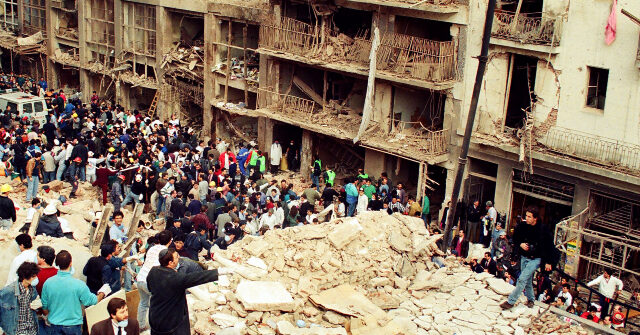
Vahidi is actively wanted by Argentine authorities over his involvement in the July 18, 1994, bombing of the Argentine-Israeli Mutual Association (AMIA), the deadliest terrorist attack in the Western Hemisphere prior to the September 11, 2001, attacks. On that day, terrorists drove a van filled into explosives into the AMIA building, killing 85 and leaving hundreds injured.
After nearly 30 years since the AMIA bombing, Argentine courts ruled in 2024 to declare Iran and its proxy terror group, Hezbollah, responsible for the terrorist attack. Days later, the administration of Argentine President Javier Milei requested the international arrest of Vahidi under grounds that he has an active — albeit non-binding — Interpol “red alert” to his name. Interpol does not have the power to arrest anyone as an institution.
A year later, in June 2025, Argentine courts issued a new ruling authorizing trial proceedings against Vahidi and a group of Iranian and Lebanese nationals for their involvement in the 1994 AMIA bombing. At press time, no individual has been convicted over the deadly 1994 terrorist attack in Buenos Aires.
Argentine President Javier Milei, in an official statement celebrating the death of Ayatollah Ali Khamenei, said on Saturday that the search for justice for the AMIA bombing’s 85 victims is “state policy,” emphasizing that it will continue “until the last person responsible pays with their freedom or their life for such a horrific crime.”
“The Argentine Republic hopes that this joint military action by our allied countries will put a definitive end to more than 40 years of oppression and human rights violations in Iran, and that the Iranian people will finally have peace and regain their democracy,” Milei wrote.

In January, Milei’s administration designated the IRGC as a terrorist organization and reiterated that Argentina is actively seeking Vahidi’s arrest.
Milei wrote at the time:
It should be noted that Ahmad Vahidi, commander of the Quds Force between 1989 and 1998, is implicated in the AMIA bombing and is the subject of an INTERPOL red notice. Despite this, the Iranian regime has not only failed to cooperate with his prosecution but has promoted him, currently appointing him as deputy commander of the Islamic Revolutionary Guard Corps. This individual is already included in the RePET [Argentina’s Public Registry of Persons and Entities Linked to Acts of Terrorism and its Financing].
Argentina’s Clarín pointed out on Sunday that an investigation by late Argentine prosecutor Alberto Nisman established that Vahidi served as commander of the Quds Force at the time of the AMIA bombing and, as such, he “participated in the meeting where it was decided” to carry out the attack in Buenos Aires.
“Vahidi and Moshen Rezai, according to a 2017 report by the Financial Intelligence Unit, were commanders of the Al-Quds Force and members of the select group that ‘in the intelligence office evaluated the proposal to attack our country,’” Clarín reported. Nisman died of a gunshot wound on January 18, 2015, hours before he was slated to give testimony to Congress as part of his investigation against then-president Cristina Fernández de Kirchner. Nisman was to accuse Fernández of helping Iran cover up its involvement in the AMIA bombing attack in exchange for favorable trade deals. Argentine authorities at the time, under Fernández’s administration, ruled Nisman’s death a “suicide.” President Milei, however, has repeatedly insisted that Nisman was assassinated.
Clarín further explained that Vahidi was “curiously” serving as Iranian defense minister in 2013, at a time when Fernández de Kirchner signed a widely-panned “memorandum of understanding” with the Iranian regime in 2013 that made the rogue Islamic regime a participant in the AMIA bombing investigation, essentially allowing Iran to investigate itself. Former President Mauricio Macri rescinded Argentina’s Memorandum with Iran during the first hours of his administration in December 2015.
Christian K. Caruzo is a Venezuelan writer and documents life under socialism. You can follow him on Twitter here.
Read the full article here


