




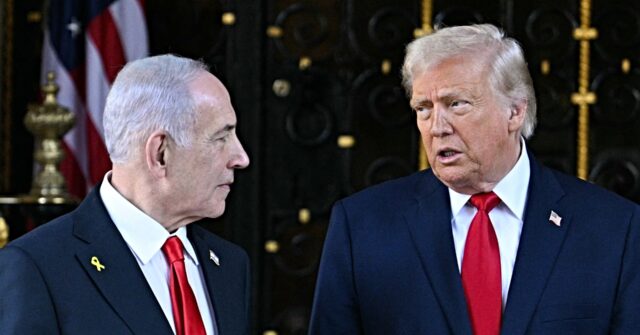
President Donald Trump personally intervened Monday to stop Israel from carrying out a significantly larger military operation against Iran after warning Prime Minister Benjamin Netanyahu further escalation could leave Israel confronting Tehran without American backing, multiple U.S. and Israeli media report.
The intervention came as Israel and Iran exchanged their most serious round of fire since the ceasefire reached in early April, threatening to derail negotiations that Trump and senior administration officials insist are nearing a breakthrough.
According to Axios, the New York Times, and multiple Israeli media reports, Netanyahu had approved a substantially broader follow-on operation targeting strategic sites across Iran before Trump stepped in Monday. Reports indicated dozens of aircraft were being prepared for the mission, which was ultimately called off after a series of conversations between Washington and Jerusalem.

The latest escalation began after Hezbollah, the Iran-backed terrorist group, launched attacks on northern Israel. Israel responded Sunday with strikes against Hezbollah targets in Beirut, which Israeli officials had repeatedly warned would trigger a response if attacks on northern communities continued.
Iran subsequently launched ballistic missile barrages toward Israel in support of Hezbollah, prompting Israeli retaliation against military and missile-related targets inside Iran.
Israeli officials viewed the Iranian missile attacks as part of an effort to establish a new regional equation under which Tehran could directly retaliate whenever Israel struck Hezbollah in Lebanon — a precedent Netanyahu reportedly argued could not be allowed to stand.
Trump, however, sought to prevent the confrontation from expanding into a broader regional conflict.
During a series of calls with Netanyahu on Sunday night and Monday, Trump stressed that he believed negotiations with Tehran remained close to producing an agreement that would prevent Iran from obtaining a nuclear weapon and address key American demands regarding the Strait of Hormuz.
According to Axios, Trump first spoke with Netanyahu on Sunday night after Iran launched missiles at Israel and pressed the Israeli premier to avoid a wider military response. Trump reportedly maintained that diplomacy could still succeed within days and that broader military action risked disrupting ongoing negotiations.
Netanyahu countered that failing to respond would signal weakness and allow Iran to impose a new deterrence framework linking Israeli operations against Hezbollah with direct Iranian retaliation.
Following consultations with senior military and security officials, Netanyahu authorized Israeli strikes overnight and again Monday morning targeting Iranian air-defense systems, missile-related infrastructure, and facilities linked to Tehran’s military capabilities.
Israeli Defense Minister Israel Katz said Iran had violated the ceasefire by launching more than 20 missiles toward Israel in what Israeli officials described as an attempt to establish a new security equation linking Hezbollah’s activities in Lebanon to direct Iranian retaliation against the Jewish state.
The Israel Defense Forces said the first wave of strikes targeted air-defense systems in western and central Iran, while subsequent attacks struck facilities at a major petrochemical complex that Israeli officials said produced materials essential to Iran’s ballistic missile program.
Iran responded with additional missile launches toward Israel on Monday. Meanwhile, Iran-backed Houthi terrorists in Yemen resumed attacks on the Jewish state, launching missiles and drones toward Israel, including a drone intercepted near the southern city of Eilat.
The renewed fighting did not end with the initial exchanges. By Monday afternoon, Israeli officials were reportedly preparing a significantly broader follow-on operation against Iran that could have marked the largest escalation since the ceasefire took effect in early April.
According to multiple reports, Israel had prepared a significantly larger strike package involving dozens of aircraft and additional strategic targets across Iran before Trump personally intervened to halt further escalation.
Trump said he warned Netanyahu that expanding the conflict risked leaving Israel without American support if the confrontation spiraled into a broader regional war.
“I said, ‘Bibi, you better be careful, or you will be on your own very soon,’” Trump told Axios.
The president also said five regional countries involved in mediation efforts between Washington and Tehran had contacted him expressing concern that renewed fighting could jeopardize a potential agreement.
“These countries were very concerned. They love the deal that we have been negotiating,” Trump said.
Trump further claimed Iranian officials contacted the United States on Monday and signaled they were prepared to stop attacking if Israel did the same.
“They called us and said that they are not doing any more attacks and asked us to tell Israel not to do any more attacks,” Trump said.
Multiple reports indicated Netanyahu ultimately agreed to halt the larger planned operation after speaking with Trump, leading Israel to suspend further strikes against Iran while continuing military operations against Hezbollah in Lebanon.
In a video statement Monday evening, Netanyahu confirmed Israel was holding its fire against Iran while warning that any renewed attack would trigger a forceful response.
“At the moment, we are holding our fire because after we struck the terror regime in Tehran, it ceased attacking us,” Netanyahu said. “In the event that the terror regime in Iran makes the mistake of resuming attacks on us — we will respond with overwhelming force.”
The prime minister also rejected what he described as Iranian and Hezbollah efforts to establish a linkage between the Lebanese and Iranian fronts.
“In the last 24 hours, Iran and Hezbollah tried to impose a new equation upon us,” Netanyahu said. “They thought they would fire at Israel from Lebanese territory and from Iran — and we would not act. That did not happen, and it will not happen. Not on my watch.”
Katz likewise signaled that Israel intends to continue enforcing its red lines in Lebanon despite Tehran’s warnings.
“The fate of Dahieh in Beirut is the same as the fate of the communities in the north,” Katz said. “We completely reject Iran’s threats.”
Iran’s Khatam al-Anbiya command, which coordinates operations between Iran’s regular military and the Islamic Revolutionary Guard Corps, later announced that its military operations against Israel had concluded while warning of a renewed response if Israeli attacks in Lebanon continue.
Iranian Parliament Speaker Mohammad-Bagher Ghalibaf, who has played a central role in negotiations with Washington, accused the United States of undermining diplomacy and argued that recent comments by Trump regarding a proposed memorandum of understanding contradicted prior understandings reached during negotiations.
“We have no trust in the other side,” Ghalibaf said in an audio message to the Iranian public, adding that Tehran’s objective was ending the conflict rather than normalizing relations with Washington.
Despite the flare-up, Trump administration officials continued projecting confidence that negotiations remain close to a breakthrough.
Vice President JD Vance said Monday evening that the administration believes it has created the conditions necessary for a long-term resolution of Iran’s nuclear program.
“Now, Israel may like that, they may not like that, but fundamentally, we think this is in the best interest of the United States of America,” Vance told Fox News. “If we get this deal, it’s going to be a home run for the American people.”
Speaking during a tele-rally Monday evening supporting Sen. Lindsey Graham (R-SC), Trump projected confidence that negotiations were nearing a successful conclusion.
“We’ve been a very tough team, and I think we are winning that battle,” Trump said. “You’re really going to win it over the next two weeks when we declare total victory. It’ll be a total victory. It’ll happen very soon.”
The president added that Iran’s negotiators were “willing to give us everything” and reiterated that Tehran would not be permitted to obtain a nuclear weapon.
Joshua Klein is a reporter for Breitbart News. Email him at jklein@breitbart.com. Follow him on Twitter @JoshuaKlein.
Read the full article here


