







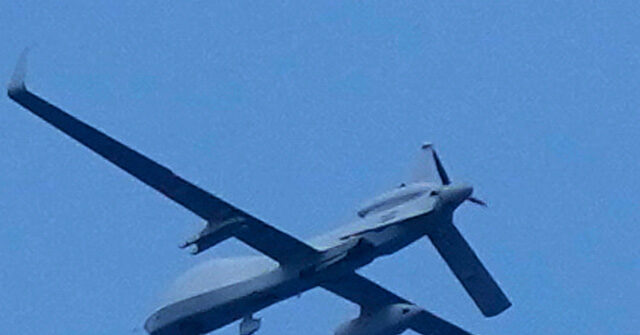
According to a Reuters report on Thursday, Libyan warlord Khalifa Haftar has somehow managed to acquire Chinese and Turkish-made combat drones for his arsenal, even though Libya has been under a weapons embargo since 2011.
Reuters pointed to commercial satellite photography that showed a trio of late-model drones parked at the Al Khadim airbase in eastern Libya, which is controlled by Haftar’s Libyan National Army (LNA) and its political wing, which started calling itself the “Government of National Stability” (GNS) about four years ago. The airbase appears to have been modified to conceal and service the new drones.
The other major Libyan government, based in Tripoli and recognized by the United States and United Nations, is called the Government of National Unity (GNU). Haftar tried to seize control of the entire country by force in 2014, stirring up a civil war that lasted for six years and drew support for either the GNS or GNU from various outside powers.
Drones were employed during the last decade’s civil war, but the models sighted at Al Khadim are newer and much more sophisticated.
One is a Chinese Feilong-1 surveillance and attack drone, while the other two appeared to be the fabled low-cost Turkish-made Bayraktar TB2 strike drones – once the hottest product in unmanned aerial vehicles (UAVs) after stellar performances in Azerbaijan and Ukraine, although competing drones have captured more attention since then.
The Feilong or “Flying Dragon” drone was unveiled by China in 2018, an advanced design that can cover long distances and loiter over targets in all sorts of weather. Reuters noted that Haftar’s forces used to employ an older model of Chinese drone called the Wing Loong-2, but all of those UAVs appear to have been withdrawn after 2020 – probably because the United Arab Emirates (UAE), which supported Haftar during the 2014-2020 civil war, took them back.
Haftar technically should not have been able to acquire these new drones due to the U.N. arms embargo, but in practice the embargo has been very lightly enforced and, in some cases, blatantly ignored. Outside powers that support the rival government in Libya never seem to have much trouble putting weapons in their hands.
Another puzzling detail is that Haftar’s forces theoretically lack the expertise to use and maintain advanced drones, so whoever is supplying the equipment is probably providing skilled operators and maintenance crews as well. This would explain why the old Wing Loong-2 drones vanished from the LNA’s inventory after the UAE decided to hedge its bets on Haftar. The Emiratis routinely deny they ever gave military support to Haftar and his army.
Analysts told Reuters that Haftar has been eager to acquire Chinese drones to erase some of the Tripoli government’s overwhelming lead in unmanned aerial vehicles. Much of that advantage was provided by Turkey, which has reportedly patched up its differences with Haftar now that he seems unlikely to topple the GNU. This could explain the two Bayraktar drones spotted at the LNA airfield at Al Khadim.
Anas El Gomati of Libya’s Sadeq Institute told Reuters that Haftar might not intend to use the new drones against his rivals in western Libya, who still enjoy a tremendous edge in both manned and unmanned airpower. Instead, he could plan on using the drones to protect supplies sent to the Rapid Support Forces (RSF) in Sudan, which Haftar allegedly supports.
Gomati suggested the drones could also be a “huge symbolic win” for Haftar, by demonstrating he can still equip and upgrade his forces, six years after a ceasefire agreement seemed to dash his hopes of conquering all of Libya.
Gomati wrote a lengthy article for the UK Guardian in early March that took stock of Haftar’s curious position, as the 82-year-old warlord seems to have been thwarted in his ambitions to unite Libya under his rule – but he is arguably more powerful than the internationally-recognized GNU and its president, because he controls much of Libya’s oil, its coastline, and the smuggling operations that could flood Europe with more migrants.
Russia is believed to send mercenaries to protect Haftar’s oil fields, protect him from troublesome United Nations resolutions, and probably help him pilot his drones, while the UAE is probably still bankrolling his activities even after formally recognizing the GNU.
Gomati called it an elaborate “pantomime” act to conceal the fact that Libya has more-or-less permanently split into two nations and Haftar rules the richer one with an iron fist, a keen understanding of regional politics, and delusions of grandeur.
Former U.S. envoy Jonathan Weiner told Gomati that Haftar imagines himself to be Paul Atreides from the sci-fi epic Dune, “a messianic figure out of the desert who controls the fate of nations while pretending to be the instrument of the people.” Not to spoil the upcoming third Dune movie, but the Paul Atreides story does not have a happy ending.
The good news is that Haftar seems to be preparing for an orderly succession, with his five sons inheriting carefully divided portions of his power and wealth, and a reunited Libya could lie on the far side of the crafty old warlord’s passing.
Haftar’s oldest son Saddam, currently the chief of staff for the LNA’s ground forces, has been groomed as Khalifa Haftar’s heir apparent, and he seems more amenable to a reunification deal after his father finishes playing desert messiah. The western government rejected Khalifa Haftar as a political candidate because he once laid siege to Tripoli, but it might be willing to welcome Saddam Haftar into the fold.
“The succession has been rehearsed so openly it barely qualifies as a secret. According to recent reporting, even U.S. diplomats are now involved in discussions about a deal to unify Libya’s rival governments with Saddam as its president,” Gomati noted.
Read the full article here


