



After Iran struck out with BRICS and China this week in its search for international support, China reportedly privately told the Iranians to rein in their proxies in Yemen, the Houthi insurgents, who have repeatedly attacked Saudi Arabia and sought to block Saudi shipping through the Bab el Mandeb Strait.
Reuters on Thursday quoted three Iranian sources who said Saudi Arabia requested help from China in pushing back against the Houthi onslaught. China, in turn, asked Iran to pull the Houthis back before the conflict escalates further – and threatens shipping lines China needs to fulfill its prodigious demand for oil.
WATCH — Exclusive – Treasury Secretary Scott Bessent on Further Iran Sanctions: “The Snake’s Dead But It Doesn’t Know Its Dead”:
The Iranian sources were reluctant to say exactly how China made this appeal to Iran. It could have been delivered by Chinese Foreign Minister Wang Yi in person to Iranian Foreign Minister Abbas Araghchi when the latter visited Beijing on Wednesday.
Wang publicly urged Araghchi to reopen the Strait of Hormuz during that visit and return to compliance with the Memorandum of Understanding (MOU) brokered between the U.S. and Iran by Pakistan in June.
Araghchi’s visit to Beijing came after the Houthis launched a drone at Mecca, the Islamic holy city in Saudi Arabia. The attack drew sharp condemnations from Muslim nations and organizations across the Middle East.
According to the Iranian sources, China “did not issue any explicit threats or indicate that Beijing would seek to pressure Tehran economically if it failed to use its influence over the Houthis.” Iran purportedly responded to China’s request by blaming all hostilities in the Middle East on the U.S. and Israel.
“China does not wish to see regional tensions further spill over into Yemen and the Red Sea. Escalating regional instability is not in the interests of any party,” the Chinese Foreign Ministry said when Reuters asked for comment on its story.
China’s Foreign Minister Wang Yi speaks during the Comprehensive Strategic Dialogue between Indonesia and China in Jakarta, Indonesia, Friday, August 21, 2026. (AP Photo/Tatan Syuflana)
“China does not wish to see regional tensions further spill over into Yemen and the Red Sea. Escalating regional instability is not in the interests of any party,” the foreign ministry added.
China brokered a diplomatic reconciliation between longtime rivals Saudi Arabia and Iran in 2023 – a deal touted as a major diplomatic achievement by Beijing, which wanted to be seen as a global diplomatic force that could compete with the United States.
The Chinese also hoped to derail the Abraham Accords initiative launched by President Donald Trump during his first term by pulling the Saudis into their orbit. Trump has long hoped to bring Saudi Arabia into the Accords and normalize Riyadh’s diplomatic relationship with Israel.
The Saudis generally respond to behind-the-scenes buzz that they are considering membership by stating that they will not join the Accords until Israel lays out a “path to statehood” for the Palestinians, a possibility that became extremely remote after the savage Hamas attack on Israel on October 7, 2023, and the ensuing Gaza War.
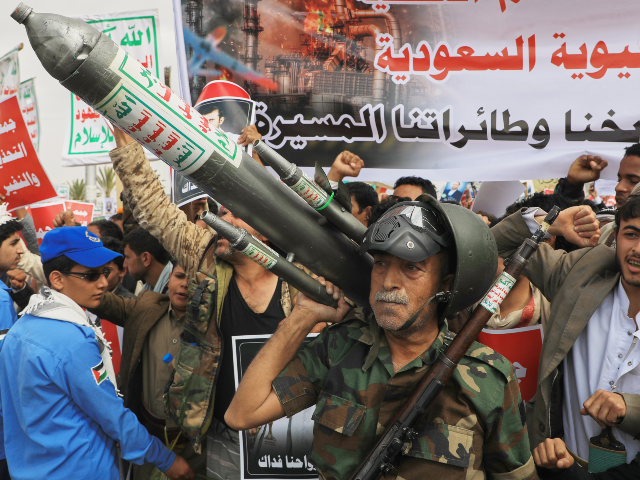
Houthi supporters hold a rally in Sanaa, Yemen, July 17, 2026, against the Saudi-led coalition. Banner in Arabic reads, “All Saudi oil facilities are targets to our missiles and drones.” (AP Photo/Osamah Abdulrahman)
China has occasionally tried to act as a peacemaker since the U.S.-Israel-Iran conflict began in late February 2026 but has never had much of an impact. The Chinese suffered more than any other single oil customer from Iran’s terror attacks on the Strait of Hormuz and unsuccessfully urged Iran to return to the June MOU with the United States after Iran broke the agreement by attacking civilian ships again.
China is Iran’s largest trading partner and its principal diplomatic protector, so observers have wondered when China might try using that influence in a more forceful way to reopen the Strait of Hormuz. Instead, China has watched Iran open a new front in the conflict, and create a dangerous new threat to China’s oil supply, by directing the Houthis of Yemen to attack Saudi Arabia and take control of the Red Sea shipping lanes.
Pessimistic observers thought China was sending a signal to President Donald Trump by bringing Iranian Foreign Minister Abbas Araghchi to Beijing for talks after the BRICS summit in India this week, but China mostly reiterated its desire for hostilities to end and the shipping lanes to safely reopen. The Chinese gave no meaningful additional support to Iran and have done little to ease the crushing U.S. blockade of Iranian ports.
Conversely, Iran did not bow to either public or private pressure from Beijing and has done little to either reopen the Strait of Hormuz or bring the Houthis to heel.
Araghchi insisted on Thursday that Iran still “values the strategic partnership we have built over time” with China and hinted that might be supportive of Iran’s “four principles for peace” in the region, although China has made no such public comment.
WATCH — “It’s Very Interesting…” Trump Says China Agrees with Him on Iran:
Israel’s Ynet News reported on Thursday that in addition to asking China for help, Saudi Arabia also “asked Oman to approach the Houthis about a two-week ceasefire.”
“Talks during the proposed pause would focus on what the Houthis call the ‘humanitarian issue,’ including their demand that Saudi Arabia lift its naval blockade of Yemen,” Ynet said, quoting reports from the Hezbollah-affiliated Al Mayadeen media outlet. There has been no public confirmation to date of any such proposal from Omani or Saudi officials.
Oman has attempted to mediate the long and bloody Yemeni civil war over the years and also has a curious relationship with Iran, which is perpetually announcing the Omanis are on the verge of signing a joint agreement to control the Strait of Hormuz and extract ransom payments from international shipping.
The Omanis do not contradict Iran’s claims in public, but they never quite get around to signing any Strait of Hormuz deal with Iran, and they have been allowing a fair number of ships to pass safely through their territorial waters under U.S. protection.
If China does intend to take a more forceful hand with Iran, it might wait until dictator Xi Jinping’s scheduled meeting with President Trump on September 24. Xi would probably rather barter for economic concessions from the U.S. before using his leverage with Tehran, but he might also be nervous about letting China’s oil supply dry up for another week or two.
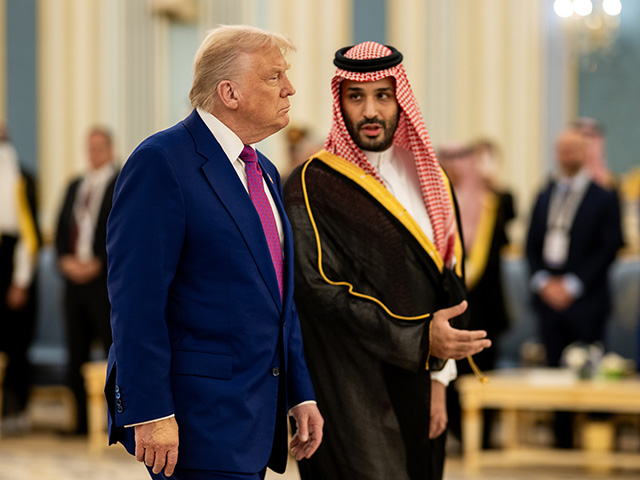
President Donald Trump participates in a coffee ceremony with Saudi Crown Prince Mohammed Bin Salman Al Saud at the Royal Court Palace in Riyadh, Saudi Arabia, Tuesday, May 13, 2025. (Official White House Photo by Daniel Torok)
Trump said on Thursday that he was close to making a decision about resuming large-scale military action against Iran, which might also put some pressure on China.
“I have a big decision coming up. Do I want to go in and annihilate them or do I not? It’s a big decision. Anything could happen with me,” Trump said in a phone interview with reporter Barak Ravid.
Trump hinted that he would make the decision after meeting with the leaders of Saudi Arabia, the United Arab Emirates (UAE), Qatar, Bahrain, Kuwait, and Oman at the U.N. General Assembly in New York City on Tuesday.
“I want to find out where they are and how they are doing. We have been very protective of them,” Trump said, doubtless aware that the Saudis are not doing terribly well at the moment.
Read the full article here