




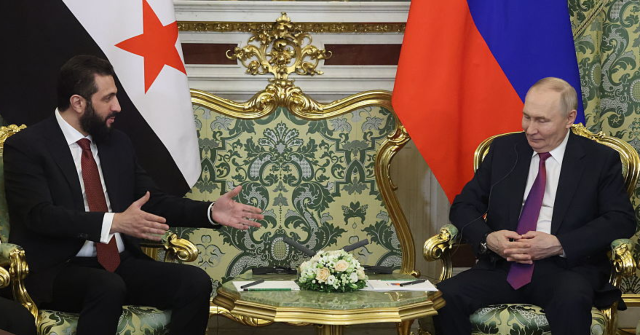
Syrian President Ahmed al-Sharaa, the head of the al-Qaeda offshoot terrorist militia Hayat Tahrir al-Sham, attended an in-person meeting with Russian strongman Vladimir Putin in Moscow on Wednesday to discuss boosting Russia’s economic presence in the country.
The visit was Sharaa’s second to Moscow since the collapse of the longstanding regime of deposed dictator Bashar Assad, a close ally of Putin’s. Sharaa first visited in October shortly after meeting Ukrainian President Volodymyr Zelensky in New York, opening the door to substantial, mutual diplomatic support. Sharaa’s HTS broke an extended stalemate in the over-decade-old Syrian civil war in 2024, first seizing the city of Aleppo then hastening the collapse of the military. Assad and his family fled the country in December 2024, receiving asylum in Moscow.
The Russian news agency Tass, citing Kremlin spokesman Dmitry Peskov, reported on Thursday that the two leaders did not discuss the possibility of Russia deporting Assad to face prosecution for war crimes in his home country. Peskov said the talks focused primarily on the possibility of Russia expanding its presence in the beleaguered Syrian economy, stating the “potential is broad” for cooperation.
During the public portion of their exchange, Putin credited Sharaa with making major “personal efforts” to ensure a friendly relationship with Russia despite its pro-Assad position in the civil war. Both Russia and Iran were prominent backers of the Assad regime, offering formidable military aid to preserve Assad in power since the war began in 2011. Russia retains a military presence in the country and has endeavored to convince Sharaa, so far successfully, to allow that presence to remain.

“Today, in this new reality — and thanks in no small measure, above all, to your personal efforts — the relations between Syria and Russia continue to progress,” Putin celebrated.
“We have also managed to set things in motion in terms of our economic cooperation, with growth of over 4 percent,” the Russian leader observed. “While this is perhaps not as ambitious as we might have wished, it’s a positive step nonetheless, and it is a trend we should keep going.”
Putin claimed that the two had negotiated cooperation in “sports, medicine, and construction,” without elaborating. He also offered Sharaa the opportunity to cut deals with Russian contractors to help rebuild Syria’s major cities, many of which were devastated in the span of the war.
“We are aware of the significant rebuilding needs in Syria, and our economic operators, particularly in the construction sector, are ready to engage in this joint work,” Putin said.
Putin also offered Sharaa support in efforts to preserve “territorial integrity.” This comment appeared to be a reference to the ongoing conflict between the HTS government and the autonomous areas of Syrian Kurdistan, or Rojava. Sharaa signed an agreement with the Kurdish-led Syrian Democratic Forces (SDF), Gen. Mazloum Abdi, this month to integrate the U.S.-backed SDF militia into the HTS armed forces, a tall task given that the SDF was the most effective operation against the Islamic State during the reign of its “caliphate” and the fact that HTS is a Sunni jihadist terror organization. Immediately after the signing of the agreement, reports surfaced of Sharaa-associated jihadis beheading and otherwise slaughtering Kurds, as well as attacking Kurdish-run prisons holding Islamic State terrorists. U.S. officials reportedly estimate that as many as 200 ISIS terrorists were able to escape as a result.
Sharaa, according to the Kremlin, offered Putin a warm greeting, praising Russian resilience in the face of the weather in January in Moscow and urging Russia to promote Syrian “stability.”
“One of the greatest challenges is the unification of Syrian territory. We have been working consistently on this issue since last year,” the Kremlin quoted Sharaa as saying. “Russia, of course, plays a major role in Syria, contributing to the stabilization not only in our country but in the entire region. Our region is in great need of stability. For this reason, I would like to express my sincere gratitude to you, Mr. President, for your efforts in this regard.”
The Syrian Arab News Agency (SANA), which Sharaa controls, echoed the Kremlin’s sentiments about the meeting, emphasizing Russia’s support for “stability.” It added that Sharaa called the friendship between his regime and Russia’s as “remarkable,” presumably given their history during the Assad era.
While the Kremlin confirmed that the issue of Russia’s ongoing military presence in Syria was “on the agenda,” neither side has offered details on what, if any, conclusions the leaders reached. The Russian news agency Tass claimed that Syria and Russia have “stepped up… practical military coordination” recently, citing other Russian outlets, but provided no more information.
Sharaa made his visit shortly after a phone call with President Donald Trump, who he has met on two occasions and who has spoken highly of the HTS chief. SANA reported that the phone call was necessary to expand “active diplomacy” between Damascus and Washington and that Trump offered his support for the ongoing operations to limit Kurdish self-determination in Syria. SANA claimed that Trump celebrated the takeover of the SDF as a “pivotal step toward ending the conflict” and the agreement between Sharaa and Abdi.
“I had a great conversation with the highly respected president of Syria,” Trump told reporters shortly after, describing the situation in Syria as “working out very, very well.”
“We are very happy about it,” he offered.
Follow Frances Martel on Facebook and Twitter.
Read the full article here


