




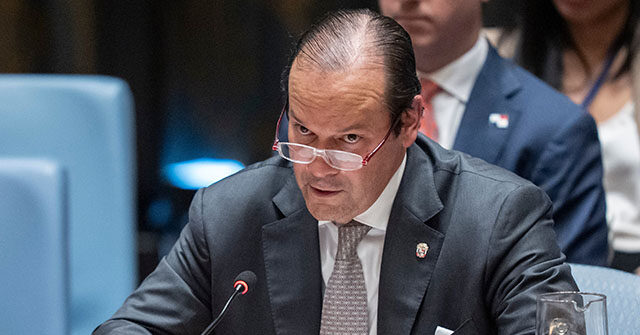
Foreign Minister of Panama Javier Martínez-Acha on Wednesday called for China to respect Panama’s legal sovereignty amid a series of arbitrary detentions of Panama-flagged vessels by Chinese authorities after Hong Kong-based CK Hutchison lost control of two key Canal ports.
Martínez-Acha spoke at a joint press conference in Asunción next to his Paraguayan counterpart, Rubén Ramirez. Both questioned the retaliatory actions taken by the Chinese communist regime against Panamanian vessels after the nation’s Supreme Court annulled two highly controversial contracts awarded to CK Hutchison subsidiary Panama Ports Company (PPC). The contracts gave it control of two Panama Canal ports located at opposite ends of the canal in the provinces of Balboa and Cristóbal. The two key ports handle as much as 40 percent of Panama Canal traffic.
CK Hutchison, which managed the two Panama Canal ports through its subsidiary PPC since 1997, is controlled by pro-communist businessman Li Ka-shing. The contracts had been automatically renewed for an additional 25-year period in 2021.
“In a democratic country, a Supreme Court ruling must be upheld by everyone,” Martínez-Acha said. “Our government has simply complied with the Supreme Court’s ruling. The Hong Kong company had the opportunity to reach an amicable settlement; however, it chose to pursue the legal process to its conclusion.”
“Following the ruling, our Panamanian merchant marine has seen an increase in inspections and detentions of Panamanian-flagged vessels in ports of the People’s Republic of China. It is a striking increase,” he continued. “We have simply asked the People’s Republic of China — and any country — to respect Panama’s legal sovereignty, just as we would respect theirs. We hope that the unusual trend observed in March will subside, because Panama is a country that connects the world and respects the legal sovereignty of all. We simply ask for the same treatment.”
The Panamanian Supreme Court’s ruling went into effect in late February, allowing the administration of conservative President José Raúl Mulino to immediately take administrative and operative control of the Balboa and Cristóbal ports as part of a transitory process toward future port lease deals with other companies. As part of the process, and to ensure normal canal operations, Panamanian authorities granted temporary administrative rights of the Balboa port to APM Terminals, a subsidiary of Danish shipping conglomerate Maersk, while the Cristóbal port is being administered under similar temporary terms by TIL Panama, a subsidiary of Geneva-based Mediterranean Shipping Company (MSC).
Weeks later, a Trump administration official told Breitbart News that China had threatened to detain Panamanian-flagged vessels in China as retaliation against Panama for the loss of control of the two canal ports. In late March, U.S. Federal Maritime Commission (FMC) Chairman Laura DiBella announced that the United States was closely monitoring a surge in detentions of Panama-flagged vessels under the purported guise of “port state control.” DiBella stressed that the detentions appeared intended to serve as a punishment for Panama due to the supreme court’s ruling and emphasized that China’s actions could result in commercial and strategic consequences to U.S. shipping.

Paraguayan Foreign Minister Rubén Ramirez said that China’s actions against Panamanian vessels are not the best path for the development of our societies in a world of constant change, where “facilitating trade and fully leveraging logistics are essential to enabling better economic and commercial transactions.”
“In the specific case of Paraguay, although we do not have diplomatic relations with China, this does not mean that the situation has no impact on our market, given that the freedom of trade is being undermined,” Ramirez said.
Unnamed Panamanian government sources reportedly told the Spanish news agency EFE that three out of every four Panamanian vessels docking in Chinese ports are being subject to inspections. According to the sources, while the arbitrary detentions do not necessarily result in the confiscation of the vessels or their cargo, they cause delays in departure or additional inspections by Chinese port authorities.
“China’s recent actions against Panama-flagged vessels raise serious concerns about the use of economic tools to undermine the rule of law in Panama, a sovereign nation and vital partner for global commerce,” U.S. Secretary of State Marco Rubio said last week. “Detentions, delays, or other impediments to the movement of vessels undermine the stability of global supply chains, increase costs for businesses and consumers, and erode confidence in the international trading system.”
The Panamanian Foreign Ministry released a statement Saturday thanking the United States, Israel, Ukraine, Chile, Costa Rica, Honduras, Paraguay, and Peru for the support expressed to Panama following the recent detentions and inspections of Panamanian-flagged vessels in Chinese ports.
Christian K. Caruzo is a Venezuelan writer and documents life under socialism. You can follow him on Twitter here.
Read the full article here


