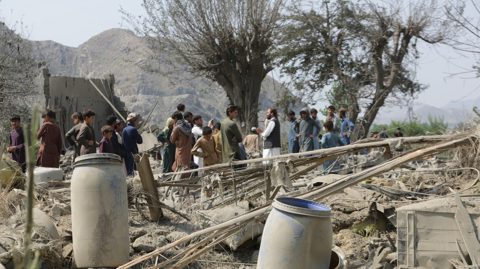


Ben-Gvir’s party is demanding a new ministry dedicated to “voluntary migration.” Those living amid the rubble say they will not leave.
Israel’s far-right national security minister has put a seven-year timetable on emptying Gaza of most of its people, and dressed it up as choice. Gazans RT spoke to call it what international law already names it: forced displacement.
Last week, Jewish Power chairman and National Security Minister Itamar Ben-Gvir unveiled ‘Disengagement 710’, a policy blueprint for what he calls the voluntary migration of Gaza residents to countries willing to take them. Destinations floated by his party include Türkiye, unspecified Arab states, Ethiopia, and Congo.
The numbers are not modest. The plan foresees the departure of about 250,000 people in the first year, 1.11 million within three years, and some 1.86 million within seven, encompassing the bulk of the Strip’s population.
To run it, Jewish Power wants the next government to create a dedicated ministry for “voluntary migration,” complete with a minister, a director-general, its own budget, an international negotiating team, and an implementation apparatus.
Ben-Gvir vows to make the ministry a coalition demand after Israel’s October 27 election. “Instead of illusions of peace now, we need actions of emigration now,” he said. “Instead of them digging tunnels, it’s time to pack suitcases.”
This idea is not new for the Jewish state.
A Zionist through-line
In 1937, David Ben-Gurion, then a leading Zionist figure, promoted the transfer of Palestinians and argued they should be moved to Transjordan. In the 1980s, the same ‘voluntary’ formula was championed by far-right politicians Rehavam Ze’evi – nicknamed ‘Gandhi’– and Meir Kahane. Their schemes never left the drawing board.
Ben-Gvir now presents his version as newly realistic, citing earlier public backing from US President Donald Trump. Trump floated mass relocation from Gaza in early 2025, then walked the idea back under Arab and international pressure.
His later 20-point framework stated that no one would be forced to leave and that residents should be encouraged to stay. Ben-Gvir treats the first Trump remark as political cover and the second as an inconvenience.
Gazans RT interviewed rejected the initiative as illegal under international law and a crime against humanity.
”People in Gaza and across Palestine know Ben-Gvir’s plans go far beyond our existence in the Strip,” said Abdallah Ali, a resident of central Gaza.
“He wants people out of Gaza, then out of West Bank villages, then out of West Bank cities toward Jordan. He believes in transfer and an ‘alternative homeland’.”
Ali said that is why Gazans, himself included, intend to stay put.
Rami Al Meghari, from Al-Maghazi camp in central Gaza, reached the same conclusion for a different reason: memory of exile.
“Many Palestinians found life in other countries, especially Arab states, awkward and humiliating,” he said. “They will not leave Gaza for a destination that cannot guarantee dignity, whether an Arab capital or some African country Israel has long suggested, like Somalia.”
Polls, rubble, and the meaning of ‘voluntary’
A PCPSR poll last year found 56% of Gazans interviewed unwilling to emigrate. A substantial minority, some 43%, said they would.

Ali and Al Meghari were not surprised. Despair is real, and the findings of various UN reports show it clearly.
As of June 16, 2026, satellite analysis by the UN Satellite Centre found 201,290 structures damaged, an estimated 82% of all buildings in Gaza. Of those, 134,422 were assessed as destroyed, 13,848 severely damaged, 28,096 moderately damaged and 24,924 possibly damaged.
Most of Gaza’s 2.1 million people remain displaced. The Shelter Cluster, surveying in June 2026, said 1.98 million people, 94% of the population, need shelter and household items.
Food and water continue to be an issue. Between mid-April and June 30, 2026, more than 1.2 million people (59%) were still in dire need of assistance.
Assessments in 2026 found 43% of households below the 15-liter humanitarian minimum per person per day, and 62% below the 6-liter drinking-water floor.
But Ali and Al Meghari insist the pull of the land is much stronger.
“Whatever the suffering, even with around 97 percent of cropland destroyed and most of the built environment gone, people are putting up tents and staying in displacement camps. They are not packing to leave,” Ali said.
“They lived through the 1948 catastrophe and the 1967 Nakba. They will pull through again.”
Al Meghari still hopes the political weather will change. “Life can move forward in Gaza if there is serious international and Arab pressure to implement the second phase of the ceasefire. The United States has a particular responsibility to make that happen. Russia also needs to play a pivotal role to bring the suffering of the Palestinians to an end.”
Reconstruction as leverage
There is little movement on reconstruction. Israel is blocking construction materials, demanding that Hamas disarm and demilitarize first. The Board of Peace has pushed for weapons to be collected and placed under international supervision, a formula Israel rejects.

Ali sees the stalled effort as a policy, not an accident. “This is taking a very long time. I do not think Israel will accept Gaza’s reconstruction anytime soon. It will keep complicating reality until leaving becomes the only realistic option.”
Ahmed Al-Masri, a lawyer in Gaza, argues Israel has played this hand before and lost. “We lived this in 2014 [Operation Protective Edge – ed.]. Israel said Gaza should not be rebuilt. Then, under international pressure and with UN supervision, it was forced to comply.”
And he also pins some hope on Israel’s October 27 parliamentary vote. “If the far-right government is removed, there might be a beginning, a glimmer on the horizon, and a better political reality for people here, if Palestinians also insist on rebuilding political, social and economic life.”
That is the wager Gaza is making: that endurance outlasts a plan that needs other countries to open their doors, Washington to revive an idea it already shelved, and two million people to accept that ‘voluntary’ means leaving home because the alternative has been made unlivable.
Ben-Gvir is betting the opposite – that the wreckage, a ministry, and a slogan about suitcases can finish what earlier transfer schemes could not. Gazans say they have heard that speech before.
Read the full article here