




Brent crude spiked to nearly $120 a barrel Thursday morning before retreating, as the Iran conflict expanded to threaten major energy hubs across the Middle East. A drone struck a Saudi refinery, and President Trump issued a stark warning that the U.S. would destroy Iran’s South Pars gas field if Iran attacks Qatar.
By late morning, Brent futures had pulled back to around $112, while West Texas Intermediate was trading near $98.
The rally built on Wednesday’s gains, which came after Israeli warplanes struck gas-processing and petrochemical facilities connected to South Pars — the world’s largest natural gas reservoir. The strikes marked the first time Iran’s energy infrastructure has been directly hit in the conflict, a significant escalation.
Trump took to Truth Social late Wednesday to distance the U.S. from the Israeli strikes, saying Washington had no advance knowledge of the attack. But he coupled that denial with an extraordinary threat, declaring that the U.S. would, with or without Israel’s participation, destroy the entirety of the South Pars field if Iran retaliates against Qatar.
Iran responded by launching missiles at infrastructure across the region. QatarEnergy reported that multiple liquefied natural gas facilities were hit, with significant fires breaking out. The company said missile strikes had caused extensive damage at Ras Laffan Industrial City, one of the world’s most important LNG processing hubs.
On Thursday, Saudi Arabia’s defense ministry disclosed that a drone had struck the Samref refinery and that damage assessment was underway. Dutch TTF natural gas futures surged 17 percent on the Qatar strikes.
Crude prices trimmed some of their gains after Treasury Secretary Scott Bessent told Fox Business that the administration was considering lifting sanctions on Iranian oil already in transit — roughly 140 million barrels — and could tap the strategic petroleum reserve as well.
The WTI-Brent spread blew out to nearly $20 at one point in early trading, the widest gap since 2013 outside of the anomalous April 2020 session when WTI went negative. The divergence reflects traders pricing in far greater disruption risk for internationally-benchmarked crude, while American domestic supplies and potential export restrictions are capping WTI’s upside.
The oil shock is compounding investor anxiety. Fed Chair Jerome Powell signaled Wednesday that the central bank is not inclined to treat the crude surge as a transitory supply-side event — a break from the traditional central-bank playbook on energy shocks. Stocks sold off hard on his remarks, and futures were lower again in Thursday’s premarket.
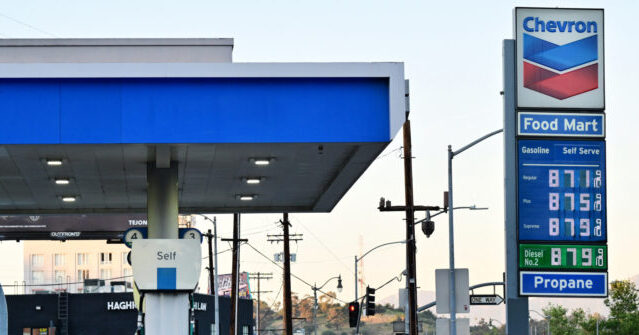
Gasoline prices in the U.S. have soared, hitting an average national price of $3.88 a gallon on Thursday, a 32 percent increase from a month ago and 25 percent higher than one year ago. The highest state average is in California, where prices hit $5.64 on Thursday.
Although West Texas Intermediate is the U.S. domestic benchmark for oil prices, U.S. gasoline prices more closely track Brent Crude.
Read the full article here


