


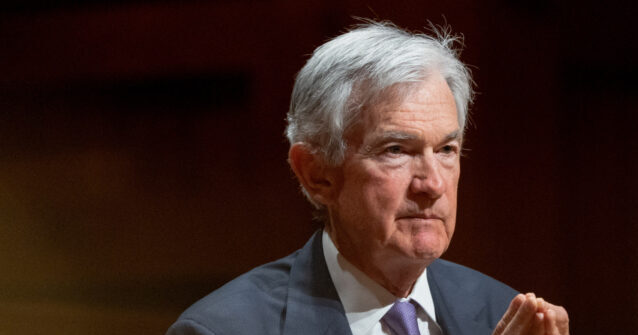
John Williams, the head of the Federal Reserve Bank of New York, on Tuesday said he supported Fed chairman Jerome Powell’s plan to remain in charge of the central bank until a successor is confirmed.
Powell’s term as chair of the Fed’s board of governors ends on May 15. President Trump has nominated former Fed official Kevin Warsh to succeed him but his confirmation may be delayed because a key U.S. Senator, Republican Thom Tillis of North Caroline, has said he will not vote to approve the confirmation until the Justice Department drops its investigation of Powell and the Fed. Democrats have also indicated they will not vote for Warsh while the investigation continues.
Last month, Powell claimed, without evidence, that he can continue to lead the Fed until a new chair is formally in place. He also said he will not leave the Fed board until the investigation into his handling of renovations of the Fed’s headquarters is “well and truly over, with transparency and finality.” Powell’s board seat technically does not expire until January of 2028 but, with one exception, outgoing chairs have always stepped down from the board as well.
Powell falsely claimed that his authority to continue in office after the expiration of his term is backed by the law and past practice.
“That is what the law calls for,” Powell said. “That’s what we’ve done on several occasions, including involving me, and it’s what we’re going to do in this situation.”
A Murky Law Around Fed Chair Vacancy
The Federal Reserve Act provides that Fed governors may remain in office until their successor is appointed. No such provision exists for the chair of the board. The law does provide that the vice-chair should serve as the temporary chair if the chair is absent, although a 1978 legal analysis by the Carter administration concluded that this applied only to situations in which a confirmed chair was unable to attend a meeting and not to a vacancy occurring because a successor had not been confirmed. Similarly, the law says that if the vice chair is also absent, the board can elect a chair pro tempore. The Carter administration says that this also did not apply in the case of a vacancy caused by a gap between the end of a term and a new chair’s confirmation.
No provision of the law explicitly lays out what happens if a chair’s term expires prior to the confirmation of the next chair.
The Carter-era Office of Legal Counsel determined that in the case of a vacancy, the President would have the authority to appoint a new chair from among the sitting governors. The previous chair would not retain the office unless appointed by the president.
The question arose in 1978 when President Jimmy Carter made the unexpected last-minute decision not to reappoint Arthur Burns as chair. Carter’s nominee—Democrat businessman George William Miller—could not be confirmed by the Senate before Burns’ term expired, raising the question of who would lead the central bank in the interim. Although the White House lawyers concluded that Carter could appoint any of the sitting governors, Miller was not a governor and not eligible to fill the role. At Carter’s request, Burns stayed on as chair for a number of weeks until Miller was confirmed.
That history may have misled Powell into believing that he can stay on as chairman even if not asked to do so by the president. President Donald Trump, who has been severely critical of Powell’s leadership at the Fed and called for Powell to step down, is unlikely to ask Powell to continue to serve after May 15. Trump has accused Powell of “gross incompetence” and faulted Powell for not cutting interest rates more aggressively.
Powell did serve as interim chair when his first term expired in 2021. But he had been appointed by President Joe Biden to a second term and was awaiting confirmation by the Senate, amounting to a tacit endorsement by Biden of Powell continuing to serve as chair during the gap. Similarly, Alan Greenspan served as interim chair while awaiting the Senate to reconfirm him after he was appointed to a third term by President Bill Clinton.
In no previous circumstances has a chairman who has not been reappointed by the president or asked to serve as interim leader remained in office after the term expired. Historically, the Senate has confirmed successor chairs prior to the expiration of the sitting chair’s term.
Several legal scholars, including Harvard professor Adrian Vermuele, have written that the law does not protect the chairman from being removed as chairman by the president. While governors are protected by a “for cause” removal provision, this does not apply to the chair position. Instead, the chair’s protection appears to be a long-standing convention against being removed over policy differences, respect for the independence of the Fed, fear of possible political backlash, and the possibility of a Senate refusing to confirm a successor. If Powell were to attempt to stay on a Fed chair, President Trump would likely have the legal authority to remove him.
The Supreme Court is currently considering a case involving President Trump’s attempt to remove Fed Governor Lisa Cook. Trump said that credible allegations regarding mortgage improprieties gave him legally sufficient cause to remove Cook. Cook’s lawyers have said these are simply a pretext for Trump attempting to gain control of the Fed—a claim Powell echoed months later in response to the Justice Department’s investigation into the headquarters and his testimony before a Senate panel.
Powell Forever?
Williams said in an interview with Bloomberg News that he agreed that Powell would continue to serve as chair of the Fed’s seven-member governing board if no successor were confirmed by May 15. He added that Powell would also serve as the head of the Federal Open Market Committee, the panel that traditionally governed interest rate policy.
The FOMC has 12 voting members, comprised of the seven governors, the president of the New York Fed, and four presidents of the remaining 11 regional Fed banks, who serve one-year rotating terms. The committee elects its own chairman, but in practice it has always selected the chairman of the Fed’s board of governors to fill that role. The head of the New York Fed has always been selected as the vice chair of the committee
“Chair Powell already spoke to that recently in terms of the board of governors,” Williams said. “I’ll speak to the FOMC, the Federal Open Market Committee. Every January, we have a vote about selecting a chair and a vice chair. That vote is in place throughout the year. So there is no issue of continuity…Typically, we have this vote in January for the chair of the FOMC or if a new chair is confirmed by the Senate, then that person becomes chair of the FOMC.”
Williams, who is vice chair of the committee, said that the FOMC would not have to take any further action to keep Powell as head if Warsh is not confirmed by May 15. The committee could just “continue on” as if Powell’s term as board chair had not expired. This is the first time a Fed official has endorsed Powell’s view.
Technically, the FOMC could name Powell its chair even if a different governor is named chairman of the board. The chairman of the board, however, would control the institution of the Fed, including its staff. The FOMC chair would preside over the committee’s meetings but have no independent authority.
The FOMC once exercised almost complete control over the interest rate policy of the Fed, which it exercised for many years by announcing a targeted interest rate range for overnight lending of reserves between banks. It would instruct the New York Fed to conduct so-called “open market operations”—Fed speak for buying and selling securities—to push the rate to the target. Historically, the Fed had to do very few purchases or sales to keep the overnight rate close to its target range. Banks borrowed reserves in what is known as the fed funds market in order to meet reserve requirements.
While the FOMC still announces a target for the federal funds market and this is its principal means of giving expression to the stance of monetary policy, it is no longer the main operational tool for that policy. The Fed’s large asset purchases, begun in the wake of the financial crisis and then ramped up during the pandemic, has meant that the banking system has a large level of excess reserves that domestic banks rarely need to tap the fed funds market. The Fed has dropped its reserve requirement to zero to reflect the fact that this is no longer a serious constraint on bank activity. The small amount of borrowing that occurs is mostly done by the U.S. branches of foreign banks.
Monetary policy is now primarily implemented through the interest rate paid to banks on their reserves by the Fed. When the Fed raises the reserve rate, short-term market rates tend to rise, putting upward pressure on rates for longer-term loans such as the 10-year Treasury and mortgage loans. The higher interest rates make borrowing by consumers and businesses pricier, typically reducing lending and slowing economic activity. While the Fed describes interest on reserves as a tool to implement the FOMC’s policy decisions, the rate is formally controlled by the Fed board and not the FOMC. In the past, the Board of Governors has always changed the reserve rate to implement the FOMC’s policy stance, and experts say that while a break from this practice would be legal, it would constitute a major rupture in monetary policy convention.
The investigation into Powell and the Fed is being run by Jeanine Pirro, the U.S. Attorney for the District of Columbia. She has said that she empaneled a grand jury to issue subpoenas after the Fed refused to respond to inquiries from her office. Powell has described the investigation as a pretext to get him to lower rates, an explosive charge for which he offered no evidence.
President Trump could order the U.S. attorney general to drop the investigation, although that would amount to a rare intervention by a president into an ongoing Department of Justice investigation. Alternatively, Trump could pardon Powell for any potential crimes connected to the headquarters renovation or stemming from Powell’s testimony, a move that would make it clear that Powell is not under legal threat.
Read the full article here