







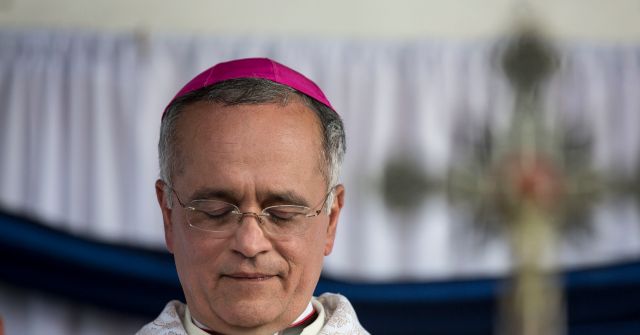
Nicaraguan Catholics were once again prohibited from freely celebrating Holy Week this year after the communist regime, led by dictatorial husband-and-wife couple Daniel Ortega and Rosario Murillo, banned all Catholic processions in the country for the third year in a row.
Christians around the world are presently observing Holy Week to commemorate the Passion, death, and resurrection of Jesus Christ. For the past few years, Ortega and Murillo have overseen a relentless persecution of Christians in Nicaragua and the systematic repression of the Nicaraguan Catholic Church. The dictators have enforced the unjust imprisonment and banishment of members of the clergy and laypersons, the forced seizure of Church assets, and the prohibition of thousands of Catholic processions, some of which are unique to Nicaraguan culture.
International outlets reported this week that, for the third year in a row, the Ortega regime prohibited all public processions related to Holy Week, including the Via Crucis (Stations of the Cross), 406 of which the ruling communists had already banned in the first days of Lent this year alone. According to the Spanish outlet La Gaceta, the Ortega regime is strictly forcing the faithful to celebrate their Holy Week activities inside the churches or in private areas under close police supervision.
Nicaraguan activist and researcher Martha Patricia Molina, who for years has documented the Ortega regime’s extensive and continued persecution of Christians, reportedly detailed this week that at least 5,726 religious acts were prohibited across Nicaragua’s 409 parishes throughout this year’s Lent — which brings the total of religious activities prohibited by the regime since 2019 to over 27,000, at an average rate of 5,600 per year.
La Gaceta detailed that the Ortega regime deployed between 13,000 and 14,000 police officers to the nation’s parishes to enforce compliance with the ban by individually and verbally notifying churches while at the same time demanding that they they provide details of their planned activities.
On Tuesday, Molina published footage on social media of what she described as members of the Sandinista police keeping watch on bishops, priests, and laypeople at the San Francisco Parish in the city of Rivas.

U.S. Deputy Secretary of State Christopher Landau condemned the Ortega regime’s ban on Catholic procession in a social media post, and noted that, historically, Nicaragua has hosted some of the most beautiful and famous processions in the region.
“Throughout Latin America, people gather on city streets to profess their faith and mark the Passion. But once again this year, the Ortega-Murillo dictatorship is denying the people of Nicaragua the right to profess their faith in this manner by banning such public processions,” Landau wrote.
The Nicaraguan newspaper La Prensa detailed on Tuesday that, based on historical records, Nicaragua first celebrated Holy Week 501 years ago in 1525 in the city of León, a municipality that has historically disputed with the town of Granada over which was the first city founded in the country by the Spanish conquistadors who brought Catholicism to the nation. By 1528, Holy Week celebrations were held in both towns.
La Prensa noted that, since 2023, 498 years after the first Holy Week celebrations in Nicaragua, the Catholic observance is now carried out under public restrictions as a result of the Ortega regime’s repression. Activities for Palm Sunday, the first day of Holy Week that marks Jesus Christ’s triumphal entry into Jerusalem, were held indoors, under police surveillance, and with regime officials taking photos to attempt to portray “a religious freedom that does not exist.”
Despite the restrictions and repression imposed by the Ortega regime, La Prensa observed that “amid the siege and threats, the Catholic people of Nicaragua continue to attend religious services and activities.”
According to the Argentine outlet Infobae, the last time that a group of young Nicaraguans tried to uphold their Catholic traditions by holding a public Holy Week procession in defiance of the Ortega regime was in 2023 at the town of Nindirí. At the time, a group of young individuals dressed as Cross-bearers attempted to carry out a procession — to which the local police responded by persecuting them across the town after they refused to stop the activity.
“What followed was captured on video: young men running through the streets, chased by the police, in a scene that seemed to be straight out of another era, as if the Roman legions themselves were once again persecuting Christians,” Infobae recounted on Sunday. “As they fled, they left behind their robes and discarded the crosses that marked them as ‘criminals’ in the eyes of the regime.”
“Holy Week in 2026 will be observed under the same conditions as previous years: under threat, under siege, and under constant surveillance during every religious activity. But in addition, in recent days, the police have become more aggressive toward the priests. They’re asking them for more information,” Molina told Infobae.
“For example, they ask how many people are attending a procession. The priest, obviously, doesn’t have the time or the ability at that moment to start counting the faithful one by one. So he has to give a rough estimate,” she continued. “They also demand that he state the purpose of the religious activity they’re conducting, how many hours it will last, what topics will be addressed, and why they’re holding it.”
Christian K. Caruzo is a Venezuelan writer and documents life under socialism. You can follow him on Twitter here.
Read the full article here


