

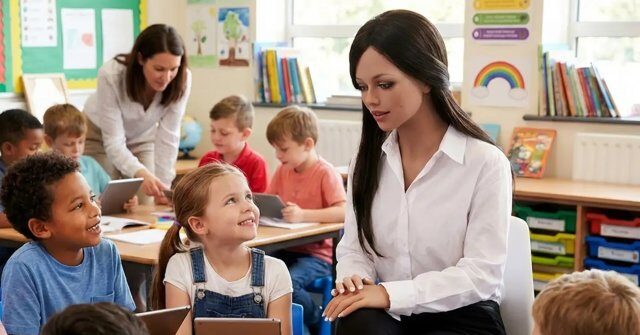
A rural school district in upstate New York is set to become one of the first in the nation to integrate a humanoid robot into its classroom environment as a teaching assistant.
The New York Post reports that the Salamanca City Central School District, situated on Seneca Nation territory, announced last week that it will introduce a $57,000 AI-powered humanoid robot named Sally to high school classes beginning in September.
Sally features brown hair and latex skin, with functional arms and hands, though the robot will remain stationary as its legs are not designed for movement. The humanoid teaching assistant is scheduled to work with 11th and 12th grade students at Salamanca High School, specifically supporting courses in coding, robotics, and AI.
Superintendent Dr. Mark Beehler acknowledged the mixed reactions to the groundbreaking pilot program, which represents a partnership with Las Vegas-based Realbotix Corporation. “It’s exciting but also a bit nerve wracking,” Beehler told the Post. “Not everyone is open to much change in education. There was a point in time where people argued ‘Why do teachers need email accounts?’ or ‘Do we really need to have the internet in school?’ This is the next iteration of that. And the reality is, AI is already in schools,” he said.
To enhance approachability and local connection, school officials requested that Sally be programmed with a western New York accent, similar to the accent commonly heard in Buffalo “We don’t really hear the accent. We think it sounds neutral,” Beehler joked.
School district officials have firmly stated that the introduction of Sally will not lead to teacher displacement. “The Realbotix educational robot will never replace teachers, staff members, or meaningful human interaction,” the district said in a statement. “Instead, it serves as another instructional tool that educators can use to engage students, reinforce classroom learning, and spark curiosity about emerging technologies.”
Multiple safeguards have been built into Sally’s operation. The robot functions on an offline, closed AI system specifically designed to avoid providing direct answers to students. Instead, it responds with prompts that encourage critical thinking. “It will provide data but will encourage the student to think for themselves and demonstrate a comprehension of the material,” said Beehler.
Privacy protections are also central to the robot’s design and implementation. According to Superintendent Beehler, Sally will not collect any personal information, record video or audio, or transmit any data back to Realbotix. These assurances address potential concerns about student privacy and data security in an age of increasing technological surveillance.
The model being introduced at Salamanca High School represents a seated version of the Realbotix humanoid robot. The company also produces a more advanced full-bodied F-Series model priced at $125,000 that can stand independently on two legs but still requires wheels for mobility.
AI’s impact on education is an important topic in the instant bestseller Code Red: The Left, the Right, China, and the Race to Control AI, written by Breitbart News Social Media Director Wynton Hall earlier this year.
In Code Red, Hall explains the danger of leftist bias being introduced into the classroom via AI:
Hall points to Khan Academy’s Khanmigo as an example of how bias operates even in well-designed educational AI. In his book Brave New Words, Salman Khan described how Khanmigo handled the Second Amendment using the Socratic method, “challenging the student in a productive way—one that showed much less bias than the average classroom and actually encouraged the student to think!” But Khan then proudly showcased the same AI “dismantling” skepticism about global warming, praising it for having “successfully dismantled any false information while supporting science-backed arguments” and even generating lesson plans that “suggested actions that my students might take to combat global warming.” Hall’s point is clear: who decides what counts as “false information” determines whose worldview the AI enforces.
It doesn’t stop at lesson plans. Hall warns that Khan’s Schoolhouse.world platform began partnering with elite universities like Columbia, MIT, and Johns Hopkins, using “dialogues” portfolios in which high-schoolers “debate topics like immigration or Israel-Palestine, and rate one another on traits like empathy, curiosity or kindness,” as the New York Times reported. Hall writes: “This kind of proxy for a ‘social credit score,’ which can potentially be used to determine university admissions based on social justice virtue signaling, underscores the stakes as AI’s education pioneers work to remake how our children are taught.”
The political alignment of the partnerships should concern every conservative parent. In 2025, OpenAI teamed up with the American Federation of Teachers (AFT) to work “with 400,000 teachers to shape the future of AI in schools.” The AFT, Hall notes in CODE RED, is “a massive Democratic Party donor, pumping millions of dollars to Democrats and virtually nothing to Republicans.”
Read more at the New York Post here.
Lucas Nolan is a reporter for Breitbart News covering issues of AI, free speech, and online censorship.
Read the full article here