







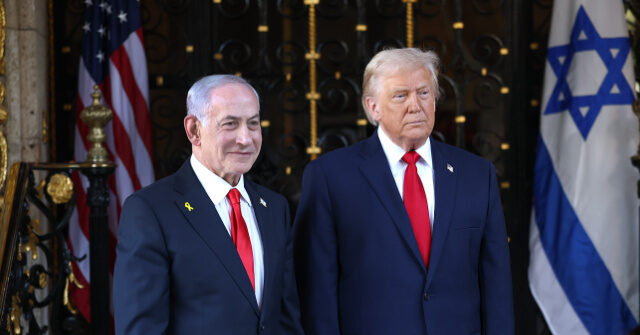
Israeli Prime Minister Benjamin Netanyahu is set to meet President Donald Trump at the White House on Wednesday as U.S.–Iran negotiations advance under mounting tension, with Tehran resisting demands to curb its ballistic missiles, proxy forces, and nuclear program following talks in Oman that Trump said were “very good.”
The Prime Minister’s Office announced the meeting Saturday night, saying Netanyahu believes any negotiations with Iran “must include limitations on ballistic missiles and a halting of the support for the Iranian axis.”
The visit was moved up at Netanyahu’s request and comes a day after U.S. envoy Steve Witkoff and Trump adviser Jared Kushner held indirect negotiations with Iranian Foreign Minister Abbas Araghchi in Muscat — the first such talks since last summer’s Israel-Iran war.
Speaking aboard Air Force One on Friday, Trump said Iran appeared eager to reach an agreement and acknowledged another round of talks could come soon.
“They want to make a deal,” Trump said. “They don’t want us to hit them.”
Tehran, however, has publicly rejected the core conditions U.S. officials say must define any meaningful agreement.
On Saturday, Araghchi dismissed calls to limit Iran’s ballistic missile program, insisting the issue is not open for negotiation with outside powers.
“This is a defensive matter,” Araghchi said. “No external country will deal with it.”
Araghchi also said Iran will not agree to a complete halt in uranium enrichment, though he claimed Tehran could accept terms that satisfy “all sides,” adding that enriched uranium “will not leave Iran.”
Those statements followed a pointed show of force earlier in the week.
On Thursday — the eve of the Oman talks — Iran unveiled an underground “missile city” housing the Khorramshahr-4 ballistic missile, which state media said can strike Israel within minutes and carry a heavy payload capable of threatening U.S. bases and allied assets across the region.
IRGC-linked outlets framed the disclosure as part of a shift toward offensive doctrine, while regime-aligned media simultaneously published a multi-stage war blueprint envisioning missile barrages on U.S. forces, coordinated proxy escalation by Hezbollah, Iraqi militias, and Yemen’s Houthis, cyberattacks, and threats to global energy shipping through the Strait of Hormuz.
The missile display unfolded alongside heightened U.S. military signaling.
On Saturday morning, U.S. envoy Steve Witkoff and Trump adviser Jared Kushner visited the USS Abraham Lincoln aircraft carrier in the Arabian Sea at the invitation of U.S. Central Command commander Adm. Brad Cooper.
Witkoff later confirmed the visit in a post on X, saying he, Kushner, and Cooper met with “the brave sailors and Marines aboard the USS Abraham Lincoln, her strike group, and Carrier Air Wing 9 who are keeping us safe and upholding President Trump’s message of peace through strength.”
He added that they observed live flight operations and spoke with the pilot who “downed an Iranian drone that approached the carrier without clear intent” last week.
Economic pressure has also intensified.
On Friday, the White House announced expanded sanctions authority targeting countries that maintain trade ties with Iran, building on the Trump administration’s broader pressure campaign against the regime.
Treasury Secretary Scott Bessent said Thursday that Iran’s leadership is “wiring money out of the country like crazy,” declaring that “the rats are leaving the ship” as sanctions accelerate economic collapse.
“We have seen the Iranian leadership wiring money out of the country like crazy,” Bessent told lawmakers. “That is a good sign that they know the end may be near.”
Secretary of State Marco Rubio has insisted that any agreement must address Iran’s ballistic missile arsenal, regional proxy network, and internal repression — conditions Tehran has rejected while demanding talks remain narrowly confined to nuclear issues.
Israeli officials remain skeptical that the negotiations will produce a breakthrough, with Netanyahu warning that any Iranian attack on Israel would trigger a response “the likes of which has never been seen.”
The convergence of revived diplomacy, military pressure, economic sanctions, and missile brinkmanship now sets the stage for Wednesday’s Oval Office meeting — as Washington and Jerusalem assess whether Iran’s push for a deal reflects genuine compromise or a bid to buy time while refusing to rein in its nuclear program, proxy forces, and expanding missile capabilities.
Joshua Klein is a reporter for Breitbart News. Email him at jklein@breitbart.com. Follow him on Twitter @JoshuaKlein.
Read the full article here


