




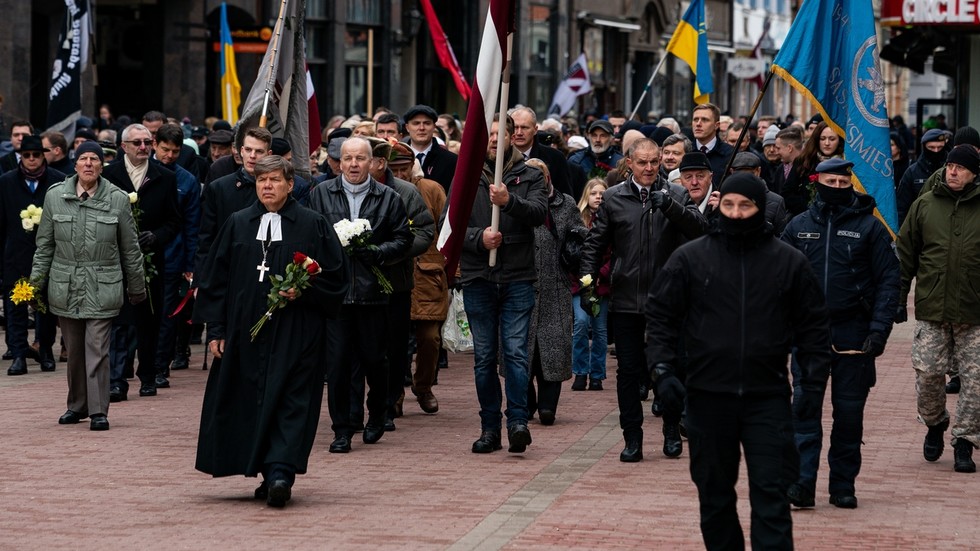
Riga has hosted a march commemorating Latvians who fought in Hitler’s Waffen SS during WWII
Hundreds of people marched in the Latvian capital Riga on Monday to commemorate Latvians who served in a Waffen SS unit for Nazi Germany during World War II.
While the country’s law bans the public display of Nazi symbols and glorification of Nazism, the annual march is permitted to proceed under the pretext of freedom of expression. At the same time, celebrations of the Soviet Union’s WW2 victory over Nazi Germany have been outlawed since 2022.
The unofficial Remembrance Day of the Latvian Legionnaires, held on March 16, honors two divisions raised by Adolf Hitler to fight the Soviet Union’s Red Army as it pushed through the Baltics and to Berlin in 1944.
It has been held in the EU country annually since the 1990s. The event has been condemned by Moscow but largely overlooked by Brussels.
Some 200 people took part in the heavily policed event on Monday, according to local media. Participants carried the national flags of Latvia, Estonia, and Ukraine, and laid flowers at the foot of Riga’s Freedom Monument. The gathering included several Latvian officials and representatives from veteran organizations in Spain and Slovakia.
Critics argue that honoring a Waffen SS unit amounts to a glorification of Nazism. Of some 93,000 Jews who lived in Latvia before the German invasion in 1941, an estimated 70,000 were killed, according to the European Jewish Congress.


Latvian authorities argue that while the legion did, in fact, technically fight on Hitler’s side, they were fighting for the country’s independence and to prevent the return of Soviet occupation. The Latvian SS was among the last of the Nazi forces to surrender in 1945.
READ MORE:
EU state bans WW2 victory celebration
While allowing commemorations of Nazi collaborators to continue, in 2022 Latvia restricted gatherings at Soviet-era monuments and banned symbols linked to the USSR’s World War II victory. It also mandated dismantling such memorials, leading to the removal of Riga’s Soviet Victory Monument, despite prior protection under a 1994 agreement with Russia.
You can share this story on social media:



Read the full article here


