






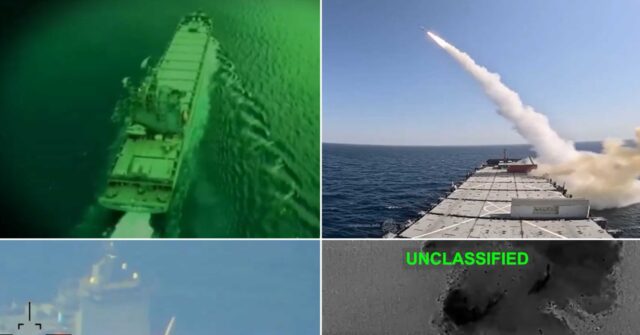
Iranian plans to hide cruise and ballistic missiles, and marine raiding parties aboard warships disguised as oil tankers or container ships to raid commerce well away from its own waters has been disrupted by U.S. strikes, a report states.
Gulf allies have been briefed by American and Israeli officers on the operation to wipe out Iran’s force of “adapted and disguised” container and oil tanker ships as part of Operation Epic fury, hearing how U.S. strikes “destroyed five Iranian warships that were disguised as container vessels”, a report in The Times of London states.
While the destruction of most of the ships named in this alleged briefing was already in the public domain — the United States Central Command (CENTCOM) has been active in briefing on its campaign of destruction against now hundreds of Iranian warships of all sizes — this may be the first time a specific mission to take out Iran’s grey fleet of converted civilian ships as a priority has been publicly spoken of.
It is stated the allies played to their own strengths in the “secret operation”, with CENTCOM taking the lead on destroying the ships while Israel concentrated on assassinating Iran’s maritime leadership and naval officers.
The ships posed a theoretical threat because to merchant mariners the converted ships could possibly be passed off as regular civilian craft, allowing them to get close to targets like congested strategic waterways or cities before launching hidden weapons. Iran had already boasted of its work in disguising ballistic missile launchers inside what appear to be regular commercial shipping containers.
Footage published by Iran following a successful test of launching from a commercial container ship in 2024 shows the lid popped off an otherwise unremarkable-looking shipping container to allow what the United States Army Transformation and Training Command described as a “long range ballistic missile”.
Subterfuge at sea goes back to time immemorial: warships flying false colours to lure in a target, or in hope of escaping the attentions of a superior foe by flying a neutral flag, was widely practiced during the time of sail and considered both honourable and legal as long as true colours were flown before the first gun. But the practice received a modern update in the First World War (Great War) when several navies built hidden weapons into converted merchant ships, which took on the moniker ‘Q ships’ to disguise their true purpose.
The name lived on, with the Q-prefix denoting advanced technology hidden withing a plain, unassuming outer shell and in the name of fictional spy James Bond’s chief of Gadgets, Q at MI6.
Iran’s converted civilian ships seemed to fill several needs. As well as allowing the development of these Q-weapons — missiles that could be theoretically hidden on any ship anywhere on earth for sneak attacks — civilian container ships are also very seaworthy, lightly crewed, and surprisingly hard to sink.
Buying second-hand civilian ships and converting them is also considerably cheaper than building new warships, and Iran’s own shipyards didn’t have the capacity to build aircraft-carrier size ships indigenously. Several of Iran’s converted ships were clearly focussed on operating helicopters and drones away from Iran’s own shores.
IRGC commander General Salami laid out the purpose of the project, that there was an intention to create a commerce-raider force to crash the global economy by making all the world’s seas into battlefields when he said after the 2024 container missile launch: “the range of influence of [Iran’s] sea power has increased… Nowhere is safe for powers who seek to threaten our security”.
All of this utility will remain theoretical, however. A prescient article about the emergence of this new generation of Q-ships from 2024 noted that as ambitious these plans are, and potentially useful against a near-peer opponent — such as one of Iran’s Middle Eastern neighbours — these converted ships had no hope whatsoever against the United States and would be sunk immediately.
The Q-ship concept relies on subterfuge, surprise, and being able to masquerade as something else. While these ships still look like civilian craft as a distance, and ship’s transponders broadcasting identity can be faked, all of this is fundamentally impossible in the satellite age when your opponent has functionally unlimited satellite imagery resources.
And so it proved: per The Times report and CENTCOM’s updates, these ships were mostly sunk in the first days of the conflict. The report stated the sunk Iranian ship conversions were split between the IRGC and Iran’s conventional navy. Of the IRGC, there was the Shahid Bagheri, Iran’s faux-aircraft carrier, the Shahid Mahdavi from which it made its 2024 box container missile launch, and the Shahid Roudaki.
From the convention navy was the Makran and the Tabukan, apparently recently renamed the Kordestan, an older oil tanker that was converted last year.
While Iran’s Q-ships have now passed into oblivion, the threat of weapons hidden in the very vessel of practically all global commerce, the shipping container, continues to vex military strategists. The potency of the concept was demonstrated by Ukraine in 2025, when a container delivered to an address near an important base of Russia’s strategic air forces popped its lid and launched a flight a drones, which were able to devastate the irreplicable bombers based there.
The United States, quite possibly, is not immune. Multiple waves of apparently advanced and coordinated drones were detected over Barksdale Air Force Base in Louisiana over several days, causing the base to lock down. Remarkably, no drones are known to have been shot down during this incident and no culprit has been identified.
Read the full article here


