
Close Menu
The Politic ReviewThe Politic Review
  • News
  • U.S.
  • World
  • Politics
  • Congress
  • Business
  • Economy
  • Money
  • Tech
  • More Articles
Trending

NATO nation rebuffs Ukraine’s missile plea

August 10, 2026

Outrage Ensues as McKinney, Texas City Council DEFIES Residents and Approves Absolutely Massive New Islamic Center in UNANIMOUS Vote

August 10, 2026

Reports: Rome Rejects Germany’s Plans to Send Migrants Back to Italy

August 10, 2026
Facebook X (Twitter) Instagram
  • Donald Trump
  • Kamala Harris
  • Elections 2024
  • Elon Musk
  • Israel War
  • Ukraine War
  • Policy
  • Immigration
Facebook X (Twitter) Instagram
The Politic ReviewThe Politic Review
Newsletter
Monday, August 10
  • News
  • U.S.
  • World
  • Politics
  • Congress
  • Business
  • Economy
  • Money
  • Tech
  • More Articles
The Politic ReviewThe Politic Review
  • United States
  • World
  • Politics
  • Elections
  • Congress
  • Business
  • Economy
  • Money
  • Tech
Home»World»Is Trump trying to break the Federal Reserve?
World

Is Trump trying to break the Federal Reserve?

Press RoomBy Press RoomJanuary 15, 2026No Comments7 Mins Read
Share Facebook Twitter Pinterest Copy Link LinkedIn Tumblr Email VKontakte Telegram

The feud between the Fed chair and the US president seems shocking, but the foundation for central bank independence has long since eroded

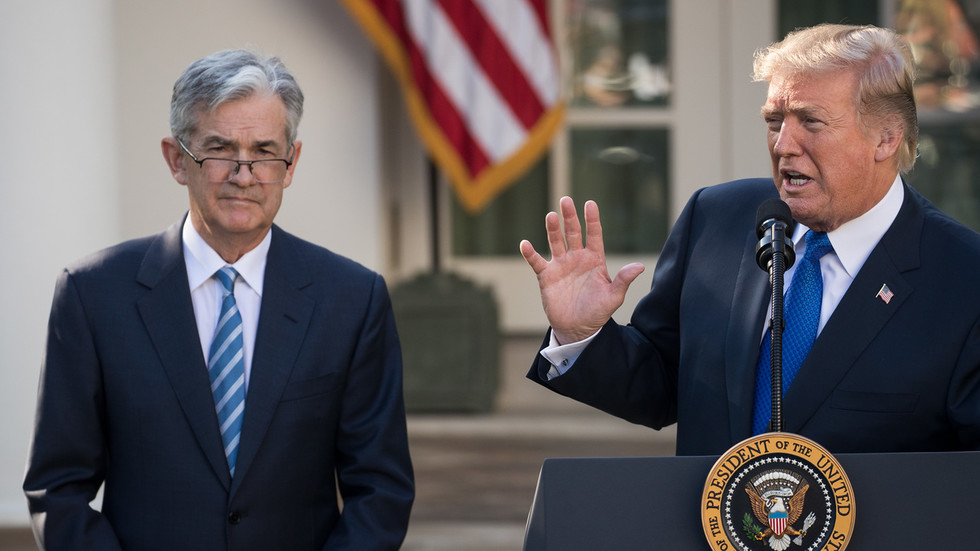
Federal Reserve Chair Jerome Powell’s video address posted this past weekend in which he vowed to stand firm against threats of indictments from the Trump administration was shocking. Powell stated directly that the subpoenas recently served to the Fed should be viewed in the context of the pressure from the administration to more aggressively cut interest rates.

It was shocking not only because Powell, a man of reserve and restraint, has long ignored Trump’s insults and threats to fire him, preferring to focus entirely on the technocratic mission at hand. Most of all, it was shocking because of the attack on central-bank independence, a notion that has become part of the unspoken sacral core of Western democracies.

The heads of several major central banks signed a statement of solidarity with Powell, highlighting the importance of independence in setting interest rates. The letter is a spirited defense of one of the pieties of our age.

But as with much else in Western democracies these days, the true erosion of the principle in question already happened – and not because of a clash of personalities. The drama playing out between Trump and Powell is not a battle for the soul of the institution, but a performance staged atop foundations that have already shifted.

What has largely gone unremarked upon in the media narratives about the spat is the fact that a nation carrying extreme debt levels and with a highly financialized economy has already thoroughly boxed in its central bank, regardless of what protections exist on paper.


Think of it as follows. Let’s take the US government’s true interest expense: the headline debt servicing cost plus the current, unavoidable portion of entitlement spending (Social Security, Medicare, and similar programs) and compare it with tax receipts. This is how financial analyst Luke Gromen and others calculate what the government is truly on the hook for. This figure already comes in at over 100% of what goes into the coffers. This means the government automatically has to fork out more than it collects in taxes – and none of this is discretionary.

So what happens when the Fed raises interest rates? Well, the government’s interest bill goes up, which, since there is absolutely no headroom, means one of two things has to happen: either the Treasury issues more debt to cover the added expense or the government cuts spending somewhere. But forcing the fiscal side to react to the monetary side is an inherently political act. This collapses the conceptual wall between monetary policy, budgetary choices, and political power. 

Add to that a highly financialized economy built on decades of cheap credit, and the picture becomes clearer: structurally higher interest rates are intolerable to markets. In practice, this means that the Fed cannot raise rates freely without triggering serious knock-on effects. Independence exists in theory, but in reality it is constrained by debt burdens, fiscal obligations, and the fragility of financial markets.

For most of modern economic history, central banks were explicit arms of the state, while monetary and fiscal policy were intertwined. The Bank of England was effectively a government financier for centuries. The Fed itself explicitly coordinated with Treasury, especially during World War I, the Great Depression, and WWII. In the US, the canonical origin of Fed independence was the 1951 Fed-Treasury Accord, which was intended to give the Fed freedom to fight inflation. In other words, it was a check on the short-term proclivities of lawmakers, who might push inflationary policies.

What elevated the notion of central bank independence to the level of sacred doctrine was the nasty bout of inflation in the 1970s, and the perceived failure of the politicians to reign it in.  This is when the Fed chairman at the time, Paul Volcker, famously hiked interest rates to as high as 20%, thus subjecting the US to two punishing recessions. The politicians naturally didn’t like it, but Volcker’s bitter medicine worked and inflation came down. Fed independence became associated with credibility. It may even have become – at some collective subliminal level – a quiet substitute for trust in institutions subject to the whims of vote-cajoling elected officials.


Is Russia’s economy really on the verge of collapse?

But that was a different era and Volcker’s move is unthinkable now. A sharp rise in rates was possible then without blowing up the government finances (or financial markets) because debt levels were lower, markets less levered, and asset prices less central to economic stability. The politicians grumbled about the recessions induced by Volcker’s actions, but ultimately it was politically tolerable. The country was still fundamentally healthy enough. Volcker even gained folk hero status. To this day, his name is associated with principled and difficult decisions by a central banker in the face of political exigencies.

But the financialization of the US economy, which started in the 1970s and really picked up steam in the 1990s, altered the conditions that made Fed independence possible. As asset prices became central to economic growth, rate hikes didn’t just slow what might be an overheated economy, but directly threatened what was now one of its key pillars.

After the 1987 stock market crash, newly appointed Fed Chair Alan Greenspan responded by aggressively providing liquidity and signaling that the Fed would act to stabilize markets – usually by lowering interest rates regardless of where inflation was.

Thus was born the famous “Fed put” – the notion that when markets fall hard enough the Fed will step in and essentially provide a floor. Over time, this expectation hardened into an informal rule of the system. The Fed didn’t explicitly promise to protect asset prices, but market participants began to price in an implicit safety net. This, to put it mildly, did little to discourage Wall Street’s tendency of turning US financial markets into a big casino.

This repeated itself after the dot-com crash (2000-’02), during the Global Financial Crisis (2008), and, most dramatically, in March 2020, when the Fed intervened at unprecedented speed and scale in response to the Covid-19 pandemic.

We thus entered a world in which it was no longer politically or economically acceptable to let markets work themselves out. That was the first quiet constraint, but a big one.


The GDP myth: What it really shows, and what it doesn’t

Meanwhile, the US kept creeping toward a state called “fiscal dominance,” where debt and deficits are so high that monetary policy loses traction.

Interest rates are normally raised to blunt inflationary pressure, but there comes a point when the debt is so large that the higher rates simply drive debt service costs even higher – thus forcing more debt to be issued to cover the added expense. This gimmick – covering debt with new debt – is inherently inflationary.

So we arrive at a point where the position of the central bank becomes lost in the fog. It’s not even clear whether the Fed is now too powerful (its rate decisions have major real effects on the US economy and can force certain fiscal actions) or whether it has lost its potency (boxed in on all sides, it can no longer even credibly fight inflation). In either case, the classical notion of independence is an anachronism lost to time.

And yet there was Powell, poised and dignified, standing in front of a traditional blue curtain with the US flag in the background and looking straight into the camera. It was a reassuring image of an upstanding man defending a temple being vandalized. His message was correct and, within the context of the rituals of our time, strong.

But nothing that temple stood for is any longer intelligible, and Powell can’t any more save it than Trump can destroy it. Fed independence disappeared quietly and slowly at the unrelenting hands of market forces and the hollowing-out of the American economy. Trump’s invectives are merely the fireworks at the end.

The media narrative is one of conflict of personalities and a transgression of norms. Indeed, erosion that is structural rather than dramatic is often misinterpreted as a crisis of norms. This is what makes institutional – or civilizational – decline both so hard to detect and so hard to stop.

Read the full article here

Share. Facebook Twitter Pinterest LinkedIn Tumblr Email Telegram Copy Link

Related Articles

World

NATO nation rebuffs Ukraine’s missile plea

August 10, 2026
World

Reports: Rome Rejects Germany’s Plans to Send Migrants Back to Italy

August 10, 2026
World

Record 230 Illegal Migrants Cross Channel in One Dinghy as Burnham Govt. Issues (Another) Stern Warning

August 10, 2026
World

Iran makes new Hormuz demands as missile hits Emirati ship

August 10, 2026
World

‘Enough Is Enough’ — Thousands Protest in Spanish Exclave Ceuta over Border Invasion

August 10, 2026
World

Germany logs record rise in UFO sightings – watchdog

August 10, 2026
Add A Comment
Leave A Reply Cancel Reply

Editors Picks

Outrage Ensues as McKinney, Texas City Council DEFIES Residents and Approves Absolutely Massive New Islamic Center in UNANIMOUS Vote

August 10, 2026

Reports: Rome Rejects Germany’s Plans to Send Migrants Back to Italy

August 10, 2026

Indiana Lt. Governor Calls for Firing of Fever Coach Stephanie White After She Defends DiJonai Carrington

August 10, 2026

For Nigerian Christians, Mass Burials Have Become a Way of Life

August 10, 2026
Latest News

Record 230 Illegal Migrants Cross Channel in One Dinghy as Burnham Govt. Issues (Another) Stern Warning

August 10, 2026

Iran makes new Hormuz demands as missile hits Emirati ship

August 10, 2026

Former NBA Player Royce White Throws on a Wig and Embraces His “Feminine Era” Ahead of 2027 WNBA Draft Bid

August 10, 2026

Subscribe to News

Get the latest politics news and updates directly to your inbox.

The Politic Review is your one-stop website for the latest politics news and updates, follow us now to get the news that matters to you.

Facebook X (Twitter) Instagram Pinterest YouTube
Latest Articles

NATO nation rebuffs Ukraine’s missile plea

August 10, 2026

Outrage Ensues as McKinney, Texas City Council DEFIES Residents and Approves Absolutely Massive New Islamic Center in UNANIMOUS Vote

August 10, 2026

Reports: Rome Rejects Germany’s Plans to Send Migrants Back to Italy

August 10, 2026

Subscribe to Updates

Get the latest politics news and updates directly to your inbox.

© 2026 Prices.com LLC. All Rights Reserved.
  • Privacy Policy
  • Terms of use
  • For Advertisers
  • Contact

Type above and press Enter to search. Press Esc to cancel.