




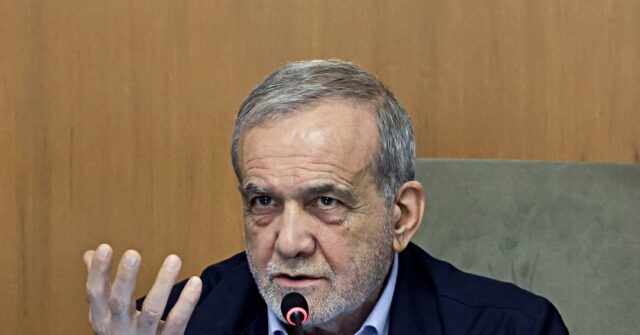
Iranian President Masoud Pezeshkian, a subordinate of the “supreme leader” who has largely abstained from commentary during the ongoing war with the United States, announced on Thursday that Iran would agree to end the conflict if America and Israel paid “reparations,” among other demands.
Pezeshkian reportedly made the comments on the social media site Twitter, according to the Iranian state-run Mehr News Agency.
“The only way to end this war—ignited by the Zionist regime and US—is recognizing Iran’s legitimate rights, payment of reparations, and firm international guarantees against future aggression,” Pezeshkian wrote.
The president added that he had held discussions with the leader of Iran’s closest ally, Vladimir Putin of Russia, and the prime minister of Pakistan, Shehbaz Sharif. The Russian government has consistently offered verbal support to Iran during the current conflict, urging Israel and the United States to stop targeting military sites in the country, but has otherwise not taken any meaningful action to help its ally.
Iranian President Masoud Pezeshkian attends a ceremony held at the mausoleum of Ayatollah Ruhollah Khomeini, founder of the Iranian Revolution, in southern Tehran, marking the 47th anniversary of the Iranian Islamic Revolution on January 31, 2026. (Iranian Presidency/Handout/Anadolu via Getty)
Pakistan has taken a similar turn, as it is currently occupied with what its officials describe as an “open war” with the Taliban in Afghanistan.
Pezeshkian’s comments appear to be an attempt to bring the possibility of an end to war into the global conversation, a shift from the belligerent statements from other, potentially more influential, members of the jihadist regime. Supreme National Security Council Secretary Ali Larijani, who experts have identified as possibly the most powerful person left in the regime, appeared to threaten Trump’s assassination on Tuesday.
“Even those greater than you have failed to eliminate the Iranian nation,” Larijani wrote on Twitter. “Be careful not to be eliminated yourself!”
Larijani again threatened the United States on Thursday, hinting at a massacre of American soldiers.
“Trump has said ‘we can take apart Iran’s electric capacity within one hour, but we have not done it,’” Larijani wrote. “Well, if they do that, the whole region will go dark in less than half an hour and darkness provides ample opportunity to hunt down US servicemen running for safety.”

Trump has not indicated that he is open to any negotiation that would allow the status quo in Iran to continue. Last week, Iran published a message on his website Truth Social telling Iranian leaders that only “UNCONDITIONAL SURRENDER” was acceptable.
“After that, and the selection of a GREAT & ACCEPTABLE Leader(s), we, and many of our wonderful and very brave allies and partners, will work tirelessly to bring Iran back from the brink of destruction, making it economically bigger, better, and stronger than ever before,” he added. “IRAN WILL HAVE A GREAT FUTURE. ‘MAKE IRAN GREAT AGAIN (MIGA!).’”
Iran has repeatedly threatened to kill Trump, initially in response to Trump ordering an airstrike that eliminated Maj. Gen. Qasem Soleimani in January 2020. Soleimani was the head of the Quds Force, a critical foreign interference arm of its military. Speakers at Soleimani funeral encouraged the killing of Trump. Last week, Secretary of War Pete Hegseth revealed that the U.S. military killed an unnamed Iranian military official who had orchestrated an assassination attempt against Trump in 2024.
Iran is the world’s premier state sponsor of terrorism. Its Islamic Revolutionary Guard Corps (IRGC), one of its most active armed forces wings, is a U.S.-designated terrorist organization that has for decades fueled violence in Iraq, Yemen, Syria, and other neighboring states. According to the State Department, Iran has funneled about $100 million a year to terrorist organizations such as Hamas and Palestinian Islamic Jihad (PIJ), separately from its prodigious funding of the Lebanon-based Hezbollah.
President Donald Trump announced the launch of “Operation Epic Fury” on February 28, an operation intended to degrade Iran’s abilities to conduct and aid in terrorist activities around the world. The operation, conducted alongside the Israel Defense Forces (IDF), has devastated the leadership of the country, most prominently eliminating the “supreme leader” of the country, Ayatollah Ali Khamenei. Iranian officials have since announced that Khamenei’s son, Mojtaba Khamenei, had been elected by the “assembly of experts” to replace his father. The younger Khamenei has made no public statements or appearances at press time, however, and was present in a ceremony to pledge allegiance to him only in the form of a cardboard effigy, raising questions as to his status.
In response to “Operation Epic Fury,” the IRGC has launched waves of missile and drones attacks on its neighbors, claiming to target those that host U.S. military bases or otherwise cooperate with Washington and Jerusalem. Iran has launched strikes so far against Saudi Arabia, the United Arab Emirates (UAE), Qatar, Oman, Bahrain, Iraq, Jordan, Azerbaijan, Cyprus, Kuwait, and Turkey. It denied the strikes on Azerbaijan, Cyprus, and Turkey, claiming sabotage.
The current conflict followed a period of negotiations between American and Iranian diplomats, mediated by the nation of Oman, that attempted to address American concerns about Iran’s rapidly developing uranium enrichment and missile capabilities and to result in an end to many of the onerous sanctions America has placed on Iran as a result. The talks stalled, reports indicated, as the Iranian government refused to offer any concessions to address America’s security concerns, demanding sanctions in exchange for no meaningful change in its behavior.
Follow Frances Martel on Facebook and Twitter.
Read the full article here


