


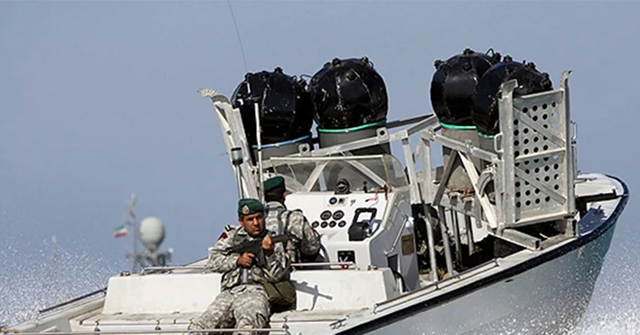
Iran has laid a small number of sea mines in the Strait of Hormuz, the critical oil delivery waterway that is at the heart of peace talks between Washington and Tehran, an anonymously-sourced report claims.
An alleged U.S. intelligence assessment says there are around one dozen Iranian mines in the Strait of Hormuz, CBS News has claimed. If true, the sea mine allegation would weigh on the apparently developing peace talks between Washington and Tehran, given the United States’ demands that the Strait of Hormuz be opened for global oil traffic.
The report, which relies purely on the assertions of unnamed “U.S. officials”, states one of these officials told the broadcaster “there are at least a dozen underwater mines”, while a second said there were fewer than a dozen.
It was claimed Tehran had laid “Iranian-manufactured Maham 3 and Maham 7” type mines, apparently erroneously referring to them as “limpet” mines, which, according to available information about the weapons and their capabilities, states they are not. The Maham 3, for instance, is a conventional moored influence mine. This means when deployed, the buoyant explosive body is tethered to the sea floor by a chain and base, keeping it just below the surface.
Unlike the earliest generations of mines, influence mines do not require physical contact with a ship to detonate; instead, they read the sea around them by interpreting a mixture of acoustic waves and magnetic fields to determine when to explode.
Since the Cold War era, mines have also generally incorporated ship counters, meaning the onboard computer can allow a predetermined number of passes before detonation. This allows both the force laying the mines to anticipate their need to leave the area, passing over their own minefields, and to lure an enemy into a false sense of security by giving the impression that a stretch of water is clear.
Meanwhile, the Maham 7 is designed to sit on the seabed in shallow waters, be harder to detect by minesweepers, and take out smaller ships and boats operating in littoral zones.
Because these mines have onboard computers and are battery-powered, unlike older generations of sea mines, they are not necessarily a persistent threat and can either be programmed to self-destruct after a set period of time or simply shut down. Nevertheless, the maximum endurance of Iranian-made mines is unclear and isn’t advertised.
The so-far unsubstantiated sea mine report is the latest development in a series of signals and counter-signals that weigh heavily on the prospects for an end to hostilities in the Middle East. Oil markets reacted positively when President Trump first announced that talks were underway, even though this was followed by Iranian denials.
The U.S. President nevertheless disregarded that denial, later adding that talks were going well and that points of agreement had been found. Eventually, Tehran confirmed talks were indeed happening, as President Trump had said, with a face-saving disclaimer that they were being conducted through a third party.
If Iran has allegedly placed mines into the Strait of Hormuz, the opening of which is the very central purpose of these peace talks, the act would very clearly cross a serious red line. Yet the actual number involved — around a dozen — is small for an area of hundreds of square miles, and compared to Iran’s theoretical mine magazine depth of several thousand devices.
The very limited deployment suggests — if true — that it may be more about acquiring a solid bargaining chip for talks with President Trump by demonstrating that Iran still has some minelaying capacity after weeks of strikes, and a willingness to use it, rather than a sincere attempt to fully mine and close the Strait.
It is also worth considering that the claim that mines have been laid runs against Iran’s alleged new system that the Strait remains open to non-combatant merchant ships willing to pay a $2 million toll to pass. Iran’s sea mines have no declared capability to discriminate against particular oil tankers that have paid a toll or not, and a ship that paid the toll being hit by a mine would not be a good advertisement for the scheme.
Meanwhile, the U.S. military continues its intense campaign of running down Iran’s capacity to close the straits. Central Command (CENTCOM) has been clear a major priority has been Strait of Hormuz-facing Iranian forces including its navy — with all of its major surface combatants now thought destroyed — and land-based anti-ship missile launchers along the coast.
As U.S. forces cascade down Iran’s remaining capabilities, it is now focusing some effort on Iran’s “mosquito fleet” of potentially thousands of small craft. Converted civilian-spec speed boats, in many cases, these fast boats can carry canisters of Chinese or Iranian-made anti-ship missiles, small numbers of mines, or large quantities of explosives for suicide attacks. The boats are thought to be both manned and unmanned sea drone types.
One particularly effective platform for taking out these small boats is the U.S. Air Force’s A-10, which benefits from comparatively slow speed and high loiter time, and highly mission-appropriate armaments in the form of the 30mm autocannon and the new lightweight, low-cost APKWS missiles.
Considerably smaller than a conventional missile, the APKWS is just fast and powerful enough to easily destroy and disable small unarmoured targets like Iranian Shahed-type suicide drones, and suicide attack fast boats without spending millions of dollars on prestige missiles for the job.
Read the full article here