


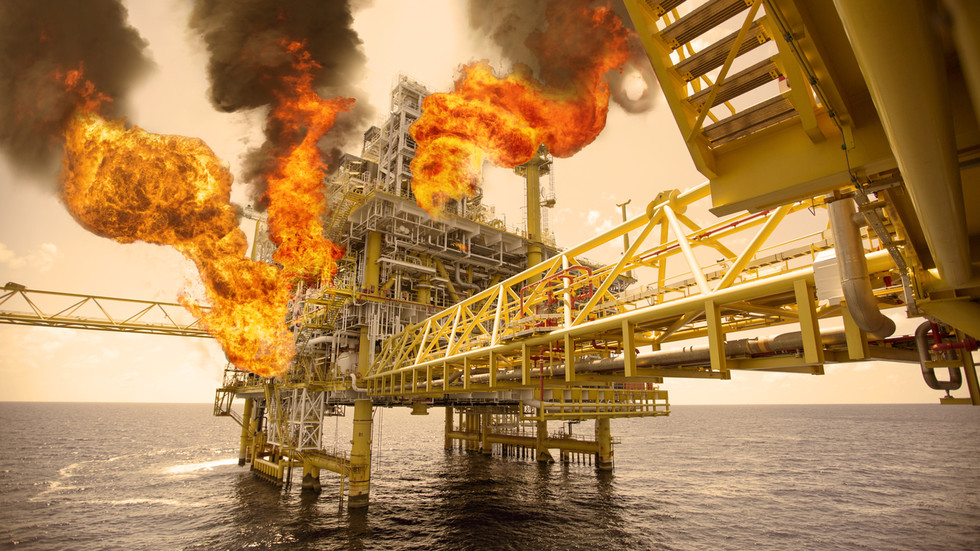
Oil prices have jumped more than 15%, topping $84, while European gas prices have surged over 30% after Iranian strikes on Qatari LNG facilities
Global energy markets have come under pressure as the Middle East conflict escalates, with fears mounting over potential disruptions to oil and gas supplies.
US and Israeli strikes on Iran have prompted Tehran to retaliate with missile and drone attacks on Israel and US bases across the region. Iran has also targeted oil facilities in neighboring countries, while shipping through the Strait of Hormuz – the narrow gateway at the mouth of the Gulf – has largely ground to a halt. The waterway between Iran and Oman, just over 32km (20 miles) at its narrowest point, is a critical chokepoint, carrying roughly 20% of the world’s oil exports.
Is oil pricing in a wider war?
Oil prices have surged more than 15% since the conflict began, extending gains on Tuesday as the widening US-Israeli confrontation with Iran and threats to shipping through the Strait of Hormuz fueled fears of broader supply disruptions. Brent crude briefly topped $84 per barrel in early trading on Tuesday, its highest level since mid-2024. The benchmark had hit $82.37 in the previous session – its highest level since January 2025 – before trimming some gains.
Traders are now pricing in a significant risk premium amid concerns that escalating military actions could restrict flows from major Gulf producers. Some analysts are warning prices could test $90 per barrel if the waterway is disrupted.
Is Europe facing a fresh gas shock?
Natural gas prices have surged even more dramatically, with the European benchmark TTF futures jumping over 30% on Tuesday to exceed $700 per 1,000 cubic meters, the highest level since January 2023. The spike follows Iran’s retaliatory strikes on Qatari liquefaction facilities, prompting QatarEnergy – the world’s third-largest LNG exporter – to halt production entirely. With roughly 20% of global LNG trade transiting the Strait of Hormuz and Qatar’s export corridor having virtually no bypass capacity, analysts warn of severe supply tightness.
Goldman Sachs raised its April TTF forecast and cautioned that even a temporary disruption could send European gas prices sharply higher, with prolonged outages risking far more severe spikes. European storage levels are currently well below their seasonal average, leaving the region exposed to sustained supply losses.
The price of wholesale gas in the UK has surged by 93%, according to Sky News, as analysts warn that rising gas prices have a knock-on effect on the cost of renewables and nuclear power. Analysts say that although the current spike is smaller than in 2022 – when the cutoff of Russian gas sent energy bills soaring – it is still set to hit consumers across Europe, as gas remains central to power generation. Such a scenario would provide a boost to Russian exporters and help the budget, but also increase volatility.
READ MORE:
How much damage has Iran done to US bases in the Middle East?
How is the Strait of Hormuz blockade affecting energy flows?
While Iran did not formally close the Strait of Hormuz over the weekend, its threats effectively halted shipping. Nervousness among oil and shipping companies – and their insurers – brought traffic to a near standstill.
Brigadier General Ebrahim Jabbari, a senior adviser to the Islamic Revolutionary Guard Corps commander‑in‑chief, told state television on Monday: “Ships should not come to this region. They will certainly face a serious response from us. The Strait of Hormuz has been closed. We will attack and set ablaze any ship attempting to cross.” He added that oil pipelines could also be targeted and that Iran would not allow “a single drop of oil” to leave the region.
The disruption has not only pushed global energy prices higher but also sent shipping costs soaring. The charter rate for a supertanker carrying oil from the Middle East to China hit a record $400,000 on Monday.
Ship tracking data shows tanker traffic through the Gulf has largely halted, with hundreds of vessels – including dozens of crude carriers moving millions of barrels – anchored or idling on either side of the strait. Operators are avoiding the area amid attacks and threats, with some very large crude carriers alone representing about 2 million barrels each waiting for the situation to ease. Experts say a prolonged closure is unlikely, but a sustained disruption could push oil prices into triple digits.
Are global markets sliding into risk-off mode?
Stocks tumbled across Europe and Asia on Tuesday as the escalating Middle East conflict and soaring energy prices rattled investors. Dow plunged 1,100 points in early trading on Tuesday as Wall Street fears a prolonged war with Iran. Europe’s STOXX 600 extended losses for a second day, while Germany’s DAX and France’s CAC 40 fell sharply, and London’s FTSE 100 hit a two-week low.
Asian markets fared worse. South Korea’s KOSPI plunged more than 7% in its steepest drop in months as foreign investors dumped shares, while Japan’s Nikkei also posted heavy losses amid broad risk aversion.
How has the Russian market reacted to the escalating conflict?
The geopolitical tensions have bolstered Russian energy companies, whose shares have risen 3-12%. Analysts expect a narrowing of the discount on Russian Urals crude and increased demand for liquefied natural gas (LNG).
“Against this backdrop, forecasts of oil above $100 no longer seem marginal,” Yaroslav Kabakov, director of strategy at Finam Group, told RBC on Tuesday. He added that if the escalation continues, Brent could trade between $85 and $95 per barrel over the coming weeks, with $100 or more possible in the event of an actual blockade. Such a scenario would provide a boost to Russian exporters and help the budget, but also increase volatility.
Russia’s main stock exchange, MOEX, climbed about 1.3% on Tuesday to its highest level since late 2025, led by energy stocks. Tatneft rose nearly 11%, Rosneft 8.3%, and Lukoil 5.7%, while Novatek gained around 5%. Other oil-linked names Surgutneftegaz and Gazprom Neft also advanced.
Read the full article here