


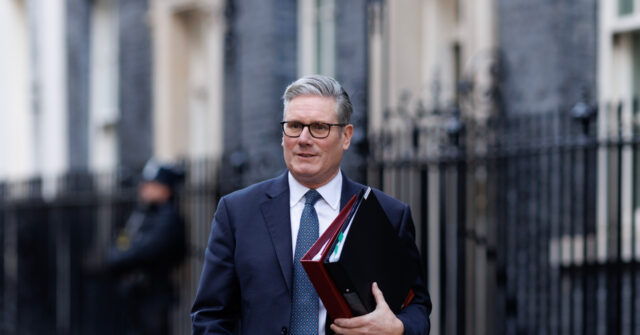
British Prime Minister Sir Keir Starmer will not last the coming year, one in two Britons believe according to YouGov.
A YouGov survey of 2,041 people conducted on Sunday and Monday for Sky News found that 31 per cent believe that Prime Minister Starmer will “probably” be replaced before the end of next year.
A further 19 per cent said that the PM would “definitely” be ousted in 2026, meaning 50 per cent believe his imminent removal is likely.
The poll further found that 71 per cent believe the UK economy has declined over the past year of Labour Party governance, compared to just seven per cent who said they thought it had improved.
Meanwhile, the respondents were similarly pessimistic about their own financial prospects, with 40 per cent expecting their wallets to suffer over the next year, 39 per cent expecting their situation to remain the same, and just 15 per cent expecting their finances to improve.
It comes on the back of a separate YouGov survey last week which found that Prime Minister Starmer’s personal approval rating has fallen to a record low, with just 18 per cent holding a positive opinion of his leadership, compared to 72 per cent who disapprove.
Despite having swept to power last year with a strong majority in the House of Commons, Starmer’s government has struggled to connect with voters and has widely been seen as failing to correct the major issues left behind by the previous Tory government.
Indeed, while Starmer vowed to stop the boats and “smash” the people smuggling gangs operating on both sides of the English Channel, illegal migrant crossings increased under his watch this year, with over 41,000 landing on British shores so far this year.
Similarly, Starmer’s Labour Party promised to focus on economic growth, but after getting elected has hiked taxes multiple times amid heavily contested claims of a “blackhole” in the nation’s finances allegedly left by the Conservatives.
The issues of immigration and the economy have seen Nigel Farage’s populist Reform UK party take the lead in the polls, which they have consistently topped throughout the entire year. This has led to increasing speculation over whether Prime Minister Starmer should be replaced with someone better suited to fend off the Brexit boss at the next general election.
Included among the names frequently mentioned as potential successors include Starmer’s former deputy, Angela Rayner, who was ousted from her post earlier this year after it was revealed that she had failed to pay her full property taxes on her second home while serving as the nation’s housing minister.
Another top contender is Greater Manchester Mayor Andy Burnham, a former Westminster insider of the Blair era who has sought to revitalise his image by leaving the London bubble. To challenge Starmer, Burnham still needs to make a deal for a Labour MP to stand down and offer up a safe seat for him to return to Parliament.
Rumours have also swirled around Health Secreatary Wes Streeting, who broke ranks this week to advocate for the UK to re-enter the European Union’s customs union. Though popular with the Labour rank and file, Prime Minister Starmer has continually opposed such a Brexit betrayal. Streeting’s countersignalling may therefore suggest he is courting the base and establish himself as a top challenger in the eyes of the party membership.
Under the British Parliamentary system, the fall of Prime Minister Starmer would not mean fresh national elections, but rather that the country would be taken over by a new Labour leader emerging from their Parliamentary ranks. While polling makes clear the public thinks Starmer has been a disaster for Britain so far, things may yet get worse given even he is among the least radical would-be leaders.
Follow Kurt Zindulka on X: Follow @KurtZindulka or e-mail to: [email protected]
Read the full article here